Tasmania, a Lovesong: Part II

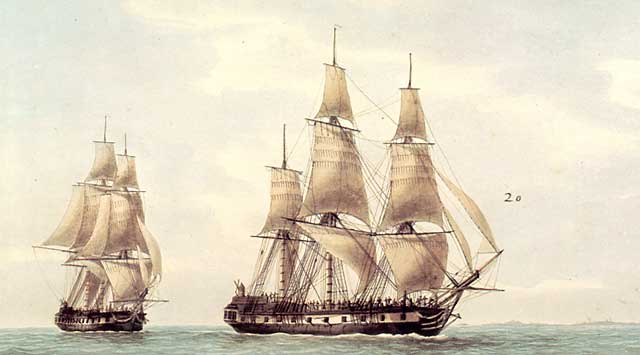
French ships Recherche, and Esperance, from the d'Entrecasteaux expedition, reaching Tasmania, c. 1792-1793
French ships Recherche, and Esperance, from the d’Entrecasteaux expedition, reaching Tasmania, c. 1792-1793

In September, we share four installments of this short story Tasmania, a Lovesong, by Australian author John Bryson, which journeys us along the eastern waters of Tasmania.

BEAUTY AND ABUNDANCE and solitude are wonders, sure, but most of us live in the cities, either born there or we joined to drift to deny some definition we had then of poverty. My genes come from out of town although I’m a city boy, and judging by the sort of people we happen on in Tasmania, anyway in the eastern half and may be all over, a lot of genes come from outside city walls, and some redefinition of poverty is taking place.

I have in mind surprises like a wayside kiosk in the Derwent Valley, now the shopfront for a local potter, one-time Englishman who fled famed Wedgewood, although he was its chief artisan, and now turns far finer things at the opposite end of the world. This is no surprise to Tasmanians, who are well accustomed to peerless hand-worked furniture and, for another example, to every day recitals from woodwind musicians who have traded the forests of Sibelius and Greig for Ferntree and Lune River.

And I have in mind happenings like watching a long married couple fish shingle pools on the Huon with deep longtail flies, in lovers’ springtime, when garlands of upstream blossom float the eddies and new salmon run beneath. While the action was slow this husband spoke his Romeo lines, with cumulus breath for it was fiercely cold, and his wife answered as Juliet lighting the East, then scene on scene, and all without fault or stammer, because both are Elizabethan scholars, he a professor of English literature, once of Glasgow but now of hereabouts, and she his captivating actress.

Here is something signal about the way folk live in these parts. Around here the intellectual world and the physical are amiable kin, they voyage together, a phenomenon I’ve not seen so strongly anywhere.

About the Author:

In 1985, the book Evil Angels by Australian author John Bryson was released. Its revelatory investigation into the disappearance of Azaria Chamberlain shed new light on the controversial case and quickly became a career defining piece of work for Bryson. Other publications include the novel, To the Death, Amic (Viking/Penguin 1994) a collection of short fiction, Whoring Around (Penguin 1981) and a collection of reportage Backstage at the Revolution. Bryson lectures in law, literary journalism, and fiction, acts on advisory panels to government, NGOs, and universities, and on literary judging panels. At the end of the millennium, a Schools of Journalism panel included him in ‘The 100 Australian Journalists of the Century’. In 2014, he was awarded membership of the Order of Australia.
Tasmania, a Lovesong: Part I

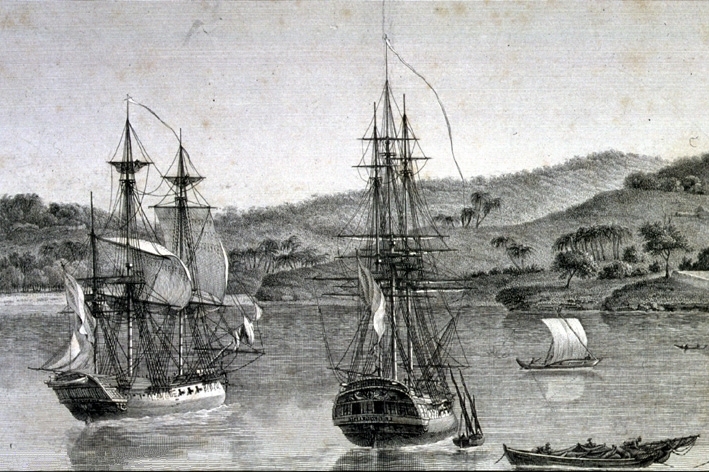
Ships Le Géographe and Le Naturaliste, from the Nicolas Baudin expedition to Australia, c. 1800-1803

In September, we share four installments of this short story Tasmania, a Lovesong, by Australian author John Bryson, which journeys us along the eastern waters of Tasmania.

SNOW ON THE MOUNTAIN above, and awash with the tides are Waterman’s steps, where a pretty Gaff Trader lies forever in state, on show to the modern world, built one hundred and ten years back, so plying these Hobart wharves in 1912, in commission loading lumber, when a Norwegian anchored alongside, this the Fram, an adventurer, leaky and gouged from the ices South, lying back on her chain while a longboat ferried quiet Amundsen for the Dockside, he loosing his greatcoat for the walk to the telegraph, composing the words to be sent to his King.

Those times, northbound out of Hobart town meant first laying south by Opossum Bay and out of the estuary, past the Iron Pot, where such is the concentration of reef-bed ore that compasses swoon and chronometers pause, beyond the Bruny Isle and the last docile lees in Storm Bay, making East under Port Arthur and the Isle of the Dead, to slip behind Tasman Island, for a few minutes out of the South East swell, which breaks shore here for the first time since it left the Antarctic.

Only gunboats, merchants and race-fleets go that way any more. The rest of us save 60 sea-miles by heading for the isthmus on which the Dutch of the Heemskirk first landed, now the channel town Dunally, where the narrows have been dredged through to the Tasman Sea, and the woody peninsular below seems to be hinged there by the Swing Bridge. Most boats anchor on the inland side overnight, and navigators will tell you this is for safer passage, although when dusk falls every one wades to the wrinkled shallows, with torches and fire sticks, so it will strike you that skillful pilotage around here has to do with grilled Southern flounder and fried anchovies.

At the earliest light the bridge draws, and the way ahead is as placid as a flooded meadow, but the tussocks float aside on the bow’s wave, for these are awakening swan and preening duck, and the depth underfoot is plenty. The bridge-keeper walking the bank in pyjamas and oilskins, collects his toll with a long handled dip net, and the tradition here is that the fee be already hitched to bottle of Pilsner so to provide ballast in transit. From here on, the perspective is of tall ash and stringybark, the forest closes astern and parts ahead, and I have watched this from landward too, the vessel seems to be sailing the woods. Here comes a time now at which the treeline thins enough to release the astonishing sun, the waters flow like the mouth of a stream into a sandy and generous bay, where an inexplicable shade at the edge of the shiny current is, most likely, a spray of minnows or basking ray, and see how all these sunbeam shallows and channel blues speak of the Western Pacific, whatever the charts might say.

About the Author:

In 1985, the book Evil Angels by Australian author John Bryson was released. Its revelatory investigation into the disappearance of Azaria Chamberlain shed new light on the controversial case and quickly became a career defining piece of work for Bryson. Other publications include the novel, To the Death, Amic (Viking/Penguin 1994) a collection of short fiction, Whoring Around (Penguin 1981) and a collection of reportage Backstage at the Revolution. Bryson lectures in law, literary journalism, and fiction, acts on advisory panels to government, NGOs, and universities, and on literary judging panels. At the end of the millennium, a Schools of Journalism panel included him in ‘The 100 Australian Journalists of the Century’. In 2014, he was awarded membership of the Order of Australia.
Just Across the Road

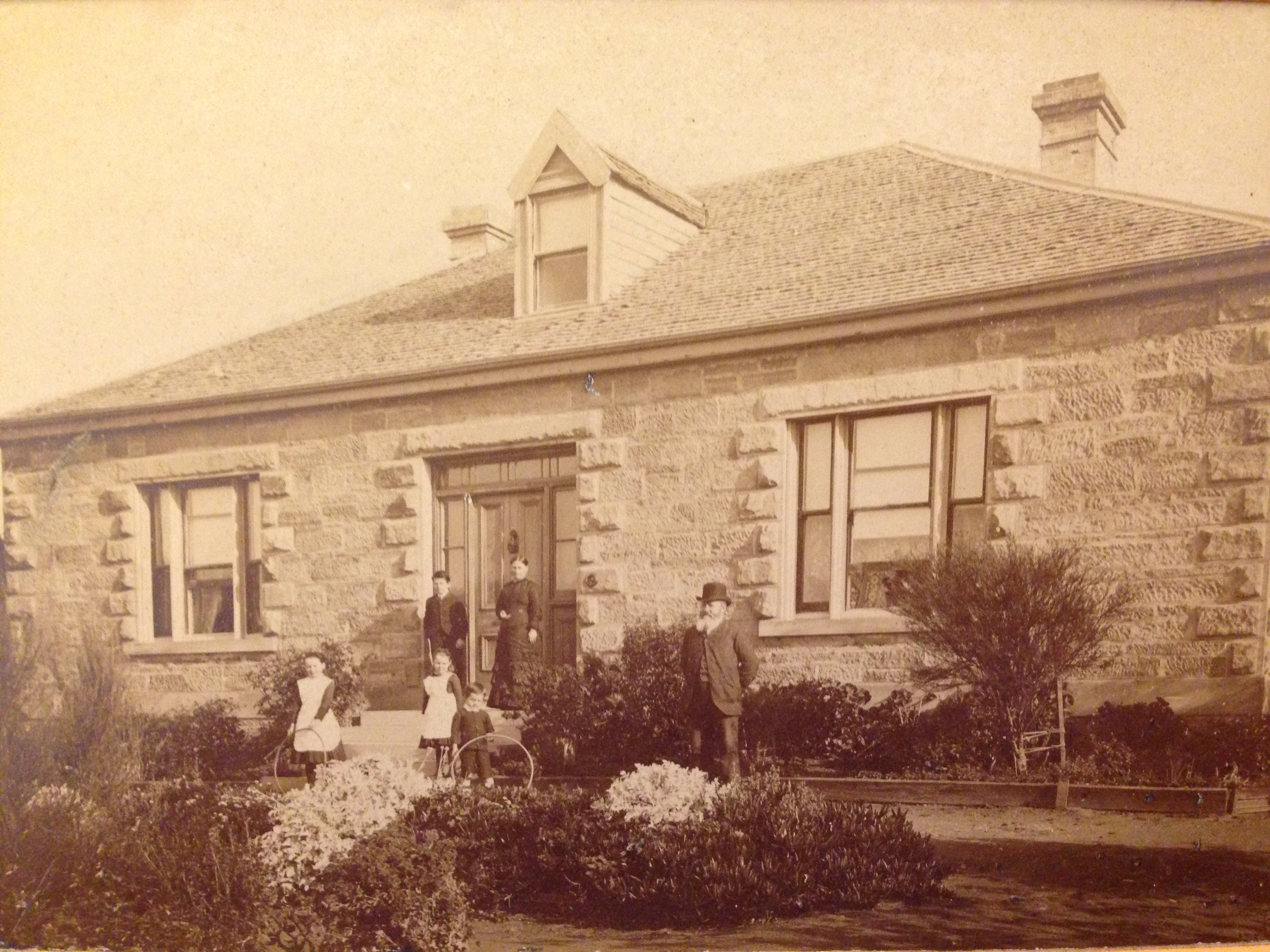
Chapman family at Maritimo

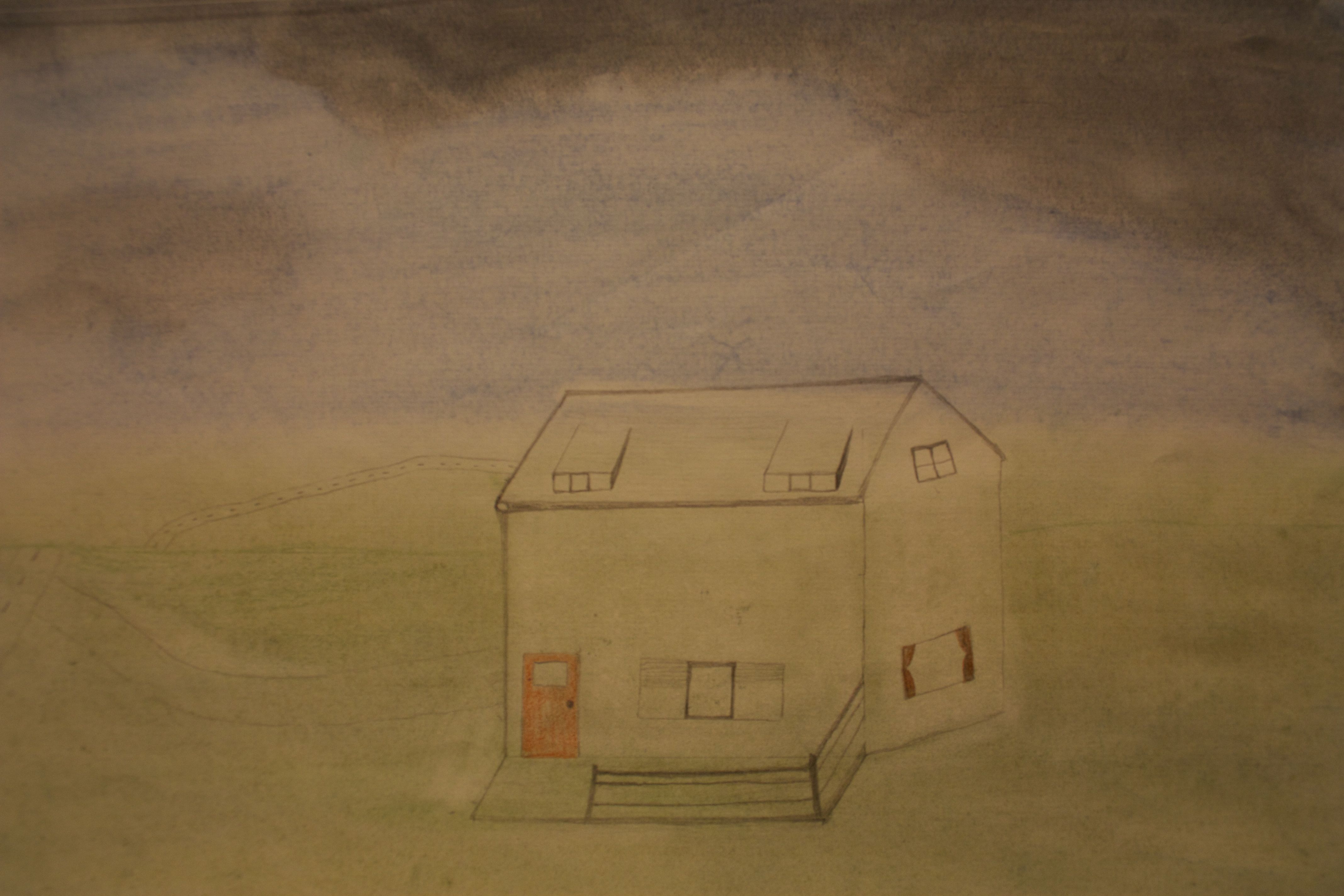
What is the story behind the house that looks over to ours, shares our street name, and watches us as we come and go? Our Girl Friday, Kristen Erskine digs a little deeper to find out.

A young Nutmegger put up his age and set sail from New Bedford, Connecticut, aboard a whaler in the early 1800s. He eventually served on the Menkar (named for one of the stars in the constellation Cetus also known as The Whale). The ship was crippled on a reef in Poverty Bay, New Zealand and limped to Hobart Town in 1858 where it was condemned and wrecked. Undaunted, Charles Augustus Chapman then joined one of the ‘luckiest and most profitable ships’ of the time, the Runnymede barque.

Three years later he married Jane Gaylor, sister of Charles (the founder of Customs House Hotel) on December 7th 1861 and continued his life at sea until he sought his real fortune by heading to the west coast and purchasing mining concessions with Dr Crowther around 1882. With the fortune he made from selling the shares in the Anchor Tin Mine he retired to Hobart Town and purchased 3 acres of land in Sandy Bay between the dairy farms of what would be Dynnyrne and the huge orchards that stretched to Nutgrove Beach.

By 1885 Maritimo (from the Portuguese for “view to the sea”) stood proudly facing the ocean where he’d spent most of his life. Already a father of four, he and Jane produced three more children with the youngest being premature and dying at birth.

I’d first laid eyes on the house whilst taking my eldest child to a nearby park. At that time it was one of those fantastic “haunted” houses, set well back from the road and virtually invisible because of the trees surrounding it. I just noted it as I walked to and from the park and as the years passed and more children joined us and more trips to the park ensued, a fair number of stories revolving around this mysterious house appeared in my writing.

Last year this all changed. We had a chance to move house and lo and behold it was directly across the road from that house which had fueled myriad plots conceived during those occasional idle moments whilst caring for my children.

When it occurred to me to look up, from beneath the boxes and chaos I realised a magical change had been wrought on the house. The hidden had become visible, the house standing proud on its gentle hill. The gigantic shrubbery tamed and snipped and trimmed. The white paint covering the bottom storey scrubbed away allowing the original sandstone to glow. And oh, what a glow in the morning, the house facing east and the stone changing hues with the dawn. There are children again, skipping and running and throwing balls. Some days I’m tempted to take them a hoop and stick across and see if they can recreate some late Victorian childhood games.

My dreams of living across the road from a haunted house have been tamed by the shouts of laughter, birthday parties, fertile pear trees and sharing a cider on the verandah. I am quite content. Some homes are grand and forbidding, Maritimo, now I’ve had the chance to get to know it, was simply lonely, needing a family and warmth within again. Not haunted at all, just waiting, for the walls to echo once more with children’s delight and for the spaces to be cherished again, the gardens cared for and reimagined.

The only photograph I’ve seen of Charles and Jane Chapman is in front of the home with some of their children, who were obviously trying very hard to be “good” but there is mischief in their grins and even Mrs Chapman is smiling slightly. I suspect she and her husband would be well pleased to see their home now. Once again a warm and congenial family home, still a “view to the sea”, and settling into a new generation growing within its sturdy walls. Meanwhile, I’m marking out other houses to feature in my haunted writing, Maritimo is far too sunny natured now.

Henry Savery: The Hermit of Van Diemen’s Land

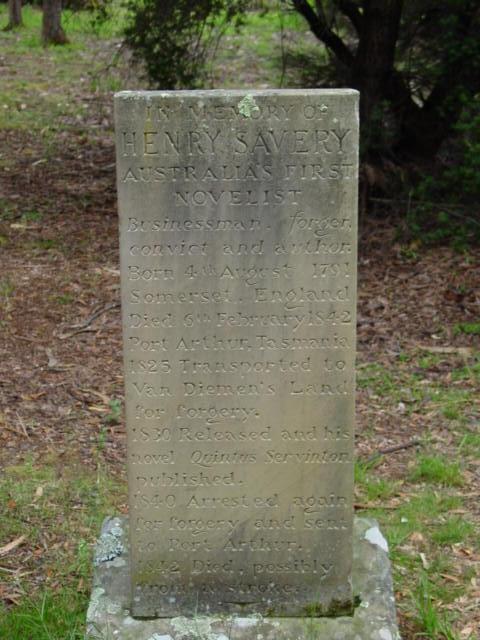
Henry Savery memorial stone, Isle of the Dead, Tasmania

Our Tasmanian editor, Rachel Edwards investigates the origin of the first published Australian novel, its distant legacy and the state of literacy today.

In 1825 a chap called Henry Savery, who had been sentenced for forgery was transported to Van Diemen’s land. He went on to become, via a stint writing a column using the pseudonym Hermit of Van Diemen’s Land and slandering various public figures, saved only by diaphanous nicknames – and via an unmatched moment in the history of the world where one small town had two newspapers with the same names and the same serial numbers, but I digress, Henry Savery went on to write what has become known as the first Australian novel. It is called Quintus Servinton and by all accounts it is an overwritten, dense, not very enjoyable read – and a thinly veiled autobiography and attempt to win back his wife, who had begun an affair with Sir Algernon Sidney Montagu, who was to join the Supreme Court in Hobart town, and who Montagu Bay was named after – and was brought up his by family friends, The Wordsworths.

Henry called himself ‘The Hermit of Van Diemen’s Land,’ an attempt at anonymity for writing a newspaper column (as indentured convict labour, it wasn’t all brickmaking and fending off bushrangers), in which he wrote assiduous and cutting summations of what was going on under Governor Arthur’s increasingly neurotic rule.

Quintus Servinton was published in 1830 and it varied most significantly from Savery’s life in its happy ending. It preceded Woman’s Love by another Van Diemonian, Mary Grimstone by 2 years and For the Term of His Natural Life, generally presumed to be the first Australian novel, by 44 years. For more academic detail about both Savery and Grimstone here is a PDF of E. Morris Miller’s 1958 paper ‘Australia’s First Two Novels, origins and background’

While it is a proud fact that these shores gave rise to the first Australian novel and it is often quoted that Tasmania has more readers per capita than other states – and more writers, we currently have only 50% functional literacy. 50% of people are ONLY functionally literate in Tasmania. It is a gobsmacking figure in Australia today and a heartbreaking one for Tasmania. In this, the International year of Communication, even more a call to action.

Readers and writers in Tasmania have a duty of care to others who struggle with these crucial life skills. While reading fiction makes the reader more empathetic and compassionate,  awards and recognition for writing are crucially important for Tasmania. To recognise and value the writing that is being done in Tasmania right now is to show that literacy is valued – and while spelling out a word in the supermarket may seem a long way from the books that have won the Tasmanian Literary Prizes, they are part of the same continuum. As a friend said “you can’t encourage kids to play footy and then take the AFL away.” The Tasmanian Literary Prize is a valuable institution that the State government must return to celebrate the strength and beauty of writing in this state and to show a society with decreasing literacy that reading and communication are valued, from the top down.

Here is an interview with Rod Howard, author of A Forger’s Tale, a biography of Henry, in 2011

Adapted from a filmed piece for the Tasmanian Leaders’ Program, July 2014.

Islands and Cities: Time and Space

post time and space

Emma L Waters reflects on time and space; its visibility, changeability and its constant influence.

The pace is different back here and I am impatient. People move with the drifting disorder of the clouds, which blow in from all directions. Tumbling down from the plentiful mountains on this island. Seeping along the rivers. This island at odds with the sea around it.

They like space here and plenty of it. When there are crowds they are not used to reigning in their movements and collide. In a drunken festival crowd, people knock into each other as they spin and turn against the city folk who’ve flown in. The contained city folk, whose bodies are bridled to small boxes.

In the city, people rat race from A to B and all the other letters too. Not stopping. Sharpening each other’s edges.

Here, people drift with time and space on their hands. They throw themselves out into the road, not expecting traffic. Thrusting themselves out like gusts of wind across the stream.

I returned here, for this dominance of nature. The sense of time and space that floats from the mountains, across farmland and down the quiet streets and out to sea. But I move in a different way. The way of the city. The way my body grew used to maneuvering through tight spaces and narrow streets. Crowds and queues. Space. Never enough.

They like time here and plenty of it. I queue behind a man for many minutes. I am leaving very definite imprints in the air, in the bitumen, in the sound waves, yet he still doesn’t know I’m here. Right behind him. I am a transient with no such permanency. A person. Not a statue. Not a shop. Not a boundary. I have just arrived and am still not grounded in this place. But – I am here – though he doesn’t seem to know it yet. He turns and I am forced to step out of his way to avoid being trampled. And still, he doesn’t see me as he leaves. Face intent on a thought that will take him to join this dot to the next dot in today’s puzzle.

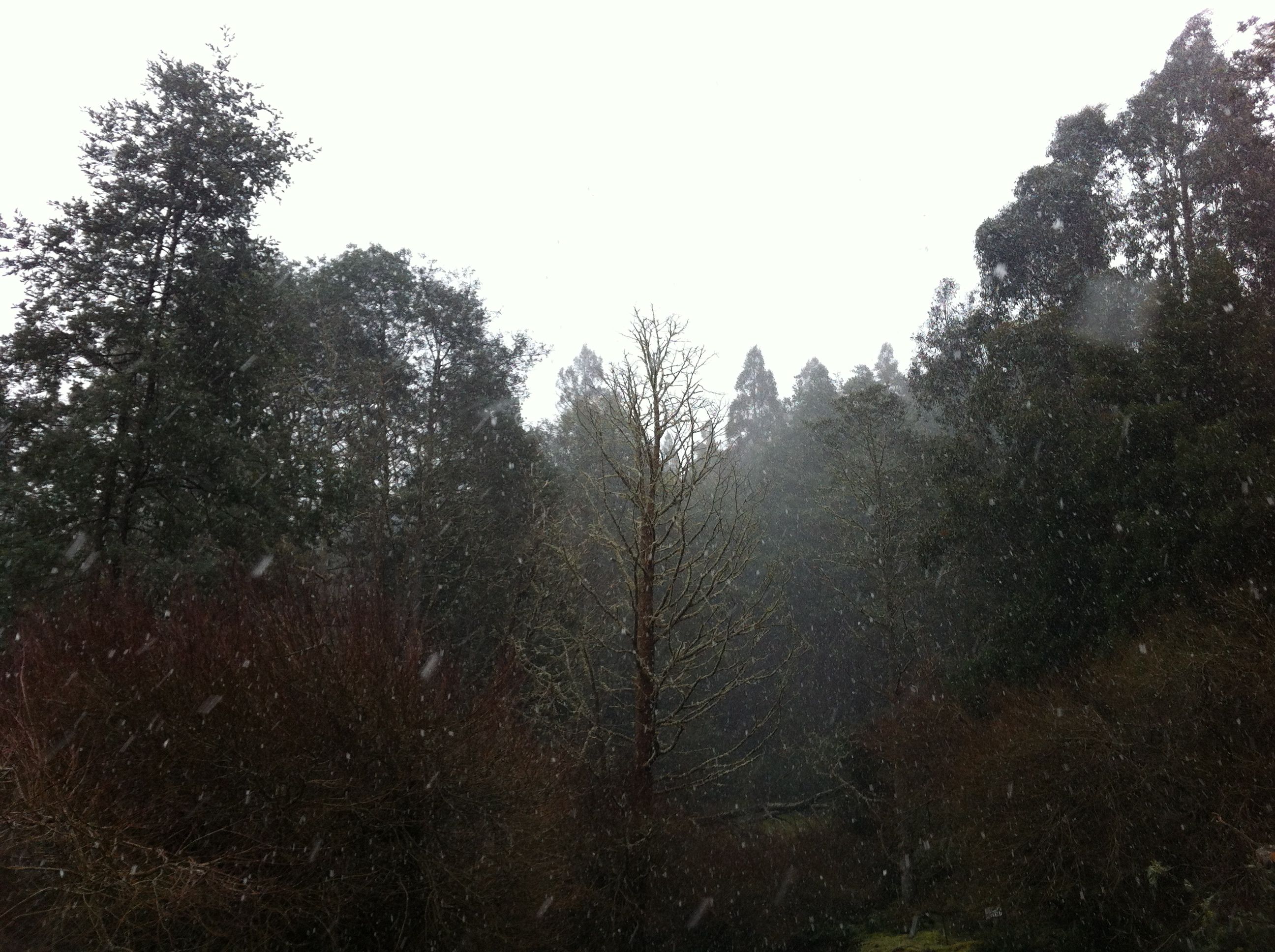
I walk in snow. It falls in large flat platelets that idle as they fall, though the wind in the treetops is certain of its strength and speed. In a forest of myrtle and tall gums. I can see distance in the air exactly. Every mobile fleck of it. All around as the slow snow falls. Far away. From high, high, high and further. Mid-air. Mid-distance. Close. On my nose, tongue and the prickle on naked eyes. It strobes the air in pointillation, like an icy pollen. It melts around my feet and then crystallizes again in a cold tightening that pulls at the skin. I watch it fall through all the open spaces between leaves and branches. Falling through to rest on the curling mud and gravel road ahead. And then there is sun, and soon all the leaves that were laden with the temporal tiny white, slip away to glossy dark green. The river tells itself to hush, but it cannot, and the more it tells itself to shh in its secret ravine, the louder it gets. Brimming and tumbling with a secret it cannot keep. And time flows at its regular pace again. The wind shakes the last of the slow snow away. I pull my feet from the ground and walk on.


Aboriginal Convicts

Aboriginal Convicts - Australian, Khoisan and Maori Exiles by Kristyn Harman
Aboriginal Convicts – Australian, Khoisan and Maori Exiles by Kristyn Harman

by Kristyn Harman

Standing before a tall, lop-sided headstone in the colonial cemetery at Maria Island just off the east coast of Tasmania, I could just make out the inscription. It commemorated Hohepa Te Umuroa, a New Zealand Māori warrior, who had died there in 1848. It was one of those moments of profound separation that occasionally jolts those who have left behind the familiarity of home to experience life elsewhere. At the time, I could not fathom what particular circumstances might have brought Hohepa so far from home at the hour of his death. It was only some years later that I grew to understand that indigenous people such as Hohepa were transported into captivity at a time when Tasmania had been Van Diemen’s Land, and Maria Island a convict probation station. In his case, he and four of his companions had been found guilty of ‘being in open rebellion against Queen and country’.

Having learnt that a few Māori warriors had been transported from New Zealand to Van Diemen’s Land, I became intrigued by the notion that perhaps some Australian Aboriginal people had also been transported within the penal colonies. While some historians considered this unlikely, a foray into the colonial newspapers and archived convict records soon revealed that that indeed had been the case. At least ninety Australian Aboriginal people were transported as convicts. And, like the Māori, they were all men. Shocking stories began to emerge, all set against a backdrop of frontier conflict with the violence and intrigue that it had entailed.

There was Jackey who, in 1834, was shipped from Newcastle to Sydney to face trial, chained naked on the deck of the steamer William IV, with the leg iron cutting through his flesh to expose his ankle bone. He died just weeks after arriving in Hobart to begin his sentence. Then there was Yanem Goona, an elder from the Grampians, who was shipped to Norfolk Island for being part of a community involved in sheep stealing (read economic sabotage – they drove of hundreds of the woolly beasties) regardless of whether he was personally involved. He was said to have cried whenever he thought of home. He died at the convict hospital in Impression Bay in Van Diemen’s Land before his sentence had expired. And there was also Tommy Boker. Charged with cattle stealing, all he could tell the criminal court was that ‘the beef was good’. They had to let him go after that. He got discharged to the Benevolent Asylum. Of the Australian Aboriginal men who were transported to Norfolk Island, Van Diemen’s Land, and the penal islands at Port Jackson, very, very few survived to return home. Many died within their first year in captivity, some of wounds suffered when they were captured, others from illness, and heartbreak at separation from kin and country.

It didn’t end there. From the late 1820s until the 1850s, at least thirty-four Khoisan people were transported from the Cape Colony (now part of South Africa) to the Australian penal colonies. Some had been soldiers who were court martialled for mutiny and desertion. Others were farm labourers indicted for theft and other crimes against their colonial masters in outlying districts. Many served months or even years at Robben Island, waiting for a convict transport (ship) to call in from England or Ireland that had room to take a few more prisoners of the Crown to the Australian penal colonies. Perhaps one of the most poignant cases was Wildschut’s. According to the Vandemonian authorities, he was ‘an old Bushman whose language cannot be understood’. Shipped half way around the world, the Khoisan convicts had no means of returning home even if they survived their sentences. And, unlike Australian Aboriginal convicts, many did survive. Their convict records are peppered with numerous offences, many of which relate to escapism. Some escaped mentally through imbibing copious quantities of alcohol. Others physically escaped through absconding. Further punishments were meted out, extending their time in captivity. Once released, these men had nowhere to go. Willem Pokbaas, a ‘cripple’ who survived Port Arthur, later lived rough sleeping behind the lime kilns on the outskirts of Launceston in the north of Van Diemen’s Land where he eventually died of an aneurism. Willem Hartzenberg ended up in the pauper depot at Port Arthur after his sentence expired, and was perhaps buried on Dead Island, now known more romantically, if still somewhat darkly, as ‘Isle of the Dead’.

Remarkably for a population that had so recently sent the last known indigenous inhabitants of its acquired land off into exile on a much smaller offshore island, the colonists of Van Diemen’s Land expressed their collective indignation when the traditionally-clothed Māori warriors arrived on their shores in 1846. How dare their colonial cousins across the Tasman Sea treat their indigenous population so badly?! As astonishing as this outpouring of outrage may appear from a present day perspective, it worked in the favour of the New Zealand captives. While Governor George Grey desired for them to be sent to Norfolk Island or Port Arthur from where they could be encouraged write cautionary tales for the consumption of other Māori, public pressure locally saw the men shipped instead to Maria Island. Given an overseer conversant with their language, the five warriors were (unlike other indigenous convicts from across the Empire) housed separately from the general convict population. They were allocated gentle tasks such as vegie gardening, and were allowed to hunt and fish. Nevertheless, their health suffered.

All were grief stricken when Hohepa Te Umuroa eventually succumbed to tuberculosis. Most unusually for a convict (but in keeping with the esteem within which the Vandemonian public held the Māori prisoners), his burial site was marked with a headstone. It was the existence of that remarkable stone that enabled Hohepa’s whanau (family) to reclaim him, and to accompany his remains home to his beloved Whanganui River in 1988, where he was laid to rest more than 140 years following his death. The last of the exiled Māori had finally returned home.

Kristyn Harman is a New Zealander currently living in voluntary exile in Tasmania. She is a historian, university lecturer, and author whose monograph Aboriginal Convicts: Australian, Khoisan, and Māori Exiles (UNSW Press) recently won the AHA Kay Daniels Award.


Booking to the Future

download

by Scott J Faulkner

Tasmanians tend to not purchase tickets for cultural events in advance. It is a habit we share with other small communities – but it frustrates organisers and threatens event viability, particularly for small event operators.

On the glittering isle of Manhattan, it is a way of life that tickets are bought weeks or months in advance. To enter the hallowed halls of the United Nations General Assembly, you need to book tickets a month before. A ticket to the Crown of the Statue of Liberty may currently be purchased by the prescient – for September. And any attempt to buy a ticket from TKTS for a Broadway show, sees you join in a queue that the author estimates was over half a kilometre long at noon on a Tuesday. The reality facing New Yorkers is that cultural, sporting, or entertainment events are popular and in high demand. This is factored into the behaviour of New Yorkers.

Such a reality, however, is one that is only now developing for many residents of Tasmania. The recent queues at Dark MoFo’s Winter Feast were met with shock and surprise from locals. Why Tasmanians have this habit is a question that is up for debate.

One reason may be for generations Tasmanians have known that they could turn up to a show at the last minute and buy a ticket, usually without any queuing. Historically events rarely sell out (indeed, with many barely, or not even, breaking even) so there were almost always seats – often good seats – available at the door. Tasmanians have had the luxury of not needing to buy a ticket in advance, and so became accustomed to not doing so.

The inclement weather of Tasmania, a place where an Antarctic blast can freeze the most beautiful summer’s day, may be another contributing factor – particularly for events held outdoors. ‘We’ll see what it’s like on the day’ was a common response from my parents for any request to attend an event. We all know just how miserable a Tasmanian day can get. Why pay in advance for the privilege of stand in bitter wind and driving rain?

Finally, there’s the ‘Catch-22’ factor of Tasmanians knowing that Tasmanians have a habit of not buying tickets to big events, which often leads to the cancellation of events due to a perceived lack of interest and the need to pursue a refund of tickets. Time and time again we’ve seen major events in Tasmania (understandably) cancelled due to a lack of interest in pre-sales – particularly music festivals or concerts. It’s probably one reason why Tasmanians still don’t see as many acts or events as their mainland counterparts.

The organisers of large and small events alike in Tasmania can find this situation incredibly frustrating. Event organiser Miss Binny Boo, founder and co-producer of the Hobart based Sideshow Cabaret, is just one of many whose business have been affected by this particularly Tasmanian habit. ‘I have in the past made show line-ups smaller because I was worried about if we could pay all the performers,’ says Binny. ‘I know some of the other Hobart producers have cancelled shows in the past due to a lack of pre-sale ticket purchases… this a real shame as a few of the shows that have been cancelled were showcasing some amazing talent.’

In an age where tickets can be bought for events of any size online, often at a discount, more Tasmanians should plan and book ahead, preferably as early as possible to give organisers the assurance that their events will be financially viable enough to proceed. By embracing early pre-booking, Tasmanians will improve the confidence of event organisers – particularly smaller organisers – to bring emerging and niche acts into Tasmania from interstate and overseas, and provide more opportunities for emerging Tasmanian performers to develop their artistic talents at home. This would allow the cultural renaissance of Hobart, and Tasmania more broadly, to flourish more strongly. While habits often take a while to change at 40o south, an adjustment to pre-booking will see improvements for audiences, artists and event organisers alike.

Scott J Faulkner is a writer and political advisor who was born in Northern Tasmania and now lives in Hobart. Having just returned from Europe and North America, he has an interest in seeing Tasmania adopt best practice from overseas while retaining the quintessential elements that make Tasmania unique.