Transportation Press: Featuring the Nottingham Writers’ Studio

images

Nottingham Loves

by Bridie Squires

I rise to the sound of the City Ground chanting,
runs and Raleigh bike rides,
riverside gathering
festivals and hissing geese,
rowing blokes’ megaphones,
the prickling of summer heat.

I get to the bus stop,
funds a bit low, so
I tick a quid off the shop
until tomorroh.

I clock Notts bop by,
hear cars rockin’ beats
from the cracked window
that causes all the beef.

Old biddies titter about
tram works and price drops,
we pass the back of Broado and
‘Ooh! This is my stop!’

We swing
down
the
green
pole
vines
of the jungle bus,
say ‘Cheers!’ to the driver
because we are a humble bunch.

Outside Viccy Centre,
gotta cross the road,
red man signals us to stop
but we don’t do as we’re towd.

A mum tells her kid to ‘HARK IT!’
while eating cobs on Viccy Market.
I skip the fish and buy some ham –
I get me cockles from Dave Bartram!

I make my way down Clumber Street,
shout ‘Ayup’ to maybe two or three
mates whose face I haven’t seen
since Macy’s.

I visit a few places:
The Corner, Confetti, Laser Quest, Library.
From Wilford Pond to Wollo Park,
it’s clean and it’s tidy.

The phone rings,
my mate’s been tryin’
to meet at the left lion
so we dip toes in the square’s fountain rain,
remembering the good old emo days.

We go Arb to take in the scenery,
the budding, fresh-cut greenery
packed with sounds of laughter laced
with love that comes quite easily.

We visit Forest Rec,
it’s filled with ducks and youths,
Goose Fair and the carnival
have joined to set the mood.

with toffee apples and live art,
rides and local music.
We’re churning creamy talent
so we nurture it and use it.

Even Whycliffe pops along
to sing a little tune
of how our city whispers ‘Nowt
is impossible to do.’

We make tracks to the Olde Trip,
sing songs among the caves,
when a text message shares tips
of a ‘CLIFTON TUNNEL RAVE!’

It’s the final hour of the eve,
I nip and see me mam,
drink cups of tea while eating three
Yorkshire puds with jam.

We talk brash, but warm and honest
from West Bridgford to Sherwood Forest.

From Silverdale to Hyson Green
and all the places in between,
we’ve built a city full of treats
on grounds of creativity.

For Nottingham, I’d pinch the throne
’cause there’s just no place like home.

Writer’s Bio:

Bridie Squires is a Nottingham enthusiast who loves to put pen to paper. As a family member of arts and culture magazine LeftLion, and of the spoken word collective Mouthy Poets, she enjoys brandishing a big gob all the same.

Cochineal

20150112_091056_Channel Hwy_11-1by Rosie Martin

Without any effort or intention, without willing it to be so, an image of a glass of water appeared in my mind. It thrills me when visual metaphors shimmer into place, for I have learned that they explain me to me in some surprising way.

Into the clear water dropped a bloodied tear of cochineal – bomb-like, turbulent, and spreading thinly, evenly, rapidly – forever changing the whole. This is what happened to my mind. In prison.

I have been doing some work in the prison. You see, I know how to teach people to read. I realise this sounds ordinary, but there is a lot of science to know, about what’s going on in the brain and mind of someone who doesn’t learn to read in the usual way. It’s anything but ordinary. I pour and pour into this work.

Two years ago I was sitting in an auditorium in which a plea was being made for volunteers to work at literacy tasks with prisoners. My colleague, who likewise pours and pours, was also there. At the end of the event, as we walked toward each other looking into each other’s faces from across the room, we knew simply what the other was thinking – we know how to add quality for these complicated souls unable to respond to regular methods of learning to read, we have the skills, we ought to be gifting this knowledge to these vulnerable men and women. In the moment my eyes met hers, I felt in my depths, a breathless sparkle like bright flow between river stones – vivacious élan which I have come to recognise as my herald of heart action.

Now, it’s a practical world that we live in and impetuous dash and ephemeral sparks have less to offer once an idea has a shape, for then of course, there is work to be done. So I rang the prison, and asked if I could come, bringing with me the skills splashed and filtered in through time in my craft, to tell about what I can do. Well – my hat is off and my shoulders are bowed – I have nought but respectful admiration for the workers in that place who consistently enabled me and showed gratitude. ‘Come, show us, tell us’, their instant reply.

Now, I’m a newcomer. Not to the work, but to this environment and this cohort. The principles to teach reading to those who have been unable to learn it are sure. Analyse each individual’s configuration of processing skills, set a plan designed for that configuration and direct-teach a hierarchy of skills at the just-right level of challenge. And all the while, honour the soul of he thus configured with warmth, patience, humour and the dignity of no judgment.  These principles work. Skills can be grown. And I saw myself unfazed by the hand scans, magnetic locks and clanging doors, for a mind is a mind and a heart is a heart, no matter where they are housed. Or warehoused.

This was the glass of water in the image of my prison experience – all this, clear and contained.

But I’m a newcomer to working at the prison and it’s not dream and sparkle and vivacity for they thus housed. For many – for most – the way of things has not been like the way of my things, but more like this: I can’t read, can’t access education, can’t get work – I’m poor. And another axis: what is tender communication(?) it has touched me so rarely(!), language is weak, vocabulary and knowledge diminished, can’t get work – I’m poor. And there are many other axes of disadvantage. Smashing, shattering axes of disadvantage shocking with tortured horror and foisted upon men and women when they were but sweet and soft-cheeked boys and girls. Through no fault of their own. Ergo, therefore – made poor.

I am reminded that miserable souls were transported to Pt Arthur bound in body and mind with the chains of events sprung of poverty. I’ve imagined those cold and wretched men. And all these years later, I stand in the gaze of souls transported to Risdon, also bound in body and mind with the chains of events sprung of poverty.

And here bombed the bloodied tear that suffused my mind in prison. Not enough had changed in two hundred years. Souls born into crippling vulnerability were then transported behind bars – and they are still being transported behind bars. These bars, the materialised versions of those already built into their minds and lives through too little of the salve of society’s tenderness upon their developing beings and impoverished stations. Bloodied poverty. Bloodied lack of compassion. The ruddy tear swept through me.

Yet I note that time settles and changes the discernment of murky waters. For I see that my community now imbues the wretched of Pt Arthur with esteem and affection – a response of compassion two hundred years too late for those lives. Their odour and base mouths are not so much now forgotten, as that without the revulsion of sensory impact, these unsavoury qualities are not even considered when convicts’ stories are told. Judgement of their crimes, likewise, is not now forgotten, but rather is barely considered; for absent now is the unclad emotion of the perpetrated and the foaming of the virtuous. Now, only the mistreatment and the humanity of those hapless are left for us to see. And they are found wretched, and heroes; revered for their human worthiness.

Time does indeed settle and change the discernment of murky waters. For I also note that the respectable of old London and Hobart towns have not withstood the judgement of time quite so well. Popular hindsight now finds heartless fault in these of the ceiled and comfortable houses, clean and cologned, sending wretches to the end of the earth for the loss of a fop’s handkerchief. Now, as we appraise, their humanity seems to have been absent and their stories are imbued with stony hardness; the London cold upon their hearts.

But it is me I see surveying the glinty image in my mind. Bloodied tear to rosy clarity. My standing and my Chanel are respectable in my era. My insured wide-screen, the fop’s handkerchief. My aversion to human pungence, the pharisaic disgust. My lack of compassion, the lock upon the chains.

Tenderness, compassion, warmth and forgiveness are in the full-blooded cochineal concoction to pour and pour upon poor – to recolour with beauty the crippling abhorrence of smell, filth and profanity; and eventually even to ease the slicing agony of the pared and naked emotion which rises in the anguish of offence. Poverty to the end of the earth I say, not the poverty-stricken. Lest we all be destined to poverty in the wholeness of our beings.

This rosied glass is not new. I’m just the newcomer who teaches people to read. Yet I’m clear that I know this: the tools of my craft – warmth, patience, humour and the dignity of no judgment – are amongst the simplest tools of the empowerment of humankind. They and their stable mates, some with much loftier names, have been written of for centuries. Many shimmering images in the minds of many have brought forth wise words pointing toward these strong and gentle tools, well-oiled. We know how they are used because we have felt them at work in our innermost beings. They are the underrated means with which large change must be crafted. If we can be courageous, and feel their weight, their fit within our hands; and use them, even when it takes grit of the heart to do so – for love is a verb. A doing word. And a mind is a mind and heart is always heart – no matter where housed.

Writers’ bio:

Rosie Martin is a Hobart-based speech pathologist specialising in intervention and support for people of all ages with literacy impairments and social communication impairments. She has recently founded a benevolent organisation, Chatter Matters Tasmania, to assist with bringing these supportive services to the most disadvantaged in our communities.

 

London

Photo by Andy Sparksby Adonis Storr

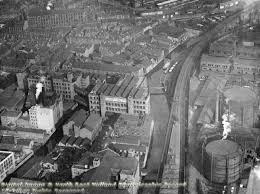
London is the Great Beast; and through the injection of an aeroplane one is swept up into her blood stream, losing the identity of the individual to be a single blood cell, one part of an enormous creature. And one is pumped through tunnels underground – the veins underneath the skin; coursed through lines like biological systems and, churning in the swell of the other cells, bubbling up further to erupt! Gushing out through tube station doors and swept onto steps worn down by millions of steps over hundreds of years.

And you are born onto the streets looking up – into the light that peaks through the gaps, of peaks that dwarf you in their shadows as they reach up to the length of their stretch. And below, on the ground where we are, there is chaos from all sides as the hordes of suits and tourists blunder passed curbside salesman spruiking incomprehensible town-crier pitches. And there are a thousand signs – you can’t read them all, all bright and loud and demanding that you need whatever it is that is on them.

And you wonder if you lived here would you become one of them – would this define you? This city? For being a traveller I see people totally absorbed by this place; and I am superfluous to their requirements; London appears often indifferent to one’s presence and from all sides confidently reminds one that you need London; and London will most certainly survive without you.

And there’s a thousand accents and languages and dialects and incomprehensible colloquialisms and funny people and sad people and animated people and shy and rich and lavishly boisterous and poor and begging and lost and homeless and celebrity, lawyer, policeman and prince. They could be sitting next to me, some sort of royalty, but I don’t read the newspapers, nor do I watch television; and I treat everyone equally; and my occasional online glances are for conversation only.

And through the deep surges of passion and apathy echoes a warm glowing sensation occurring within – this feeling of being apart of something large, grand even, the feeling that one might heave on an axis and turn millions of people into a different direction entirely; being at once almost inconceivably small and magnificently important.

London. Her body divine – of bricks, cement, metal and glass. Shot up from the ground – buildings like flowers. London. Your old skin speaks without words – of the years and bodies and stories. London. Whose epitaphs – obelisk-esque – stand tall, elegantly iconic, endlessly inspiring, yet still – looking up, then looking down, one can not unnotice the wondrous gap between the dirty old stone floor; and the glorious and golden shiny peaks.

And the mirage is three hundred and sixty degrees wide; and it forces you around chasing your tail, coming back to similar places – the old haunts.

London. All your roads are full. All your doors are open. You’re Sinatra’s New York. You’re a place to make it. To be somebody. You’re a one hundred year old lemonade and there’s only one left. You’re a restaurant that specialises in mashed potato. And there’s the thought that the longer you walk the more roads become large rivers of cars and doors, one-by-one, close forever. Almost like you might wander round London, only to one day look in the shiny reflection of a shop front window and notice that you’ve become old; and wonder how it happened.

And you make a loyal friend at the Society Club, surrounded by the portraits – all leather-bound paper and ink, of Burroughs, Joyce, Wilde, Woolf and Bacon. And you write yourself in here, over a latte; and the background chatter, minimal dance, the coffee machine and staff. And we’re all here – at the Society Club; and everyone is reading, or writing, or planning. And the girl making the coffees gives you a look.

And you know as you sip your coffee, these moments will pass into eternity and will mean nothing at all very soon. And in the Society Club it could the 50s, or the 60s, or the 70s, but not the 80s, 90s, or now. We exist in a past tense – here, now; and we drown sweetly in Vintage, and Retro, and Nostalgia.

And as the dogs fight in a dance in the middle of the room, you think that the floor tiles should look like a chessboard. And you sit in a brick building that was constructed a hundred years before you were born; and you wonder at the history and stories the walls could share. And my coffee and the words come closer to the end. But the coffee will flow forever, and the words will never stop.

London. You beautiful maze that has a thousand million masks, that is a mirage upon each corner, who holds ghosts in your leather-tough hands. London, whose magic I found, whose feet brushed history, whose mind mingled with royalty. London. My city, my capital, my friend.

Writers’ bio:

Adonis Storr is an English-Australian Poet, Author, Event Organiser, Master of Ceremonies and former Radio show host. He created Tasmania’s ‘Silver Words’ which has hosted an incredible array of literary talent and has been published by the Society Club in London. He toured regularly in Australia including venues like the Cygnet Folk Festival, The Festival of Golden Words and Passionate Tongues Poetry.

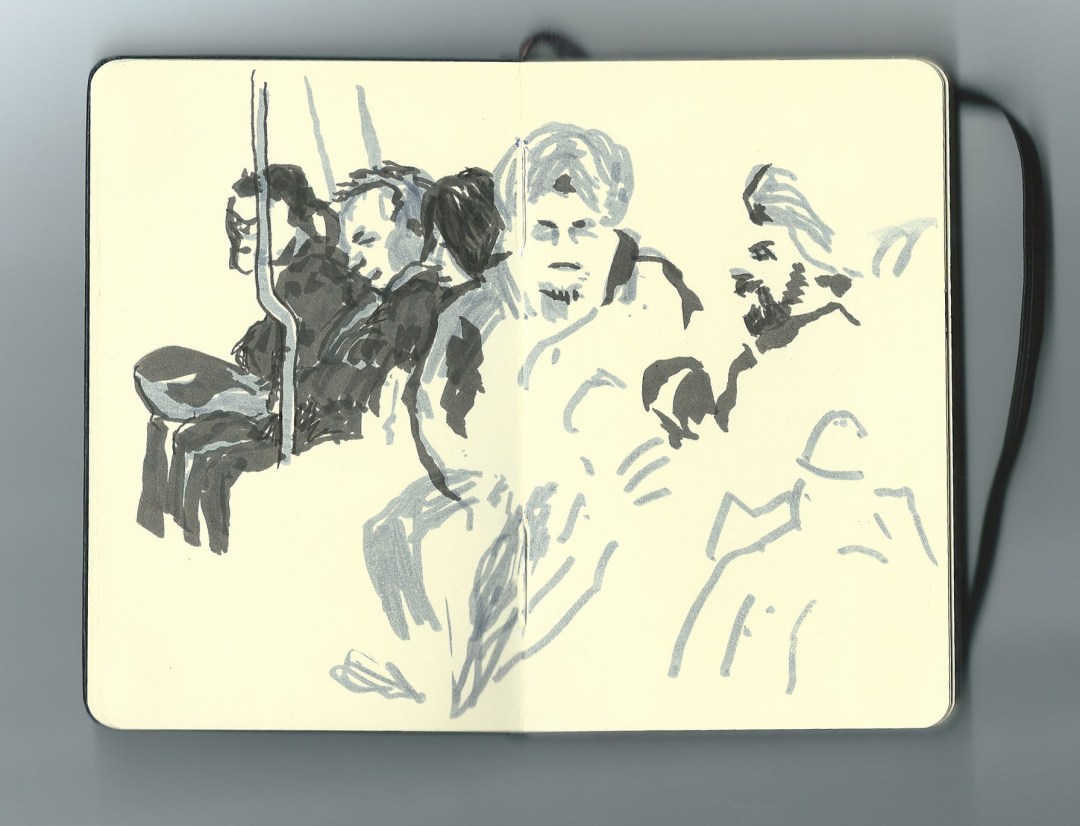
lines from the underground: writers respond to Tony Thorne’s illustrations

Tony_Thorne_Darren_Lee_response_toCOUP

by Darren Lee

He was a Sentinel.

The Sentinels didn’t have names, at least not in the human sense. If he could have picked something for himself he would have settled on “Metro”; a name he kept seeing on the masthead of the free newspapers that the humans liked so much. The word stood out on the front page, bold and constant; he aspired to these attributes.

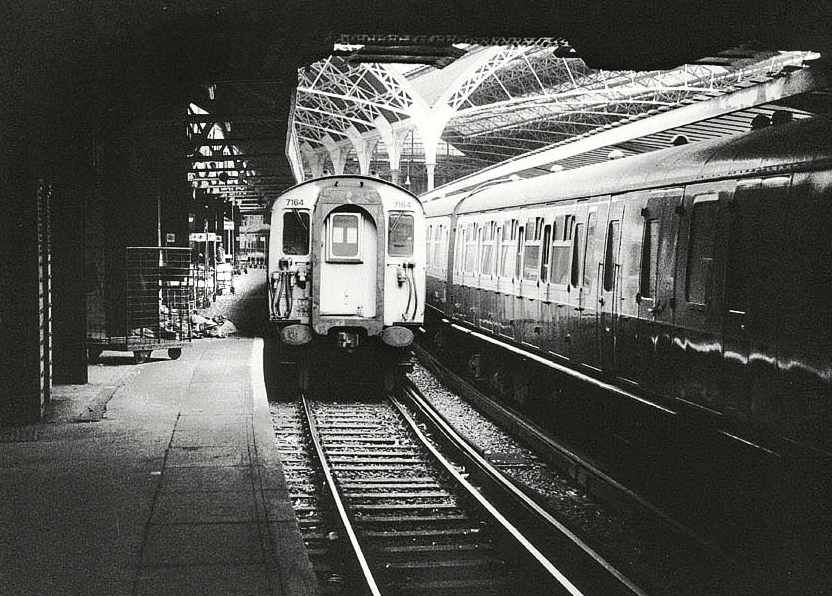
It was with the newspaper that Metro found a kindred spirit; like the strange, papery object he too spent most of his days loitering on the tube. This was his beat. He sat for most of the day, absorbing the rhythm and rattle of the carriage, observing closely the behaviour patterns of his fellow travellers: aloof, restrained and noncommittal. The humans hid behind their sheets of newspaper, hungrily devouring it with their darting eyes, before throwing them over their shoulders to litter their vacated seats. A fickle bunch, thinks Metro. Ripe for a takeover.

He coughs and a small specked feather escapes from his mouth. He had been briefed about this: nothing

to worry about, Control told him. The disguise had yet to be perfected. The rest of the Bakerloo passengers conform to type and don’t register anything untoward.

Metro is learning the Humans’ reading habit, but he mostly looks at the pictures: glittering people waving as they walk into a cinema, a plastic-faced man holding a battered briefcase aloft, a bloodied child crying amid rubble. As a Sentinel it’s Metro’s job to learn what he can and these abandoned items are good tidbits for his report; all nourishing breadcrumbs for a curious intellect.

On the way to Charing Cross he puzzles over a picture of a human female; he has seen her image before and is aware that she has elevated status within human society. She is showing her posterior to the camera. Metro doesn’t understand this and ponders if the backsides of the rich do not fulfil their original purpose; are they purely ornamental? He makes a note. This is something to brood over later with Control.


There is no danger of Metro going native. Control had warned him about that too: previous expeditions had turned and lost their avian nature. Metro thinks he saw one once in Regent’s Park. She was in the form of an old woman who sobbed openly as she tore up hunks of stale bread which lay uneaten at her feet. Her former brethren watched indifferently from the trees, forbidden to descend and peck at the tainted crumbs.darren lee crop 1


Metro is quiet and unmoving for most of the journey. It’s best for him to sit still; the disguise chafes his breast and his folded wings regularly cramp. There is some release when he reaches Charing Cross and he settles into the task of piloting his human shell to Trafalgar Square. His steps are tentative at first, but he eventually settles into a pattern, a stroll which syncopates with the bustle around him. Of all human activity, it’s walking that puzzles Metro the most. How did they cope with being
 so earthbound all the time? Maybe this was why they distracted themselves so much with the rear ends of the great and good?

darren lee crop 2
Metro bounds up the stairs to Trafalgar Square two at a time. He is showing off, trying to make a grand entrance. The crowds, too absorbed in taking photographs of themselves, fail to notice him. The birds sense his presence straight away; they immediately land and a silence spreads. They all look towards the corner where Metro is waiting.

A fat pigeon descends from Nelson’s hat and circles it’s way down the column, swooping over the silent brood. The pigeon gracefully lands at Metro’s feet.

Metro bends down and offers Control his hand. The pigeon rests upon his palm and is slowly elevated level to Metro’s face. The Sentinel launches into his latest report. After being confined to his disguise it feels good to revert to the old language once again.

Control listens patiently, processing all he can, hoping that among Metro’s theories on celebrity and transportation may lie the seed that grows into the humans’ final destruction. His flying army is ready, stationed on rooftops everywhere throughout the capital, ready to swarm as soon as the chink in the armour is revealed. Until then, the Sentinels arrive and share their knowledge.

Metro finishes his report and goes back to the tube.

Control flies upwards to his perch and defecates on Admiral Nelson. He continues his watch, making sure the world ends not with a bang, or whimper, but a bloody coo.

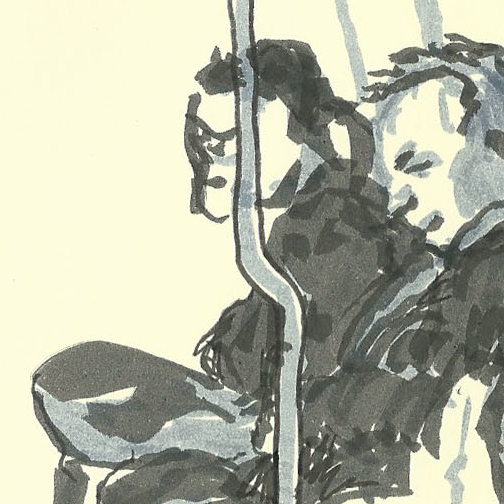
Tony Thorne’s illustrations, sketched while in London, travelling the iconic underground rail system will feature throughout the upcoming publication Islands and Cities, a collection of short stories by Tasmanian and London based writers. To celebrate this cross-cultural exchange, writers from the publication have each been assigned an illustration by Tony Thorne to respond to, for publication on our website. 

lines from the underground: writers respond to Tony Thorne’s illustrations

Tony_Thorne_Ian_Green_response_toby Ian Green

About the size of a packet of cigarettes, the cheap plastic of the Buddha machine fits snug in my palm. It is simple- a speaker, a volume wheel, a switch, a red LED, a headphone port. A few basic circuit boards sit encased in what was once pristine white. I turn the wheel of the Buddha machine to its full volume and a loop begins to play in my ears. I close my eyes. Thirty seconds of gentle tones expanding and contracting, and then it repeats. I could turn the switch and another loop would come, but I am lucky. My breathing synchronises effortlessly with the ebb and flow of this first loop. I open my eyes.

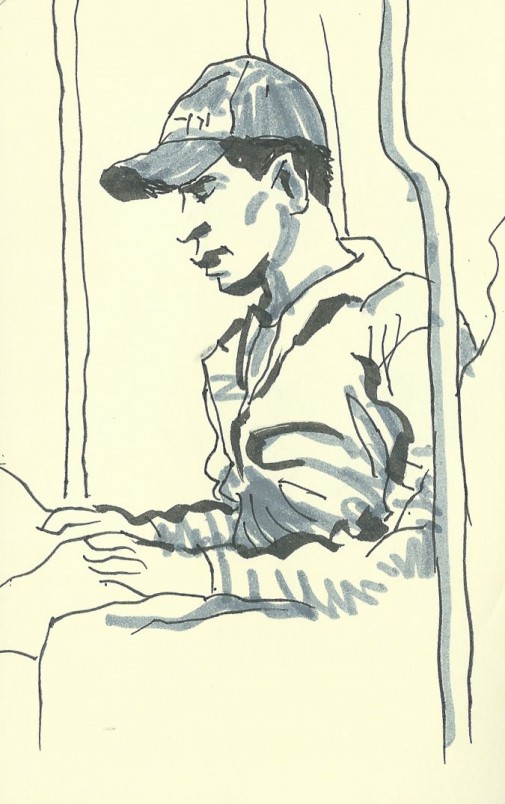
T_Thorne_cropped_Ian_Green_response_1It’s close enough to winter that the trees past the train windows are gilded with ragged leaves. People are wearing jackets, but not yet scarves or gloves. Everyone is too hot in this carriage. Past the noise of the Buddha machine, I can feel the train vibrate, I can almost hear voices. The loop is ambiguous- every noise that sidles past the headphones is incorporated until the train is breathing with me. Across the aisle men gesticulate and smile and talk. A girl is reading a book. A grey haired man looks pained as he casts his eyes around, oppressed by the weight of life pressed into the carriage. Beyond him in the gloaming I can see lights burning in office buildings.

We stop. We accelerate. We continue. We decelerate. We stop. We accelerate. We continue.

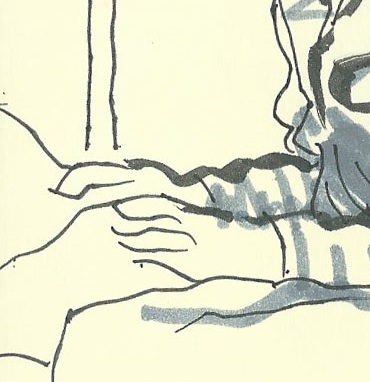
T_Thorne_Ian_Green_response_cropped_2It feels as if there is a larger pattern, as if the loop is changing, as if it draws out – there is not. The change is in the train and in the passengers. This loop is thirty seconds long. The man next to me is reading a free newspaper. I am tired.

We reach my station and I step out onto the platform and the train keeps going, and the loop repeats.

Tony Thorne’s illustrations, sketched while in London, travelling the iconic underground rail system will feature throughout the upcoming publication Islands and Cities, a collection of short stories by Tasmanian and London based writers. To celebrate this cross-cultural exchange, writers from the publication have each been assigned an illustration by Tony Thorne to respond to, for publication on our website. 

Peel Island

peel-island-while-we-were-filmingby Jamie Collinson

An island in London inspired me to write a book. Well, that and the idea of killing a flatmate I lived with for a while. Perhaps that came first. The killing, then the running away to an island.

The book ended up being set on another island, in a very different part of England. This other is real, too, although I’ve never seen it. I spent a huge amount of time on it though, on the page and in my head.

Other books are set there, too.


The island in London that inspired me is in Victoria Park. It’s the one reserved for wildlife that you see as you enter the park from the Old Ford Road side. Forget the re-sculpted one with the rude red pagoda that you can actually walk on. This was pre-clean up, when the park provided a physical manifestation of the mess inside my head.

On Sunday mornings, in the generic sort of life I once lived in East London, I would pause and regard that island. Hungover and often very guilty, I’d briefly entertain the fantasy of living on it. I’d take a tent, I imagined; wade out at night, live amongst the geese, ducks, herons and trees. I’d wonder how long I’d last.

Afterwards, I’d walk along the canal with a person I would disappoint in every way. I’d make promises to myself, and to that person, that I would fail to keep.

That place still features in my life. Whenever I come back to our ruddy little English island, I live within its orbit. It is different, and I am too.


My desire to kill that flatmate was converted into fiction. I poured all the rage out like hot bile and it cooled into a scene.

A while later, on a street not far from the island in Victoria Park, the man in question asked me what my book was about. I could tell he already knew.


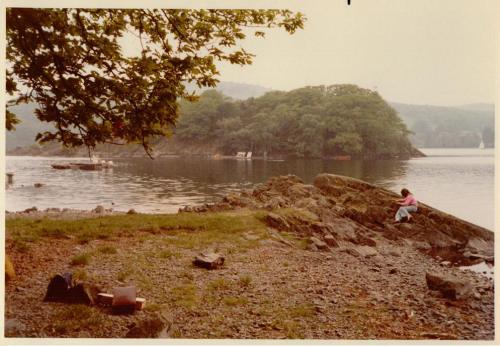
The island that part of the book is set on is in Coniston Water in the Lake District. I think I was wrong to say I’ve never seen it; I must have, once, because I’ve driven past that lake. Can the memory of being a child, sitting in the back of a car and promising to buy it for my grandmother, possibly be real?

I can’t remember it though, not as it truly is. On maps and in pictures it is shaped like a comet, fading out into a rocky tail. Its trees sprout from it like a tuft of pubic hair.

Peel Island.

Wildcat Island, in the other books.

Donald Campbell died beside it. His last words were:

‘Straightening up now on track… I’m getting a lot of bloody row in here… I can’t see anything… I’ve got the bows up… I’m going… oh…’

I was listening to the radio one day, before I wrote the book. The presenter said that Peel Island’s pub had lost its landlord, and needed another one. It was an important tradition that there was a landlord in the pub, and that person was always known as the King of Peel.

Of course, there is no pub on Peel Island. For years I thought I must have imagined the story. Writing this, however, has revealed to me the existence of Piel Island.

Islands within islands within islands.


No one lives on Peel Island, Coniston Water. A character called John tried to for a while, but he didn’t last very long.


transportationbook.com submissions:

Please send us short fiction, between 500-800 words for consideration for the website to transportationalmanac@gmail.com

Bulbowen

Sunset Over Bulbowen - Artist: Fiona Lohrbaecher
Sunset Over Bulbowen – Artist: Fiona Lohrbaecher

by Fiona Lohrbaecher

The giant Bulbowen was as high as the sky and as old as the hills.  For him years were as seconds, centuries as minutes, millenia as hours.  When he walked the earth shook and when it rained his footprints filled with water to make lakes.

One day, after years of walking, Bulbowen grew tired.  He had walked from one side of the earth to another and was weary.  He sat down, yawning and stretching.  He lay down on his back and closed his eyes.  The warm summer breeze caressed his eyelids and whispered lullabies in his ears, weaving a warm blanket of sleep around him.  For years Bulbowen slept.  For centuries he slumbered.  And as he slept the wind blew dust across him.  Year upon year, layer upon layer, the dust grew thicker and thicker, turning into soil. Birds dropped seeds on Bulbowen and, watered to life by the gentle rain, plants grew, spreading out their roots to hold the soil in place.

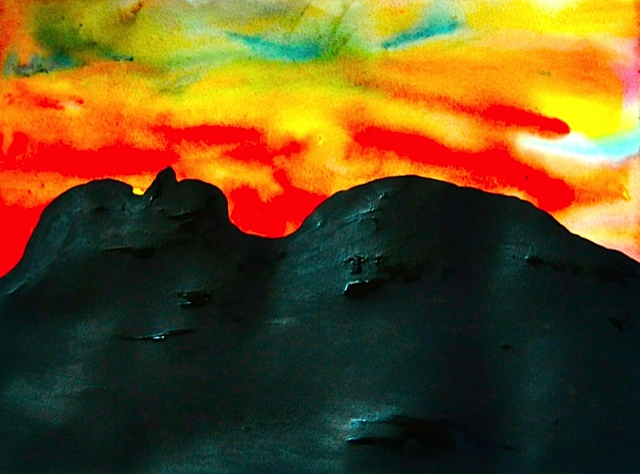
Millenia passed and, eventually, people came to the area.  They noticed the shape of the mountain; its outline resembling the silhouette of a sleeping giant.  They named the mountain Bulbowen, after the great giant of ancient legend.

The first people hunted on Bulbowen’s slopes, sleeping under trees or in bark shelters, moving on when the weather grew cold.  After many centuries they started building houses and farming in the flat land around the mountain.  A village grew up.  Children went to school.  People were born, grew old and died, all in Bulbowen’s shadow.  They took their recreation on the mountain, walking in its cool forests, skiing in winter and mountain climbing, although nobody ever climbed the highest peak, known as Bulbowen’s nose.  Legend promised disaster to anyone that tried.

Then, one day, the earth began to move.  The first tremors were small, barely discernible.  Windows rattled, crockery clattered, pebbles danced on the ground.  The quakes increased in intensity.  Buildings shook, trees bent and swayed in an eerie dance.  The people were frightened.  They ran out of their houses, workshops and schools.  The ground was moving violently beneath their feet now.  Boulders bounced down the side of the mountain and trees slid down in flurries of earth.  People grabbed their most treasured possessions and ran for their lives, across the plain, away from the mountain but still the rocks bounced around them and the tremors could be felt for miles.  They ran and did not stop running until they were sure they were quite, quite safe.

The mountain shook and heaved.  Every tree toppled and tobogganed down its slopes.  Great landslides were stripping the mountainsides bare.  Slowly, slowly the mountain changed shape.  It seemed to spread out for miles, then great tranches of land stretched up to the sky.  The top half of the mountain rose skywards as the giant Bulbowen rose to a sitting position, stretching and yawning.  He looked around him in mild surprise at the ruined houses, the fallen trees, that lay around him.  Then he rose to his feet, shook the last remnants of soil from his hair and beard and continued his walk.

When the people returned to rebuild their ruined houses they found a vast new lake where their mountain had been.  A new layer of fertile soil was spread across their farmland and hundreds of fallen trees lay scattered around to be used for the rebuilding.  So the people changed from skiing to water-skiing, and their recreation pursuits all centered on the lake.  They swam, fished, boated and wind-surfed in the vast body of water they called Bulbowen’s Bath.

transportationbook.com submissions:

Please send us short fiction, between 500-800 words for consideration for the website to transportationalmanac@gmail.com

Litzilla vs The World

Litzillaby Darren Lee

For some time now I have been incubating a monster in a quiet corner of my house.

It started off as an innocent enterprise, the result of over-eagerness during free time spent nonchalantly wandering around bookshops; I caved in at the distraction of the many colourful spines compressed on the shelves, the tables of promotions and carefully curated selections from the bibliophile bucket list. I bought the books and took them home intending to wallow in the wisdom of their pages, but instead there were other things to which I diverted my attention. And so, these stories that I had hoped to enjoy sat ignored in the corner, patiently waiting for the day in which they would feel my fingers tickling their pages and see my eyes dart back and forth across their text.

This was never intended to be a permanent arrangement, but over the years this nameless corner grew until it became time for it to be christened as “the To Read pile”. But that name seems no longer appropriate; something has began too fester in the pile, a dark malevolence spreading its tendrils throughout the room. The pile has propagated and mushroomed into a pulsating monster, a beast born from my addiction to books, a foaming monster I have ignored to far too long. The To Read Pile is dead, long live LITZILLA!

Litzilla is a creature made of many parts: Its legs are sturdy, and made of the thickest tomes from the Three-For-The-Price-Of-Two era. It clomps around supported by these pages, novels that were intended to be read, but have been mostly ignored since they were the unloved stepchildren of the originally purchased trio.

Litzilla’s girthy waistline is comprised of charity shop finds; as if the frivolous purchase of a book was justified by its philanthropic intent. This part of Litzilla is mostly made up of seventies Penguins, and their distinctive spines make it look like the abominable creature is sporting a distinctive orange jockstrap.

Litzilla’s torso is made up of those important books that I’ve genuinely always meant to read, but have found physically inaccessible; removing one from the pile will cause the entire structure to teeter over, burying me under a Jenga tower of unread text.

Litzilla’s head is a bulky, Easter Island type-affair made from hardbacks grabbed in the January sales. At first I was eager to leaf through these, but now they’re bulky and cumbersome in comparison to their paperback compatriots.

The crowing of the beast is a single cyclopic eye made from Richard Flanagan’s Booker winner, purchased automatically following the award. It is the capstone holding Litzilla together, staring at me with its beady gaze. Even though it’s only been there for a few weeks, it stares at me, hurt with neglect and demanding to be read next..

Efforts to constrain Litzilla have met with failure; I’ve tried pruning its limbs by slowly reading those books that I have so cruelly ignored. Litzilla has also been cropped, cuttings have been made and sent to the second-hand shop, where they will no doubt take root in someone else’s library. In one drastic move to arrest the growth of this bibliogical behemoth I banned myself from adding to it’s weight for several months, thereafter the siren call of literary shopping lured me back in. I have tried to cage Litzilla on a sturdy shelf, but now its bars are buckling and the monster is breaking free to leave its deposits around the house; all of them guilty piles admonishing my shortcomings as a reader.

The monster has become sentient. I fear its retribution. One day it will swallow me whole and trudge slowly from my house, looking for similar To Read Piles with which to merge. This giant book monster will run rampant, devouring streets, neighbourhoods and cities. No one will be safe! Run for your lives Litzilla has been awakened!

And yet still, I realise that I’ve not bought the new Ian McEwan yet, and well, it is on special offer at the moment. I would be foolish not to…

You can read, The Assembled Self, by Darren Lee in the upcoming publication from Transportation Press, Islands and Cities, for updates on the release subscribe to our newsletter.

Tasmania, a Lovesong: Part IV

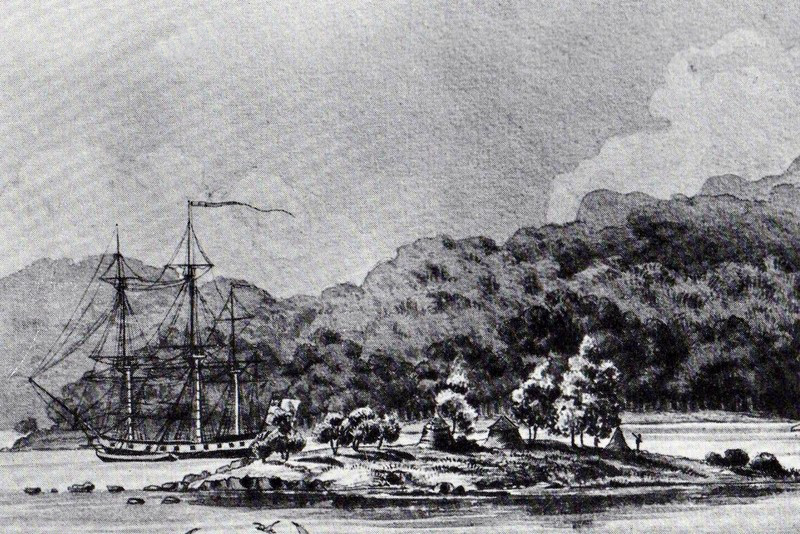
Week 4 – 24 sep – last instalment of john Bryson The ship Ocean, off Hunter Island c. 1804
The ship Ocean, off Hunter Island c. 1804

In September, we share four installments of the short story Tasmania, a Lovesong, by Australian author John Bryson, which journeys us along the eastern waters of Tasmania. Here is the final part.

SUCH IS THE TIMING of these passages that I’ve never seen this part of the coast other than etched on the radar screen, at night. Bisheno town makes a bright circle, and you’d think so snug a harbour safe in any weather, but a bar-room wall somewhere in every fishing village carries a framed photograph of the tempest of the 1960s, this causeway astream with foam, trawlers at terrified mid-leap, overwrought anchor cables whining and defeated, hulls on the Esplanade already stripped to the ribs, where huddle the watchful townsfolk, awed, ruined.

A southbound freighter, chatty, nearly home, found the right frequency to tell us we would have a tough night once we made it around the corner. He meant Cape Naturaliste, and we knew already. The sea was still slick, but the deck was atilt from other pressures high in the rigging. Mathers, who delights in the advent of small miracles, found he could read a magazine at the stern rail, so bright was the luminous wake. This was partly the gift of the vanishing moon, now heading to the clouds.

The Eddystone Beacon, blinding as it caught the deck, swept then the path maybe a mile ahead, rain squalls and scuttling cloud at whitecap height. By Mussel Roe Bay, at the northern tip, we were into the gale. The tide was headstrong, so we stood toward Clarke Island, to quarter the seas, but maybe also because of the association with good fortune, for when the Sydney Cove went down around here in 1797 the nine survivors were taken by Captain Flinders only as far as the mainland edge, told to walk to Botany Bay, and Clarke, with one other, made it.

Mathers was showing considerable grit himself, and I revere the picture of him still. This was his first passage and he might have hoped for better. Making soup, he jammed himself by the stove to hold the kettle over the flame. He judged the troughs, rather than the crests, would give him the correct momentum to run a steaming mug up the stairway, from the galley through to wheelhouse. It was Mather’s idea to extinguish all deck lights, since what they lit best were the frightening seas, and no freighter could see us anyway. Meantimes, he lay on the saloon floor, not to be thrown again from the bunks, and it was his questing fingers which found water there, so we had damage the pumps were not holding.

At sour first light we swung for Franklin Sound, between Flinders Island and Cape Barren. The approach is long and lumpy in these conditions, but around midmorning we had company, a fishing boat waiting in the channel to stand alongside us the rest of the way in. I knew her well, had fished on her two years or more, and might have expected nothing less than her appearance here, at this moment, should have expected her clowning skipper to toss a can of beer off board so we could toast landfall in tandem, should have expected his waving wife, who is also the Harbour Master here, to shout of a readied birth at the wharf.

Astounding it was how these folk warmed the morning. Is this all it takes, these acts of kindness, to sweeten the world? To remember that these are seas of beauty and abundance, where you may happen on one hundred and fifty acres of resting shearwaters, watch ridiculous dolphin roll and dandy for hours under the bow, sometime follow wave upon wave of glittery tuna surfing the shoals?

To still the wind, to blue the deep, to summer the firmaments? Is this all it takes?

About the Author:

In 1985, the book Evil Angels by Australian author John Bryson was released. Its revelatory investigation into the disappearance of Azaria Chamberlain shed new light on the controversial case and quickly became a career defining piece of work for Bryson. Other publications include the novel, To the Death, Amic (Viking/Penguin 1994) a collection of short fiction, Whoring Around (Penguin 1981) and a collection of reportage, Backstage at the Revolution. Bryson lectures in law, literary journalism, and fiction, acts on advisory panels to government, NGOs, and universities, and on literary judging panels. At the end of the millennium, a Schools of Journalism panel included him in ‘The 100 Australian Journalists of the Century’. In 2014, he was awarded membership of the Order of Australia.

Tasmania, a Lovesong: Part III

The Lady Nelson in the Thames, whose explorations included the Bass Strait c. 1802

In September, we share four installments of this short story Tasmania, a Lovesong, by Australian author John Bryson, which journeys us along the eastern waters of Tasmania.

THE SEA PASSAGE I’m speaking of now also carried Peter Mathers who was, around that time, moving from the writing of novels to the writing of plays, despite his brace of Miles Franklin awards, or maybe because of them. From the Dunnally channel we set North, to take the landward side of Maria, the mountain Island named for the wife Van Diemen, and the convict settlement until Port Arthur was thought of. Mathers likes stories to do with delusional grandure, and he had a fine time with this place. Maria, in the late 1800s, was leased for its limestone, kilns built, a hostelry sprang to its feet at North Point, the township fattened, and the company’s paper given a flutter on the London stock exchange. All this enterprise was the vision of Diego Bernacci who then renamed the town San Diego. The timing was just right, as events turned out, for the crash of the 1890s, but thirty years later Bernacci did it again, this time for the crash of 1929. Tasmanians have changed the name of the town back to Darlington.

Not far off course, and worth every mile, is Isle des Phoques. Left over from some previous arrangement of nature, these grand pillars have no inland to support any more. The pose is of enough scale, and of might, to stand as a nostalgia for the size of the world once was: here is Atlas relieved of duty. The trick now is to glide as closely as nerve allows. These heavy portals have been teetering here a long time so far anyway, and watch the birds nesting the ledges. The instant they scream: the terns, gulls, cormorants, all into the heart-beating whirling air, so will it seem that you have chosen the exact moment for the collapse of the counterpoise, of the entire crumbling vault, pealing from higher than the masthead, a landslide exploding into the waters all around, and I’ve watched seafarers go ashen right then, until the eyes catch up with the action enough to see that these are seals, hundreds maybe, the bulls and the cows roaring their dainty calves to the long plunge, to surface again in the tumultuous water, whiskery and inquisitive.

Dusk is not long away, but before it’s too dark I want to get us through the Schouten Passage, sea side of the Great Oyster Bay, and near enough to halfway now to Bass Strait. We could go around, and out into the Tasman, but the charm of the inshore route is the scenery, and the navigator’s excuse that, in here, we dodge the south set of the outer current. The island and the peninsular almost meet, and it’s difficult to see the convenient gap. But the run, when you find it, is very deep indeed, and so a favourite of locals. I know a Hobart seaman with a Masters ticket whose job is to pilot rusty ships from the far Orient to his home port for refit, and who, one summer evening, turned the 25,000 tonnes of Japanese freighter under his command through the skimpy passage here, grinding neither side on the rocks, to the tooting delight of the nearby lobster fleet, which understood just who must be up on the Bridge there, whose hand to the wheel.

About the Author:

In 1985, the book Evil Angels by Australian author John Bryson was released. Its revelatory investigation into the disappearance of Azaria Chamberlain shed new light on the controversial case and quickly became a career defining piece of work for Bryson. Other publications include the novel, To the Death, Amic (Viking/Penguin 1994) a collection of short fiction, Whoring Around (Penguin 1981) and a collection of reportage, Backstage at the Revolution. Bryson lectures in law, literary journalism, and fiction, acts on advisory panels to government, NGOs, and universities, and on literary judging panels. At the end of the millennium, a Schools of Journalism panel included him in ‘The 100 Australian Journalists of the Century’. In 2014, he was awarded membership of the Order of Australia.