
Women and Minorities: Part III

tooting, london georgia Mason-Coxby Georgia Mason-Cox

Patrick dropped me off at the station. ‘Let me know,’ he continued. ‘The sooner the better, because sorting things out with Duane could take some time.’

The journey home was quicker than I wanted. Soon I was navigating the blustery granite angles of Kings Cross. At the hostel, the weekend crowd was checking in. Uni students, mostly, down in London for a party weekend. They booked months in advance, pushing out the tide of people washed up from all corners of the EU and further afield. It was a Friday, so I had to move. My standards had lowered with my bank balance. Gone were the days of four bed all-female dorms, hairdryer and toiletries included. The new dorm was practically in the basement. A Tetris nightmare of cheap metal bunks, on entering I was greeted by the familiar odour of cleaning chemicals and bodies stewing on stale sheets. No windows. But it was quiet. The dorm was empty.

I turned on the lights and hung my towel over the railing at the end of the bed. Next to me, someone had done the same thing. An elaborate curtain was rigged up out of sheets. Taking advantage of the unexpected privacy, I began to undress. The position of the room gave me plenty of warning if someone was coming. I tugged off my jeans and threw my t-shirt into the corner of my suitcase reserved for dirty clothes. My bra was almost off when a haggard face briefly appeared from behind the sheet curtain next to me. I screamed, and he retreated. We never spoke, but on a few occasions that night his rough damp foot brushed against mine. The thin wooden bunk dividers were only waist-high. In the morning I rang Patrick. This time there was no hesitation. ‘I’ll take the room,’ I said.

I didn’t stay there long, a few months at most. Like I had suspected, the small print was a disclaimer, authorised by Patrick’s conscience. He continued to be slippery about prices and I had no allies once Daria was evicted. She threatened to take him to court over the illegal extensions, but that’s another, longer, story. I saw Duane once more, soon after moving in. There was a big black guy outside Tooting station in some kind of awkward dispute. He might have been asking for money. Maybe it wasn’t him, we only crossed paths briefly. Anyway, I’ve left Tooting behind. Recently I got a new job, front-of-house at a hotel in Mayfair, so I’m crossing the Thames, moving up, moving on. I found a little bedsit in Kilburn. It’s a start. Before leaving I went down to the station to try and find Duane. I wanted to tell him he could have his room back, but I couldn’t find him. I suppose he’s probably moved on as well.

Writer’s bio:

Georgia Mason-Cox is a Tasmanian-born writer living in Sydney. Her London adventures took her from dishwashing, to charity collecting, to working for the Royal Household. This is her first published work. It is fiction, just.
Women and Minorities: Part II

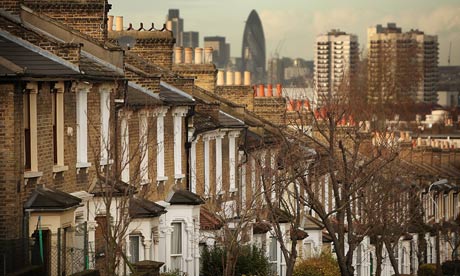
A-row-of-houses-in-south--001 photo peter madciarmid getty images the guardianby Georgia Mason-Cox

Patrick drove fast, gliding around corners and talking about his investments. The villain of the piece was a real estate agent, but this was separate to his job – this was his own property he was renting out. It was just around the corner, he said. The protracted drive built up expectations that crumbled unceremoniously as he began to slow down. ‘I like my tenants to have an education,’ he said, hastily parking.

The house was medieval brown and squatted at the end of a wistfully named street. Inside was a maze of stairs and corridors. Patrick was in a hurry. I lagged behind, struggling to reconcile the puzzling dimensions of the house’s interior with the modest proportions visible from outside. We passed three distended washing machines and a big yellowish sink. ‘The laundry,’ said Patrick. His shiny winklepickers lacked grip on the scrappy lino and he steadied himself on a small bar fridge. ‘Also the kitchen.’

We climbed the stairs. Chipped bannisters and peeling paint. Medium furnished room. The first floor smelt of fat and onions. All utilities included. Scraggy carpet and sweating walls. Women and minorities welcome. Abruptly Patrick turned left, stopping outside a door littered with faded Pokemon stickers. ‘This is the one,’ he said, unlocking it. A woman inside yelled out, and we both jumped.

‘Christ!’ Patrick crossed his arms and stood with his back to the door. ‘Are you decent?’ he said, and stuck his head inside. ‘Daria, I’m afraid you owe me more rent.’

‘No! This is not what we agreed!’

‘We agreed you would be out by now.’

They argued, and I studied the floor. After a minute, Patrick glanced my way. ‘Do you want to….’ He nodded towards the room.

‘No, it’s okay.’

‘Don’t worry about her, she shouldn’t even be here.’

The room was cramped but scrupulously tidy. I did a quick twirl, enough to get a general sense of the space, before backing out. Downstairs, he asked me what I thought.

‘That lady – Daria – she’s definitely moving out?’

‘She – she’s Polish or something, she’s been nothing but trouble.’

I confirmed the price. Patrick’s intricately gelled hair seemed to wilt a little. ‘What did I say? Is that what I said?’

We faced off over the boot of his car. ‘The ad said all utilities included.’

‘You must want the other one.’ He started to explain when his phone began to purr. ‘I’ll have to take this,’ he said, walking a little way up the street. I jammed my hands under my arms to keep warm. Patrick seemed agitated. I heard the word depression, several times. Then, ‘It’s news to me he’s unemployed.’

Patrick returned to the car, shaking his head. ‘I’ve just had his mother on the phone. She’s not happy because she says he has issues and he’s better off living with her and sorting them out.’

‘Who’s this?’

‘Duane. The one in your room. The room you said you wanted.’

I followed him back inside. Patrick had advertised two rooms and shown me the wrong one. ‘I leased it to Duane purely on a trial basis,’ he explained, climbing a newer, different staircase. ‘But nothing’s settled yet.’ We walked to the end of a dim hallway. There was nowhere to go from here.

‘Duane!’ Patrick banged on the door. ‘I’ve just had your mother on the phone!’

Barefoot in shorts, Duane was silent and motionless in the doorway. His fingers clenched and unclenched an open packet of jaffa cakes. Eventually he stepped back, allowing us a little way into the room. It wasn’t much wider than the flat screen TV wedged at the foot of the single bed.

‘I’ve just had your mother on the phone,’ Patrick repeated. Duane winced. After the second time I realised it was a nervous blink. He looked away. I thought Patrick had stared him down but Duane was in fact looking behind us. We tried to turn around too, bumping shoulders and stepping on each other’s toes, and I found myself face to face with the small figure on the bed that I’d tried so hard to avoid seeing just a few minutes earlier.

Daria stood in the hall. She looked determined, but maybe she was just cold. Her ugg boots looked like they’d stolen all the fluff from her dressing gown.

‘The pilot light, Patrick. It fucking goes out even when a little breeze is coming.’

Patrick grunted and disappeared down the hall. Now it was just me and Duane.

‘Mothers can be difficult,’ I said. He remained silent. Shoulders squared, he could have been wearing a combat uniform rather than a stained t-shirt that read ‘phat papa’. I wondered why his room was the only one without a bulky padlock on the old-fashioned swinging latch.

‘Mostly,’ I continued, ‘they just want the best for you.’ I couldn’t look at Duane, so I let my eyes drift up to the small high window. A few frigid trees against a restless sky. Duane still wasn’t talking.

‘What do your parents want you to be?’

‘Afro-Caribbean,’ he said, disbelieving. I nodded quickly but he called my bluff. ‘Doctor, lawyer…’

He sat on the bed. ‘Sorry about this,’ I said. We waited in silence. ‘It’s a good little room,’ said Patrick when he returned. ‘Duane, we’ll talk.’

‘He’s dropped out of college too,’ confided Patrick as we went downstairs. ‘Actually I think his mother has a point.’

In the car we got down to business. ‘I’d take it,’ I said, carefully locating my enthusiasm in the realm of the hypothetical.

‘As I said, I like my people to be educated.’

‘I’ll think about it.’

Writer’s bio:

Georgia Mason-Cox is a Tasmanian-born writer living in Sydney. Her London adventures took her from dishwashing, to charity collecting, to working for the Royal Household. This is her first published work. It is fiction, just.
Women and Minorities: Part I

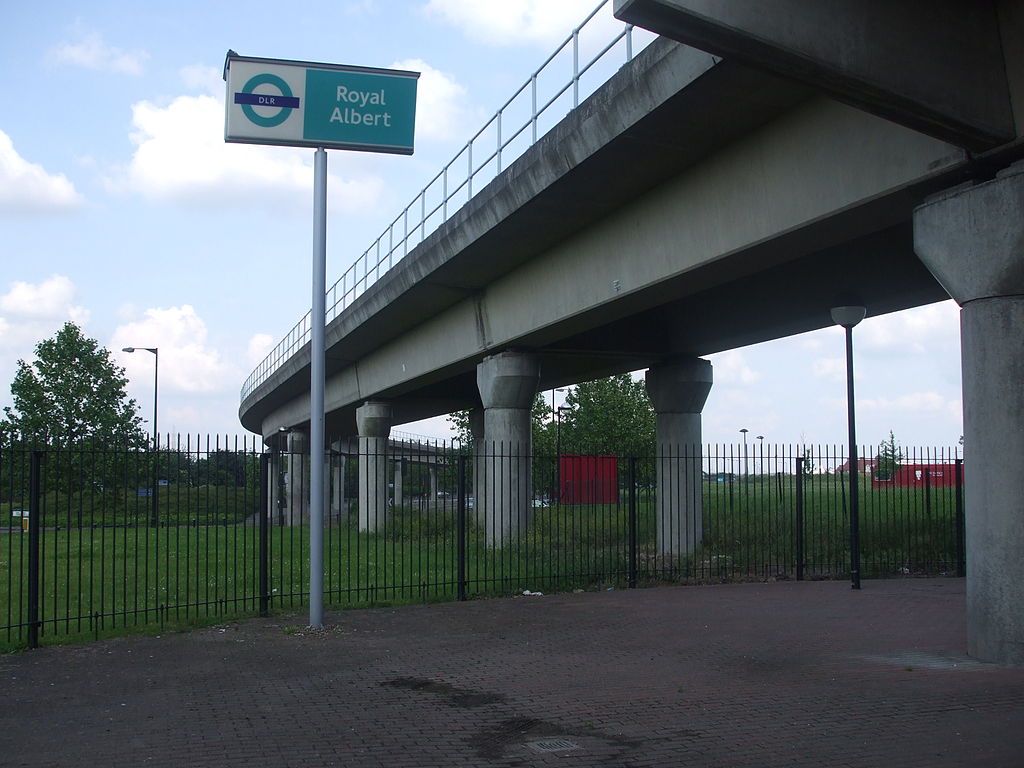
1024px-Royal_Albert_station part Iby Georgia Mason-Cox

The room was cheap, but ‘cheap for London’ wasn’t the same as being affordable. I scrutinized the ad. Of course it was a shared house (‘we are six friendly Eastern Europeans’) but I couldn’t expect to go straight from a crowded hostel to my own flat. I had to be realistic, but there were some things I wouldn’t compromise on. Balancing my laptop on my knee, and resting one arm protectively on my bag, I found the crucial information in the third paragraph: Royal Albert was the closest public transport link. After clicking through the photos, I concluded location was about all it had to recommend it. The rooms were dark and severe, with incongruous touches of chintz. But when the hostel looked like a school camp that had hosted a bucks’ night, what was a bit of jarring interior design? For central London it wasn’t a bad deal.

I was on the Beckton branch of the Docklands Light Railway when I realised Royal Albert had nothing whatsoever to do with the Royal Albert Hall. The address was in fact way out east, beyond the loop of the Thames. Still believing geographical isolation caused its metaphorical equivalent, I had no desire to tempt loneliness by being stranded out in no-man’s land. But there were worse things than a hostile flat. With its air of quiet paranoia, its rules and complex hierarchies, the hostel sometimes felt more like a low-security prison. If I didn’t get out soon I’d become a lifer, hanging around the common room and dishing out advice on the best time to get a hot shower and where to find a power point.

So I stayed on the DLR, and did some belated location research. Google said it was a good place to watch the take-off and landing of planes. The scenery had a low-rise bleakness common to the immediate vicinity of airports. Overpasses loomed briefly, a concrete blur. Things soon came into focus once I stepped out into the rain. Factories and fly-tips dominated the streetscape. Eventually I found the house. The front yard announced itself by extending an uneven carpet of cracked pavers onto the road. A few rubbish bins, huddled together for warmth, were the only obstacles to the front door. Now it was only curiosity impelling me to knock.

Bogdan was a Bulgarian security guard with a boxer’s nose. He owned the place; we had talked on the phone. Charming and proprietorial, he led me inside. ‘It is very good possibilities for the renovation,’ he announced. We toured the ground floor. The décor was eclectic, like a hermit and an Orthodox priest had fallen out over furnishings. I asked who else lived there but Bogdan didn’t hear me. Distracted, he used his foot to nudge a thigh-high leopard-print welly out of our path. ‘Anastasia’s,’ he muttered. ‘We go up!’

I sat on the bed, observing Bogdan observing me pretending to observe the space. It was quiet, a long way to the high street. In fact it felt a long way from anywhere. Bogdan said there was a short-cut to the Tesco’s. He told me about the other tenants, pointing out their rooms: a Latvian student in that one, a Polish couple next to her, a young Estonian woman over there. As he showed me the upstairs bathroom I peeked into the half-open door beside it. Centre stage was a dressing table, weighed down by a shining sea of perfume bottles and jars of lotion that were reflected back in a vast wall-mounted mirror.

‘Who lives there?’ I asked, imagining an exotic Russian showgirl – Anastasia, no doubt, the owner of the glamorous welly. Bogdan closed the door. ‘This is my room,’ he said.

Downstairs we chatted. He was about to go into business. There was a gap in the market for Slavic home gym equipment, and he knew some suppliers. Perhaps I’d like to be his secretary? But I’m only telling you this for context – it has nothing to do with the actual story.

That begins a week later, with Patrick. I saw his ad at breakfast and had arranged a viewing by lunch. The small print troubled me but four words weren’t enough to put me off going. We met outside his office. Tooting was almost as far south as Royal Albert was east, but there was no mistaking it with any famous landmarks. ‘It’s a good area,’ said Patrick. ‘Lively.’ The wind gnawed at my knuckles and I pulled my sleeves down to cover them. He inspected me carefully. ‘I assume you’ve a job?’ I made my hands visible again, and told him I waitressed part-time. ‘Right,’ he said, unlocking a peach sports car. ‘Hop in.’

Writer’s bio:

Georgia Mason-Cox is a Tasmanian-born writer living in Sydney. Her London adventures took her from dishwashing, to charity collecting, to working for the Royal Household. This is her first published work. It is fiction, just.

London

Photo by Andy Sparksby Adonis Storr

London is the Great Beast; and through the injection of an aeroplane one is swept up into her blood stream, losing the identity of the individual to be a single blood cell, one part of an enormous creature. And one is pumped through tunnels underground – the veins underneath the skin; coursed through lines like biological systems and, churning in the swell of the other cells, bubbling up further to erupt! Gushing out through tube station doors and swept onto steps worn down by millions of steps over hundreds of years.

And you are born onto the streets looking up – into the light that peaks through the gaps, of peaks that dwarf you in their shadows as they reach up to the length of their stretch. And below, on the ground where we are, there is chaos from all sides as the hordes of suits and tourists blunder passed curbside salesman spruiking incomprehensible town-crier pitches. And there are a thousand signs – you can’t read them all, all bright and loud and demanding that you need whatever it is that is on them.

And you wonder if you lived here would you become one of them – would this define you? This city? For being a traveller I see people totally absorbed by this place; and I am superfluous to their requirements; London appears often indifferent to one’s presence and from all sides confidently reminds one that you need London; and London will most certainly survive without you.

And there’s a thousand accents and languages and dialects and incomprehensible colloquialisms and funny people and sad people and animated people and shy and rich and lavishly boisterous and poor and begging and lost and homeless and celebrity, lawyer, policeman and prince. They could be sitting next to me, some sort of royalty, but I don’t read the newspapers, nor do I watch television; and I treat everyone equally; and my occasional online glances are for conversation only.

And through the deep surges of passion and apathy echoes a warm glowing sensation occurring within – this feeling of being apart of something large, grand even, the feeling that one might heave on an axis and turn millions of people into a different direction entirely; being at once almost inconceivably small and magnificently important.

London. Her body divine – of bricks, cement, metal and glass. Shot up from the ground – buildings like flowers. London. Your old skin speaks without words – of the years and bodies and stories. London. Whose epitaphs – obelisk-esque – stand tall, elegantly iconic, endlessly inspiring, yet still – looking up, then looking down, one can not unnotice the wondrous gap between the dirty old stone floor; and the glorious and golden shiny peaks.

And the mirage is three hundred and sixty degrees wide; and it forces you around chasing your tail, coming back to similar places – the old haunts.

London. All your roads are full. All your doors are open. You’re Sinatra’s New York. You’re a place to make it. To be somebody. You’re a one hundred year old lemonade and there’s only one left. You’re a restaurant that specialises in mashed potato. And there’s the thought that the longer you walk the more roads become large rivers of cars and doors, one-by-one, close forever. Almost like you might wander round London, only to one day look in the shiny reflection of a shop front window and notice that you’ve become old; and wonder how it happened.

And you make a loyal friend at the Society Club, surrounded by the portraits – all leather-bound paper and ink, of Burroughs, Joyce, Wilde, Woolf and Bacon. And you write yourself in here, over a latte; and the background chatter, minimal dance, the coffee machine and staff. And we’re all here – at the Society Club; and everyone is reading, or writing, or planning. And the girl making the coffees gives you a look.

And you know as you sip your coffee, these moments will pass into eternity and will mean nothing at all very soon. And in the Society Club it could the 50s, or the 60s, or the 70s, but not the 80s, 90s, or now. We exist in a past tense – here, now; and we drown sweetly in Vintage, and Retro, and Nostalgia.

And as the dogs fight in a dance in the middle of the room, you think that the floor tiles should look like a chessboard. And you sit in a brick building that was constructed a hundred years before you were born; and you wonder at the history and stories the walls could share. And my coffee and the words come closer to the end. But the coffee will flow forever, and the words will never stop.

London. You beautiful maze that has a thousand million masks, that is a mirage upon each corner, who holds ghosts in your leather-tough hands. London, whose magic I found, whose feet brushed history, whose mind mingled with royalty. London. My city, my capital, my friend.

Writers’ bio:

Adonis Storr is an English-Australian Poet, Author, Event Organiser, Master of Ceremonies and former Radio show host. He created Tasmania’s ‘Silver Words’ which has hosted an incredible array of literary talent and has been published by the Society Club in London. He toured regularly in Australia including venues like the Cygnet Folk Festival, The Festival of Golden Words and Passionate Tongues Poetry.

lines from the underground: writers respond to Tony Thorne’s illustrations

Tony_Thorne_Darren_Lee_response_toCOUP

by Darren Lee

He was a Sentinel.

The Sentinels didn’t have names, at least not in the human sense. If he could have picked something for himself he would have settled on “Metro”; a name he kept seeing on the masthead of the free newspapers that the humans liked so much. The word stood out on the front page, bold and constant; he aspired to these attributes.

It was with the newspaper that Metro found a kindred spirit; like the strange, papery object he too spent most of his days loitering on the tube. This was his beat. He sat for most of the day, absorbing the rhythm and rattle of the carriage, observing closely the behaviour patterns of his fellow travellers: aloof, restrained and noncommittal. The humans hid behind their sheets of newspaper, hungrily devouring it with their darting eyes, before throwing them over their shoulders to litter their vacated seats. A fickle bunch, thinks Metro. Ripe for a takeover.

He coughs and a small specked feather escapes from his mouth. He had been briefed about this: nothing

to worry about, Control told him. The disguise had yet to be perfected. The rest of the Bakerloo passengers conform to type and don’t register anything untoward.

Metro is learning the Humans’ reading habit, but he mostly looks at the pictures: glittering people waving as they walk into a cinema, a plastic-faced man holding a battered briefcase aloft, a bloodied child crying amid rubble. As a Sentinel it’s Metro’s job to learn what he can and these abandoned items are good tidbits for his report; all nourishing breadcrumbs for a curious intellect.

On the way to Charing Cross he puzzles over a picture of a human female; he has seen her image before and is aware that she has elevated status within human society. She is showing her posterior to the camera. Metro doesn’t understand this and ponders if the backsides of the rich do not fulfil their original purpose; are they purely ornamental? He makes a note. This is something to brood over later with Control.


There is no danger of Metro going native. Control had warned him about that too: previous expeditions had turned and lost their avian nature. Metro thinks he saw one once in Regent’s Park. She was in the form of an old woman who sobbed openly as she tore up hunks of stale bread which lay uneaten at her feet. Her former brethren watched indifferently from the trees, forbidden to descend and peck at the tainted crumbs.darren lee crop 1


Metro is quiet and unmoving for most of the journey. It’s best for him to sit still; the disguise chafes his breast and his folded wings regularly cramp. There is some release when he reaches Charing Cross and he settles into the task of piloting his human shell to Trafalgar Square. His steps are tentative at first, but he eventually settles into a pattern, a stroll which syncopates with the bustle around him. Of all human activity, it’s walking that puzzles Metro the most. How did they cope with being
 so earthbound all the time? Maybe this was why they distracted themselves so much with the rear ends of the great and good?

darren lee crop 2
Metro bounds up the stairs to Trafalgar Square two at a time. He is showing off, trying to make a grand entrance. The crowds, too absorbed in taking photographs of themselves, fail to notice him. The birds sense his presence straight away; they immediately land and a silence spreads. They all look towards the corner where Metro is waiting.

A fat pigeon descends from Nelson’s hat and circles it’s way down the column, swooping over the silent brood. The pigeon gracefully lands at Metro’s feet.

Metro bends down and offers Control his hand. The pigeon rests upon his palm and is slowly elevated level to Metro’s face. The Sentinel launches into his latest report. After being confined to his disguise it feels good to revert to the old language once again.

Control listens patiently, processing all he can, hoping that among Metro’s theories on celebrity and transportation may lie the seed that grows into the humans’ final destruction. His flying army is ready, stationed on rooftops everywhere throughout the capital, ready to swarm as soon as the chink in the armour is revealed. Until then, the Sentinels arrive and share their knowledge.

Metro finishes his report and goes back to the tube.

Control flies upwards to his perch and defecates on Admiral Nelson. He continues his watch, making sure the world ends not with a bang, or whimper, but a bloody coo.

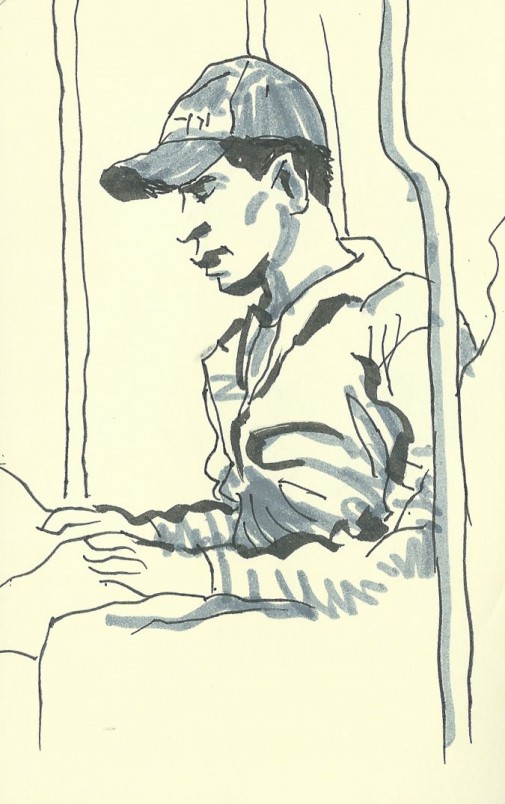
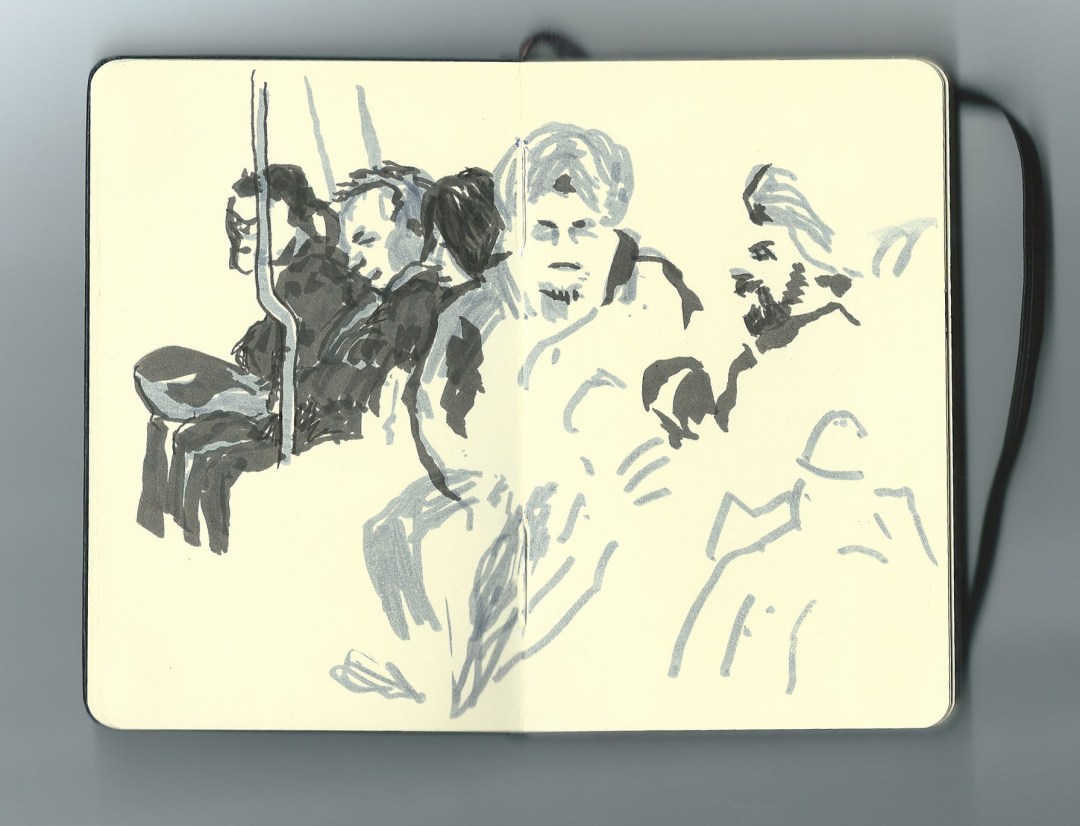
Tony Thorne’s illustrations, sketched while in London, travelling the iconic underground rail system will feature throughout the upcoming publication Islands and Cities, a collection of short stories by Tasmanian and London based writers. To celebrate this cross-cultural exchange, writers from the publication have each been assigned an illustration by Tony Thorne to respond to, for publication on our website. 

lines from the underground: writers respond to Tony Thorne’s illustrations

Tony_Thorne_Ian_Green_response_toby Ian Green

About the size of a packet of cigarettes, the cheap plastic of the Buddha machine fits snug in my palm. It is simple- a speaker, a volume wheel, a switch, a red LED, a headphone port. A few basic circuit boards sit encased in what was once pristine white. I turn the wheel of the Buddha machine to its full volume and a loop begins to play in my ears. I close my eyes. Thirty seconds of gentle tones expanding and contracting, and then it repeats. I could turn the switch and another loop would come, but I am lucky. My breathing synchronises effortlessly with the ebb and flow of this first loop. I open my eyes.

T_Thorne_cropped_Ian_Green_response_1It’s close enough to winter that the trees past the train windows are gilded with ragged leaves. People are wearing jackets, but not yet scarves or gloves. Everyone is too hot in this carriage. Past the noise of the Buddha machine, I can feel the train vibrate, I can almost hear voices. The loop is ambiguous- every noise that sidles past the headphones is incorporated until the train is breathing with me. Across the aisle men gesticulate and smile and talk. A girl is reading a book. A grey haired man looks pained as he casts his eyes around, oppressed by the weight of life pressed into the carriage. Beyond him in the gloaming I can see lights burning in office buildings.

We stop. We accelerate. We continue. We decelerate. We stop. We accelerate. We continue.

T_Thorne_Ian_Green_response_cropped_2It feels as if there is a larger pattern, as if the loop is changing, as if it draws out – there is not. The change is in the train and in the passengers. This loop is thirty seconds long. The man next to me is reading a free newspaper. I am tired.

We reach my station and I step out onto the platform and the train keeps going, and the loop repeats.

Tony Thorne’s illustrations, sketched while in London, travelling the iconic underground rail system will feature throughout the upcoming publication Islands and Cities, a collection of short stories by Tasmanian and London based writers. To celebrate this cross-cultural exchange, writers from the publication have each been assigned an illustration by Tony Thorne to respond to, for publication on our website. 

Peel Island

peel-island-while-we-were-filmingby Jamie Collinson

An island in London inspired me to write a book. Well, that and the idea of killing a flatmate I lived with for a while. Perhaps that came first. The killing, then the running away to an island.

The book ended up being set on another island, in a very different part of England. This other is real, too, although I’ve never seen it. I spent a huge amount of time on it though, on the page and in my head.

Other books are set there, too.


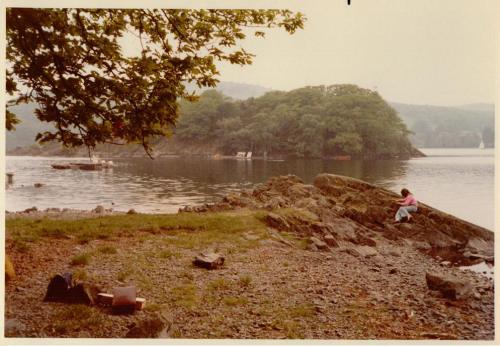
The island in London that inspired me is in Victoria Park. It’s the one reserved for wildlife that you see as you enter the park from the Old Ford Road side. Forget the re-sculpted one with the rude red pagoda that you can actually walk on. This was pre-clean up, when the park provided a physical manifestation of the mess inside my head.

On Sunday mornings, in the generic sort of life I once lived in East London, I would pause and regard that island. Hungover and often very guilty, I’d briefly entertain the fantasy of living on it. I’d take a tent, I imagined; wade out at night, live amongst the geese, ducks, herons and trees. I’d wonder how long I’d last.

Afterwards, I’d walk along the canal with a person I would disappoint in every way. I’d make promises to myself, and to that person, that I would fail to keep.

That place still features in my life. Whenever I come back to our ruddy little English island, I live within its orbit. It is different, and I am too.


My desire to kill that flatmate was converted into fiction. I poured all the rage out like hot bile and it cooled into a scene.

A while later, on a street not far from the island in Victoria Park, the man in question asked me what my book was about. I could tell he already knew.


The island that part of the book is set on is in Coniston Water in the Lake District. I think I was wrong to say I’ve never seen it; I must have, once, because I’ve driven past that lake. Can the memory of being a child, sitting in the back of a car and promising to buy it for my grandmother, possibly be real?

I can’t remember it though, not as it truly is. On maps and in pictures it is shaped like a comet, fading out into a rocky tail. Its trees sprout from it like a tuft of pubic hair.

Peel Island.

Wildcat Island, in the other books.

Donald Campbell died beside it. His last words were:

‘Straightening up now on track… I’m getting a lot of bloody row in here… I can’t see anything… I’ve got the bows up… I’m going… oh…’

I was listening to the radio one day, before I wrote the book. The presenter said that Peel Island’s pub had lost its landlord, and needed another one. It was an important tradition that there was a landlord in the pub, and that person was always known as the King of Peel.

Of course, there is no pub on Peel Island. For years I thought I must have imagined the story. Writing this, however, has revealed to me the existence of Piel Island.

Islands within islands within islands.


No one lives on Peel Island, Coniston Water. A character called John tried to for a while, but he didn’t last very long.


transportationbook.com submissions:

Please send us short fiction, between 500-800 words for consideration for the website to transportationalmanac@gmail.com

Bulbowen

Sunset Over Bulbowen - Artist: Fiona Lohrbaecher
Sunset Over Bulbowen – Artist: Fiona Lohrbaecher

by Fiona Lohrbaecher

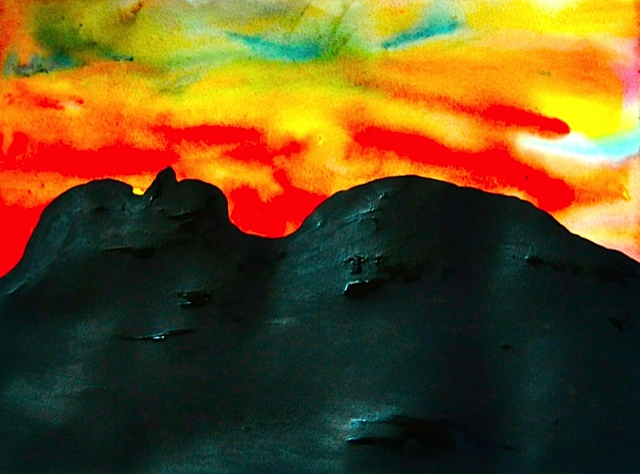
The giant Bulbowen was as high as the sky and as old as the hills.  For him years were as seconds, centuries as minutes, millenia as hours.  When he walked the earth shook and when it rained his footprints filled with water to make lakes.

One day, after years of walking, Bulbowen grew tired.  He had walked from one side of the earth to another and was weary.  He sat down, yawning and stretching.  He lay down on his back and closed his eyes.  The warm summer breeze caressed his eyelids and whispered lullabies in his ears, weaving a warm blanket of sleep around him.  For years Bulbowen slept.  For centuries he slumbered.  And as he slept the wind blew dust across him.  Year upon year, layer upon layer, the dust grew thicker and thicker, turning into soil. Birds dropped seeds on Bulbowen and, watered to life by the gentle rain, plants grew, spreading out their roots to hold the soil in place.

Millenia passed and, eventually, people came to the area.  They noticed the shape of the mountain; its outline resembling the silhouette of a sleeping giant.  They named the mountain Bulbowen, after the great giant of ancient legend.

The first people hunted on Bulbowen’s slopes, sleeping under trees or in bark shelters, moving on when the weather grew cold.  After many centuries they started building houses and farming in the flat land around the mountain.  A village grew up.  Children went to school.  People were born, grew old and died, all in Bulbowen’s shadow.  They took their recreation on the mountain, walking in its cool forests, skiing in winter and mountain climbing, although nobody ever climbed the highest peak, known as Bulbowen’s nose.  Legend promised disaster to anyone that tried.

Then, one day, the earth began to move.  The first tremors were small, barely discernible.  Windows rattled, crockery clattered, pebbles danced on the ground.  The quakes increased in intensity.  Buildings shook, trees bent and swayed in an eerie dance.  The people were frightened.  They ran out of their houses, workshops and schools.  The ground was moving violently beneath their feet now.  Boulders bounced down the side of the mountain and trees slid down in flurries of earth.  People grabbed their most treasured possessions and ran for their lives, across the plain, away from the mountain but still the rocks bounced around them and the tremors could be felt for miles.  They ran and did not stop running until they were sure they were quite, quite safe.

The mountain shook and heaved.  Every tree toppled and tobogganed down its slopes.  Great landslides were stripping the mountainsides bare.  Slowly, slowly the mountain changed shape.  It seemed to spread out for miles, then great tranches of land stretched up to the sky.  The top half of the mountain rose skywards as the giant Bulbowen rose to a sitting position, stretching and yawning.  He looked around him in mild surprise at the ruined houses, the fallen trees, that lay around him.  Then he rose to his feet, shook the last remnants of soil from his hair and beard and continued his walk.

When the people returned to rebuild their ruined houses they found a vast new lake where their mountain had been.  A new layer of fertile soil was spread across their farmland and hundreds of fallen trees lay scattered around to be used for the rebuilding.  So the people changed from skiing to water-skiing, and their recreation pursuits all centered on the lake.  They swam, fished, boated and wind-surfed in the vast body of water they called Bulbowen’s Bath.

transportationbook.com submissions:

Please send us short fiction, between 500-800 words for consideration for the website to transportationalmanac@gmail.com

Slight delays on all services

waterloo mg_0006by Ian Green

“Sfuloo?”

“Nah, Rose, listen- it’s Cthulhu. CUH-THOO-LOO, yeah?”

Rose frowned and kicked at a pebble with her battered hi-tops.

“And you reckon it’s him in the underground?”

They were down a side street south of Waterloo station, far from picturesque skylines. The surrounding warehouses loomed in the tarnished glare of sodium streetlamps.

“Not IN,” Keith said, smiling, “UNDER. A three hundred metre tall octopus-elephant-beast-god-monster. You saw the badges, yeah? Something’s down there, and I reckon these guys are keeping him asleep. ‘Cos if he comes up it’s like end of the world-Armageddon Ragnarok APOCALYPSE level stuff, right?”

Rose smiled. She had seen the badges. They had spent days riding the underground checking members of staff. Each wore a little pin on their chest, a single point the size of a button with eight lines curving out from it. Most were silver, some gold. Keith swore he saw a jet black one on a guy at Marble Arch, but Rose hadn’t seen that. Sat in Keith’s flat, it all seemed fun, like signalling saucers from Primrose Hill, or trying to sneak cameras on tours of masonic halls.

Keith stopped in front of an anonymous steel door and consulted a battered A to Z.

“This is it,” he said. Rose leaned over his shoulder and looked at the map.

“Jubilee, Circle, District, Victoria, Northern,” Rose incanted. They had spent hours poring over maps of ley lines drawn by pagans. When you overlaid the ancient lines of power and the underground map, well… Rose was the one who noticed the nexus; one point circumscribed by the Jubilee, Circle, District, Victoria, and Northern lines- the point just south of Waterloo.

“The deepest point of the London underground,” Keith had said, and they had grinned.

“What do you think is down there?” Rose asked. Keith’s eyes sparked.

“I’ve got my ideas. I need to check some sources. I’ll tell you when we go down…”

This was what they did for fun- Rose didn’t drink, not after seeing her dad drink. Keith wasn’t good with people. So they followed clues, they tramped across the city. It filled time, it was fun, and it hurt no-one. They had spent a month tracking the grave of the Hampstead vampire and had ended up lighting some candles and leaving garlic and crosses over their top suspect’s tombstone. They had spent weeks conspiring to steal the London Stone, before Keith decided it was too dangerous— if the Stone left London, the city would fall. This was the way it had been, for years now. Rose wanted was to be part of something bigger- Keith helped her.

The tube strike was a blessing. No trains to worry about, no people, no electrified lines. The door was unlocked, swinging open onto darkness at Keith’s touch. He grinned at Rose and held a finger to his lips and they began the descent.

Seventy feet down and two hundred feet south they heard the footsteps. Keith grabbed Rose and pulled her tight to the wall and they turned off their head torches.

Silence.

Footsteps.

“Transport police— stop right there!”

Suddenly there were torch beams crisscrossing their paths, blinding their eyes. Rose tripped on a railway sleeper and fell, her face and hands landing in rough gravel inches from a rail. Would that rail be electric? She didn’t know. She was breathing so hard she thought she might burst. She could hear Keith scuffling behind her. She stared at the rail until she was roughly picked up.

“What’re you up to?” asked one, whilst another leafed through Keith’s A to Z. He stopped on a page and showed it to a few of the others. They stared at Keith and Rose then, and their faces hardened.

The officers walked them further down the tunnel and refused to be drawn out by pleading or questions or apologies. Finally they came to an opening, an arched vault where a dozen lines crossed.

Keith saw it first, and began to scream, swearing, shouting, struggling. Between the tracks there was hole— darkness thicker than ink, an onyx maw. An absence of light— a presence of darkness. Not brick or stone or mud— something organic. Rose’s eyes widened and she looked around for salvation. She saw the pin on the lapel of the British transport police officer holding Keith— a solid black point with eight curved lines spreading from its centre. Rose stared at it and then locked eyes with the officer.

“What’s down there? Sfuloo?” she heard her voice ask. Keith had stopped screaming, had started crying. The officers forced them to the precipice. Rose couldn’t stop herself from looking- blackness and darkness and endless depth and something else far below.

Movement.

The man holding her gave her shoulder a squeeze.

“Sorry love,” he said. He pushed, and Rose tumbled into the black, toward something bigger.

You can read, Water Birds, by Ian Green in the upcoming publication from Transportation Press, Islands and Cities, for updates on the release subscribe to our newsletter.

Writers’ Bio:

Ian Green is a writer from Northern Scotland. His short fiction has been performed at Liars’ League London, LitCrawl London, the Literary Kitchen Festival, and published in OpenPen London magazine. His work can also be heard on The Wireless Reader literary podcast and will feature in the upcoming short story anthologies Broken Worlds by Almond Press. His story Audiophile was a winner of the BBC Opening Lines competition 2014 and was produced and broadcast by Radio 4.

Traffic Report

WALCH, J & SONS FIG. 5by Claire Jansen

Hey London – what did you get up to on the weekend?

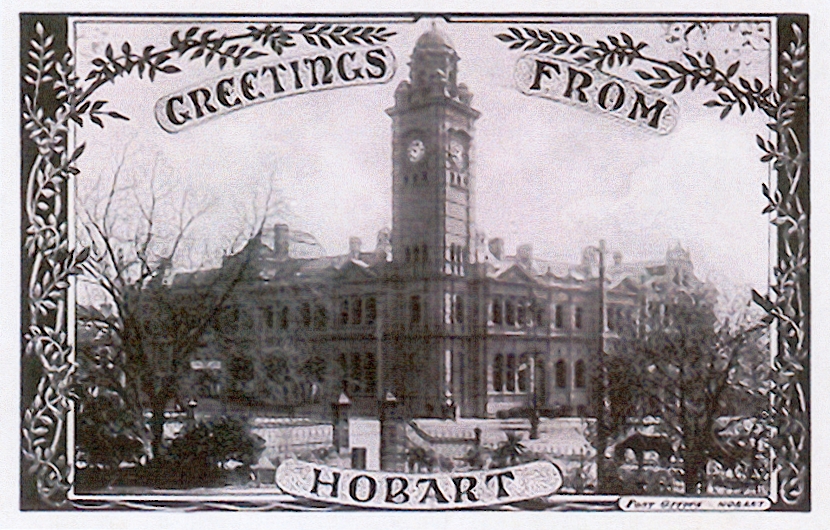
This weekend in Hobart, I went to an art exhibition and saw a video piece by Georgia Lucy who had hung a hundred corn chips from a backyard clothesline – a hills hoist. Each bright orange triangle was strung up with a plastic clothes peg and fishing line. They fluttered like a mobile. Georgia cranked the clothesline handle to move the hoist up and down and the chips floated and jerked towards bowls of salsa and guacamole set up on red bricks near a sprinkler that came on intermittently to water the grass.

On Saturday night, I went to a party at a giant share house with a smoke machine set up in a downstairs room full of blurry people dancing. At the party I met one of the housemates who is from England and back in Hobart for a second time. I asked him why he had come back, and he said there is something about Tassie. I don’t disagree and wonder if by the place he meant people too, and if the two factors don’t become pretty close to the same thing in choosing a place to live.

I’ve never lived in London but I’ve been there. Not with much money though. Your pound swallowed my dollars and I mostly ate fish n chips so I still had money for (warm?) beer.

When I was in London the Olympics were on and your TVs didn’t mention anything about the Australians winning medals, which I found more unsettling than I thought I would. I picked blackberries from the laneway behind a house in Chingford that looked like all the other row houses. I caught the Tube into the centre from Walthamstow station and the double decker night bus back to Charing Cross. At the Notting Hill Carnival I was crushed against a barrier as a truck with a hip hop band on the back passed over a bridge creating a bottleneck and had to literally unplug to calm everyone down. It scared me because of how many people there were and how frenzied everyone became when we started to panic. Every time I watched the news it seemed like another teenager had died in a gang related shooting.

I didn’t work in a bar or drink Fosters or live in a shoebox-sized flat with fifteen other Australians. But I probably would have enjoyed doing that if I had for a while at least. I flew home. The trip was over like the weekend.

Today I drove to work because I got out of bed late and ten minutes went by with the radio on so I could listen to the news, trying to reconcile what I feel like I should know versus what I can remember. I found myself hopelessly tuned into the national traffic report – a car and truck collided on the approach to Woolloomooloo outside of Sydney – road closures in Blacktown due to scheduled maintenance on Bundgarribee Road, West, between Balmoral Street and Craiglea Street.

In contrast Hobart has been fine, said the presenter, before he looked towards Adelaide, also nothing much to report, and out across the Nullarbor to Western Australia.

Against a collection of stories, I arrived. But as I start to plan my week I’ve been thinking, like all good escape artists do – what is it like to live in London? What is it about that place? And what do you get up to on the weekend?

You can read, Manhattan is an Island, by Claire Jansen in the upcoming publication from Transportation Press, Islands and Cities, for updates on the release subscribe to our newsletter.