Peel Island

peel-island-while-we-were-filmingby Jamie Collinson

An island in London inspired me to write a book. Well, that and the idea of killing a flatmate I lived with for a while. Perhaps that came first. The killing, then the running away to an island.

The book ended up being set on another island, in a very different part of England. This other is real, too, although I’ve never seen it. I spent a huge amount of time on it though, on the page and in my head.

Other books are set there, too.


The island in London that inspired me is in Victoria Park. It’s the one reserved for wildlife that you see as you enter the park from the Old Ford Road side. Forget the re-sculpted one with the rude red pagoda that you can actually walk on. This was pre-clean up, when the park provided a physical manifestation of the mess inside my head.

On Sunday mornings, in the generic sort of life I once lived in East London, I would pause and regard that island. Hungover and often very guilty, I’d briefly entertain the fantasy of living on it. I’d take a tent, I imagined; wade out at night, live amongst the geese, ducks, herons and trees. I’d wonder how long I’d last.

Afterwards, I’d walk along the canal with a person I would disappoint in every way. I’d make promises to myself, and to that person, that I would fail to keep.

That place still features in my life. Whenever I come back to our ruddy little English island, I live within its orbit. It is different, and I am too.


My desire to kill that flatmate was converted into fiction. I poured all the rage out like hot bile and it cooled into a scene.

A while later, on a street not far from the island in Victoria Park, the man in question asked me what my book was about. I could tell he already knew.


The island that part of the book is set on is in Coniston Water in the Lake District. I think I was wrong to say I’ve never seen it; I must have, once, because I’ve driven past that lake. Can the memory of being a child, sitting in the back of a car and promising to buy it for my grandmother, possibly be real?

I can’t remember it though, not as it truly is. On maps and in pictures it is shaped like a comet, fading out into a rocky tail. Its trees sprout from it like a tuft of pubic hair.

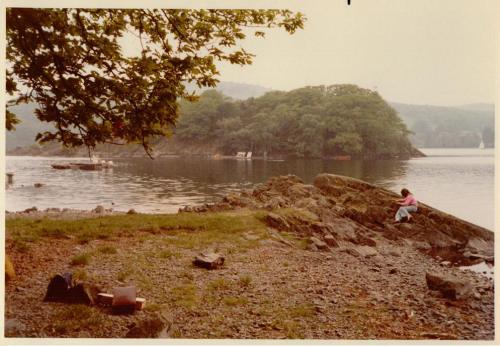
Peel Island.

Wildcat Island, in the other books.

Donald Campbell died beside it. His last words were:

‘Straightening up now on track… I’m getting a lot of bloody row in here… I can’t see anything… I’ve got the bows up… I’m going… oh…’

I was listening to the radio one day, before I wrote the book. The presenter said that Peel Island’s pub had lost its landlord, and needed another one. It was an important tradition that there was a landlord in the pub, and that person was always known as the King of Peel.

Of course, there is no pub on Peel Island. For years I thought I must have imagined the story. Writing this, however, has revealed to me the existence of Piel Island.

Islands within islands within islands.


No one lives on Peel Island, Coniston Water. A character called John tried to for a while, but he didn’t last very long.


transportationbook.com submissions:

Please send us short fiction, between 500-800 words for consideration for the website to transportationalmanac@gmail.com

Invisible Women

Invisible Women Croppedby Zane Pinner

Bearing dust from distant lands, the petitioners sit on Calvino’s cool slate floor or stroll about his bare prison yard. They tell him stories in many languages, languages mostly incomprehensible to them – languages known only to Calvino.

The faintest hint of temple incense from the gust of an envoy’s cape describes, to the great seer, the piety of some distant city where unclothed skin is frowned upon and the church bells ring in exacting unison on every turn of the hour. The sunburned eyelids of a new guard illustrate an island village where drunks sleep on the beach wrapped around their brown guitars, where wild boars are cooked over fires built from dried banana leaves. The guarded silences of a dark pilgrim recount, to the great artist, the oft-remembered blows of leather and metal endured in a bonded childhood and the sound of waves slapping against the side of an airless hull.

From this opaque, dense dialogue, Calvino feeds his gift – his vision – and does not go mad amongst the flat grey walls of his prison. But while he is grateful to his patrons for the emissaries they send, grateful for the pilgrims who simply want to meet him, it is not enough.

In sentencing Calvino to a lifetime of remote isolation, the Emperor’s instructions were simple and explicit: no female visitors.

Accordingly, it has been many years since the visionary has known company of the fairer sex. While his extraordinary imagination helped him stave off loneliness for many years, the memory of sweetness eventually turned stale. Now the great lover has almost forgotten the embrace of a woman. It sickens him to think that he might go to his unmarked grave without any memory of that sweetness.

His sentence was one of life. His sentence is almost spent. He turns his great vision to the afterlife – and finds himself alone. It is too much to bear. His throat raw, Calvino considers the insignificant noise of his spirit amongst the echoes of time – a minor note, an anguished quaver.

It is during such a moment that the Marquis first lays eyes on the venerated artist.

The ingenious foreigner spent many months searching for the desert routes that would lead him to the prison. A gypsy charmed with luck and wit, the Marquis has travelled hard to come and bid for the great artist’s lucrative affection. Now that he stands in this legendary cell, a situation that so many throughout the world might dream themselves in, he would have Calvino’s attention.

The Marquis perceives, at a glance, the cause of the great artist’s pain. For the singular purpose of distracting of the revered seer from his brooding, the Marquis begins to describe women encountered on his most recent journey.

In a universal language of sighs and winks, yawns and ovation, the emissary summons the women one by one to Calvino’s hankering imagination.

The effervescent change that overtakes the Marquis’s manner as he describes each woman, the degree of lust in his eye and vigor in his hands, tells the great artist more than his lilting tongue alone ever could. Through gestures both subtle and ostensive, through the dancing motion of his shoulders and the delicate rolls of his tongue, the Marquis conjures spirits for Calvino to apprehend.

***

Sophronia uses skin as a costume and joins the parade. With all eyes on her, she twists unselfconsciously and gasps for air, her costume livid. Blood barrels through languid veins, sweat beads down the arc of her spine and she pulls the hair out of her face, eyes flashing, gasping the sulfuric fire of a she-devil.

***

Penthesilia watches the traffic from between iron bars. White-knuckled fists grip the wooden arms of her chair while she counts the pieces of dust on her tongue.

There is water in this old woman’s dreams. She can swim further than a scream can carry, swim until the coldness is above her head, filling her lungs, filling her eyes. She is overjoyed at the dark water drifting past her ankles. Her frozen knuckles are whiter than the belly-up fish that slowly float by.

***

Despira displays one face to the newcomer and a different one to he that is leaving.

The newcomer sees stability, a smile that welcomes his fingers, warmth that smells of fire-baked custards and cooing infants, sturdy shoulders and hips ready to care for boy and man alike.

He that is leaving sees in her entropy, knuckles splayed over red knees, burnt iron brandished in cotton gloves, a gentle storm in an iron cup.

Despira straddles borders and is made of glass.

Bulbowen

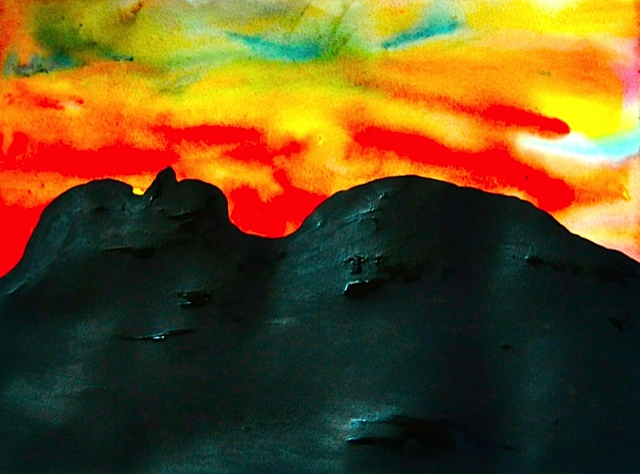
Sunset Over Bulbowen - Artist: Fiona Lohrbaecher
Sunset Over Bulbowen – Artist: Fiona Lohrbaecher

by Fiona Lohrbaecher

The giant Bulbowen was as high as the sky and as old as the hills.  For him years were as seconds, centuries as minutes, millenia as hours.  When he walked the earth shook and when it rained his footprints filled with water to make lakes.

One day, after years of walking, Bulbowen grew tired.  He had walked from one side of the earth to another and was weary.  He sat down, yawning and stretching.  He lay down on his back and closed his eyes.  The warm summer breeze caressed his eyelids and whispered lullabies in his ears, weaving a warm blanket of sleep around him.  For years Bulbowen slept.  For centuries he slumbered.  And as he slept the wind blew dust across him.  Year upon year, layer upon layer, the dust grew thicker and thicker, turning into soil. Birds dropped seeds on Bulbowen and, watered to life by the gentle rain, plants grew, spreading out their roots to hold the soil in place.

Millenia passed and, eventually, people came to the area.  They noticed the shape of the mountain; its outline resembling the silhouette of a sleeping giant.  They named the mountain Bulbowen, after the great giant of ancient legend.

The first people hunted on Bulbowen’s slopes, sleeping under trees or in bark shelters, moving on when the weather grew cold.  After many centuries they started building houses and farming in the flat land around the mountain.  A village grew up.  Children went to school.  People were born, grew old and died, all in Bulbowen’s shadow.  They took their recreation on the mountain, walking in its cool forests, skiing in winter and mountain climbing, although nobody ever climbed the highest peak, known as Bulbowen’s nose.  Legend promised disaster to anyone that tried.

Then, one day, the earth began to move.  The first tremors were small, barely discernible.  Windows rattled, crockery clattered, pebbles danced on the ground.  The quakes increased in intensity.  Buildings shook, trees bent and swayed in an eerie dance.  The people were frightened.  They ran out of their houses, workshops and schools.  The ground was moving violently beneath their feet now.  Boulders bounced down the side of the mountain and trees slid down in flurries of earth.  People grabbed their most treasured possessions and ran for their lives, across the plain, away from the mountain but still the rocks bounced around them and the tremors could be felt for miles.  They ran and did not stop running until they were sure they were quite, quite safe.

The mountain shook and heaved.  Every tree toppled and tobogganed down its slopes.  Great landslides were stripping the mountainsides bare.  Slowly, slowly the mountain changed shape.  It seemed to spread out for miles, then great tranches of land stretched up to the sky.  The top half of the mountain rose skywards as the giant Bulbowen rose to a sitting position, stretching and yawning.  He looked around him in mild surprise at the ruined houses, the fallen trees, that lay around him.  Then he rose to his feet, shook the last remnants of soil from his hair and beard and continued his walk.

When the people returned to rebuild their ruined houses they found a vast new lake where their mountain had been.  A new layer of fertile soil was spread across their farmland and hundreds of fallen trees lay scattered around to be used for the rebuilding.  So the people changed from skiing to water-skiing, and their recreation pursuits all centered on the lake.  They swam, fished, boated and wind-surfed in the vast body of water they called Bulbowen’s Bath.

transportationbook.com submissions:

Please send us short fiction, between 500-800 words for consideration for the website to transportationalmanac@gmail.com
Slight delays on all services

waterloo mg_0006by Ian Green

“Sfuloo?”

“Nah, Rose, listen- it’s Cthulhu. CUH-THOO-LOO, yeah?”

Rose frowned and kicked at a pebble with her battered hi-tops.

“And you reckon it’s him in the underground?”

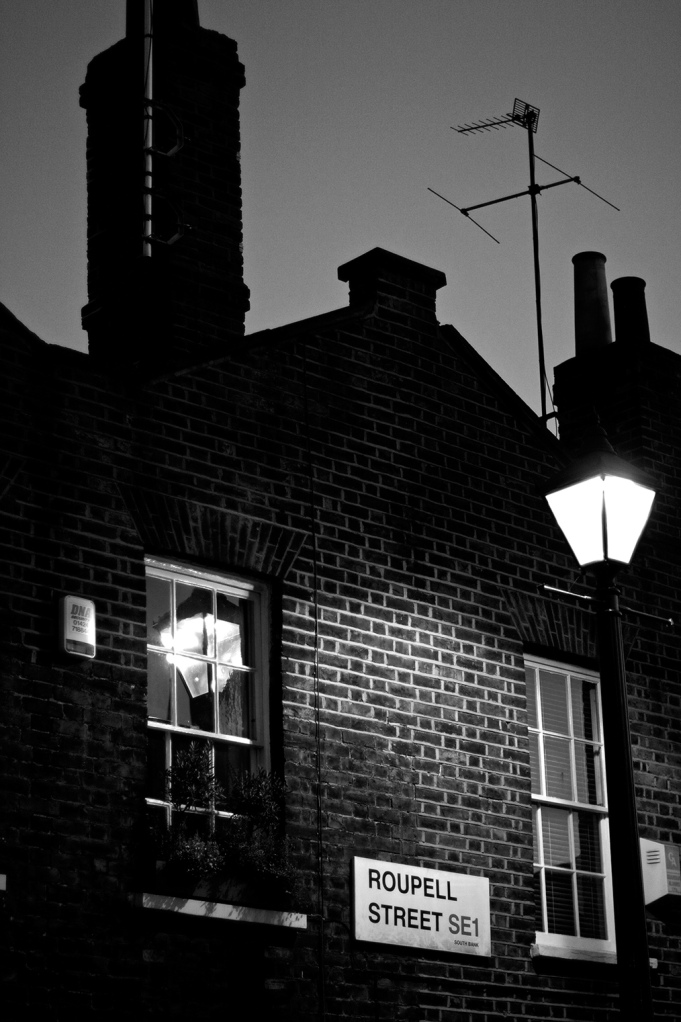
They were down a side street south of Waterloo station, far from picturesque skylines. The surrounding warehouses loomed in the tarnished glare of sodium streetlamps.

“Not IN,” Keith said, smiling, “UNDER. A three hundred metre tall octopus-elephant-beast-god-monster. You saw the badges, yeah? Something’s down there, and I reckon these guys are keeping him asleep. ‘Cos if he comes up it’s like end of the world-Armageddon Ragnarok APOCALYPSE level stuff, right?”

Rose smiled. She had seen the badges. They had spent days riding the underground checking members of staff. Each wore a little pin on their chest, a single point the size of a button with eight lines curving out from it. Most were silver, some gold. Keith swore he saw a jet black one on a guy at Marble Arch, but Rose hadn’t seen that. Sat in Keith’s flat, it all seemed fun, like signalling saucers from Primrose Hill, or trying to sneak cameras on tours of masonic halls.

Keith stopped in front of an anonymous steel door and consulted a battered A to Z.

“This is it,” he said. Rose leaned over his shoulder and looked at the map.

“Jubilee, Circle, District, Victoria, Northern,” Rose incanted. They had spent hours poring over maps of ley lines drawn by pagans. When you overlaid the ancient lines of power and the underground map, well… Rose was the one who noticed the nexus; one point circumscribed by the Jubilee, Circle, District, Victoria, and Northern lines- the point just south of Waterloo.

“The deepest point of the London underground,” Keith had said, and they had grinned.

“What do you think is down there?” Rose asked. Keith’s eyes sparked.

“I’ve got my ideas. I need to check some sources. I’ll tell you when we go down…”

This was what they did for fun- Rose didn’t drink, not after seeing her dad drink. Keith wasn’t good with people. So they followed clues, they tramped across the city. It filled time, it was fun, and it hurt no-one. They had spent a month tracking the grave of the Hampstead vampire and had ended up lighting some candles and leaving garlic and crosses over their top suspect’s tombstone. They had spent weeks conspiring to steal the London Stone, before Keith decided it was too dangerous— if the Stone left London, the city would fall. This was the way it had been, for years now. Rose wanted was to be part of something bigger- Keith helped her.

The tube strike was a blessing. No trains to worry about, no people, no electrified lines. The door was unlocked, swinging open onto darkness at Keith’s touch. He grinned at Rose and held a finger to his lips and they began the descent.

Seventy feet down and two hundred feet south they heard the footsteps. Keith grabbed Rose and pulled her tight to the wall and they turned off their head torches.

Silence.

Footsteps.

“Transport police— stop right there!”

Suddenly there were torch beams crisscrossing their paths, blinding their eyes. Rose tripped on a railway sleeper and fell, her face and hands landing in rough gravel inches from a rail. Would that rail be electric? She didn’t know. She was breathing so hard she thought she might burst. She could hear Keith scuffling behind her. She stared at the rail until she was roughly picked up.

“What’re you up to?” asked one, whilst another leafed through Keith’s A to Z. He stopped on a page and showed it to a few of the others. They stared at Keith and Rose then, and their faces hardened.

The officers walked them further down the tunnel and refused to be drawn out by pleading or questions or apologies. Finally they came to an opening, an arched vault where a dozen lines crossed.

Keith saw it first, and began to scream, swearing, shouting, struggling. Between the tracks there was hole— darkness thicker than ink, an onyx maw. An absence of light— a presence of darkness. Not brick or stone or mud— something organic. Rose’s eyes widened and she looked around for salvation. She saw the pin on the lapel of the British transport police officer holding Keith— a solid black point with eight curved lines spreading from its centre. Rose stared at it and then locked eyes with the officer.

“What’s down there? Sfuloo?” she heard her voice ask. Keith had stopped screaming, had started crying. The officers forced them to the precipice. Rose couldn’t stop herself from looking- blackness and darkness and endless depth and something else far below.

Movement.

The man holding her gave her shoulder a squeeze.

“Sorry love,” he said. He pushed, and Rose tumbled into the black, toward something bigger.

You can read, Water Birds, by Ian Green in the upcoming publication from Transportation Press, Islands and Cities, for updates on the release subscribe to our newsletter.

Writers’ Bio:

Ian Green is a writer from Northern Scotland. His short fiction has been performed at Liars’ League London, LitCrawl London, the Literary Kitchen Festival, and published in OpenPen London magazine. His work can also be heard on The Wireless Reader literary podcast and will feature in the upcoming short story anthologies Broken Worlds by Almond Press. His story Audiophile was a winner of the BBC Opening Lines competition 2014 and was produced and broadcast by Radio 4.

Traffic Report

WALCH, J & SONS FIG. 5by Claire Jansen

Hey London – what did you get up to on the weekend?

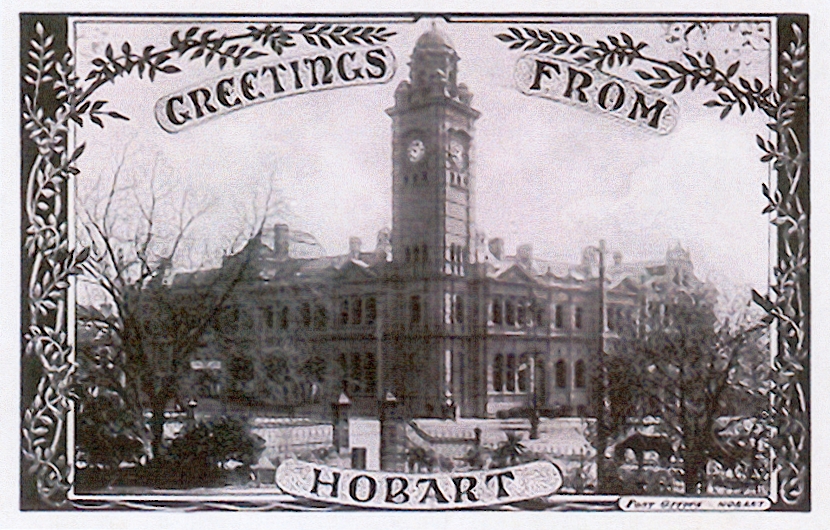
This weekend in Hobart, I went to an art exhibition and saw a video piece by Georgia Lucy who had hung a hundred corn chips from a backyard clothesline – a hills hoist. Each bright orange triangle was strung up with a plastic clothes peg and fishing line. They fluttered like a mobile. Georgia cranked the clothesline handle to move the hoist up and down and the chips floated and jerked towards bowls of salsa and guacamole set up on red bricks near a sprinkler that came on intermittently to water the grass.

On Saturday night, I went to a party at a giant share house with a smoke machine set up in a downstairs room full of blurry people dancing. At the party I met one of the housemates who is from England and back in Hobart for a second time. I asked him why he had come back, and he said there is something about Tassie. I don’t disagree and wonder if by the place he meant people too, and if the two factors don’t become pretty close to the same thing in choosing a place to live.

I’ve never lived in London but I’ve been there. Not with much money though. Your pound swallowed my dollars and I mostly ate fish n chips so I still had money for (warm?) beer.

When I was in London the Olympics were on and your TVs didn’t mention anything about the Australians winning medals, which I found more unsettling than I thought I would. I picked blackberries from the laneway behind a house in Chingford that looked like all the other row houses. I caught the Tube into the centre from Walthamstow station and the double decker night bus back to Charing Cross. At the Notting Hill Carnival I was crushed against a barrier as a truck with a hip hop band on the back passed over a bridge creating a bottleneck and had to literally unplug to calm everyone down. It scared me because of how many people there were and how frenzied everyone became when we started to panic. Every time I watched the news it seemed like another teenager had died in a gang related shooting.

I didn’t work in a bar or drink Fosters or live in a shoebox-sized flat with fifteen other Australians. But I probably would have enjoyed doing that if I had for a while at least. I flew home. The trip was over like the weekend.

Today I drove to work because I got out of bed late and ten minutes went by with the radio on so I could listen to the news, trying to reconcile what I feel like I should know versus what I can remember. I found myself hopelessly tuned into the national traffic report – a car and truck collided on the approach to Woolloomooloo outside of Sydney – road closures in Blacktown due to scheduled maintenance on Bundgarribee Road, West, between Balmoral Street and Craiglea Street.

In contrast Hobart has been fine, said the presenter, before he looked towards Adelaide, also nothing much to report, and out across the Nullarbor to Western Australia.

Against a collection of stories, I arrived. But as I start to plan my week I’ve been thinking, like all good escape artists do – what is it like to live in London? What is it about that place? And what do you get up to on the weekend?

You can read, Manhattan is an Island, by Claire Jansen in the upcoming publication from Transportation Press, Islands and Cities, for updates on the release subscribe to our newsletter.

Litzilla vs The World

Litzillaby Darren Lee

For some time now I have been incubating a monster in a quiet corner of my house.

It started off as an innocent enterprise, the result of over-eagerness during free time spent nonchalantly wandering around bookshops; I caved in at the distraction of the many colourful spines compressed on the shelves, the tables of promotions and carefully curated selections from the bibliophile bucket list. I bought the books and took them home intending to wallow in the wisdom of their pages, but instead there were other things to which I diverted my attention. And so, these stories that I had hoped to enjoy sat ignored in the corner, patiently waiting for the day in which they would feel my fingers tickling their pages and see my eyes dart back and forth across their text.

This was never intended to be a permanent arrangement, but over the years this nameless corner grew until it became time for it to be christened as “the To Read pile”. But that name seems no longer appropriate; something has began too fester in the pile, a dark malevolence spreading its tendrils throughout the room. The pile has propagated and mushroomed into a pulsating monster, a beast born from my addiction to books, a foaming monster I have ignored to far too long. The To Read Pile is dead, long live LITZILLA!

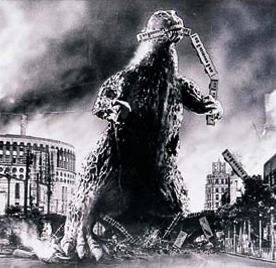
Litzilla is a creature made of many parts: Its legs are sturdy, and made of the thickest tomes from the Three-For-The-Price-Of-Two era. It clomps around supported by these pages, novels that were intended to be read, but have been mostly ignored since they were the unloved stepchildren of the originally purchased trio.

Litzilla’s girthy waistline is comprised of charity shop finds; as if the frivolous purchase of a book was justified by its philanthropic intent. This part of Litzilla is mostly made up of seventies Penguins, and their distinctive spines make it look like the abominable creature is sporting a distinctive orange jockstrap.

Litzilla’s torso is made up of those important books that I’ve genuinely always meant to read, but have found physically inaccessible; removing one from the pile will cause the entire structure to teeter over, burying me under a Jenga tower of unread text.

Litzilla’s head is a bulky, Easter Island type-affair made from hardbacks grabbed in the January sales. At first I was eager to leaf through these, but now they’re bulky and cumbersome in comparison to their paperback compatriots.

The crowing of the beast is a single cyclopic eye made from Richard Flanagan’s Booker winner, purchased automatically following the award. It is the capstone holding Litzilla together, staring at me with its beady gaze. Even though it’s only been there for a few weeks, it stares at me, hurt with neglect and demanding to be read next..

Efforts to constrain Litzilla have met with failure; I’ve tried pruning its limbs by slowly reading those books that I have so cruelly ignored. Litzilla has also been cropped, cuttings have been made and sent to the second-hand shop, where they will no doubt take root in someone else’s library. In one drastic move to arrest the growth of this bibliogical behemoth I banned myself from adding to it’s weight for several months, thereafter the siren call of literary shopping lured me back in. I have tried to cage Litzilla on a sturdy shelf, but now its bars are buckling and the monster is breaking free to leave its deposits around the house; all of them guilty piles admonishing my shortcomings as a reader.

The monster has become sentient. I fear its retribution. One day it will swallow me whole and trudge slowly from my house, looking for similar To Read Piles with which to merge. This giant book monster will run rampant, devouring streets, neighbourhoods and cities. No one will be safe! Run for your lives Litzilla has been awakened!

And yet still, I realise that I’ve not bought the new Ian McEwan yet, and well, it is on special offer at the moment. I would be foolish not to…

You can read, The Assembled Self, by Darren Lee in the upcoming publication from Transportation Press, Islands and Cities, for updates on the release subscribe to our newsletter.

The Hateful Sea

The Hateful seaby Tadhg Muller

LEAVING MY HOTEL room I tread into early morning, out onto a street of shadows and darkness. It is hell to distinguish one thing from another, there are tangible objects like dull weights that lend the earth some concrete meaning: bricks, walls, streetlights, gutters, bins overflowing with shit, and waste, and refuse. But something else captures my dull morning consciousness, the sponge like sensation of cardboard moving beneath my feet, moving like tectonic plates, moving on the stone shifting the reality I am in, and leaving in its wake minor eruptions and minor marks of ruin. There are countless boxes broken and laid out under arches, inside doorways, beneath the rotting awnings of this tired Mediterranean dump. Grim shelters that call to mind a thousand lamentations: failed pasts, lost dreams, broken promises, and mostly misery, mostly the misery and inequality of this age we are in. Mega wealth, competition and success; poverty, defeat and failure.I’m on route to a funeral – on an island that I must take a ferry too. I hate the sea. I hate the sea twice over. I’ll walk the 10 kilometres down to the port, the prospect of old companions and water lend themselves to a long fruitless walk, and the constant reminder of my hate for the sea. There are only two ferries this week (even though it is high season), and on this route I anticipate a ferry packed full of old acquaintances. The face of my past, faces that once belonged to friends. I’ll know once and for all how much I hated them, each and every last one, and I’ll see my own hate reflected back at me. And we will reflect on how we have grown old, and fat, and bald, and ugly… mostly ugly and mean with age.

I begin my walk amongst long forgotten and decrepit buildings, on a side street that will metamorphose into an urban highway, a highway that runs to the port and along which I will chart my journey. A tired road, cracked and damaged like a skeleton, its walls stencilled with empty slogans. There is a madness to this world.

The footpath becomes narrower its surface broken. There are groups of scroungers by the side of the road. I’ll make my way down an adjoining street: find some peace and quiet and compose myself. I turn on my I-Phone and go to Google Map. I have been walking for some time and the water I have is empty. There is a hint of salt on the breeze. I turn a corner and discover I am back on that main road. Aren’t we always pressured and pulled towards the centre. Isn’t that life all over. One moment we make the call and we head out in our own direction only to be pulled back, driven towards the centre. It is hard to pull away, it is hard to chart your own course.Now I am descending further and further into the freeway apocalypse, the pit and the concrete labyrinth that surrounds the modern city. Its poison, and gas, and rage, and fury – somewhere beyond this is the water. Rising on elevated concrete pillars the road narrows like a funnel, higher, faster, madder, more unforgiving. Along the edge, the footpath is vanishing into overgrown vine: I have entered the hinterland. All the while the traffic becomes madder and madder. Cars hurtle closer and closer. Drivers thump horns and gesture frantically towards me as if I have intruded on a very intimate moment – finally the footpath is gone altogether. And the cars come closer, and the drivers’ faces feel as if they are pressed against my own. Mostly they look dead, angry, sad and desperate. It is hard to understand what this is all for. I turn back and very carefully follow the map on my I-Phone, and I go a long way down until I can exit back onto the main road… this time intent on taking the right turn… No! I realise I have made the same mistake, and the whole world is hurtling towards me once more, and I am hot and tired and there is no respite.

I start to visualise the players and pieces that filled my past down at the port in a long sensible line. My brothers and sisters, a school teacher, a friend now a lawyer, a doctor, a member of parliament, a teacher, a kid from down the rd, a girl I convinced myself I loved, an old man from the bottom of my street. I have taken the wrong path once more, made the same mistake again and again, looked back and retraced the footsteps of this life and lost my way having always angled away from the centre. I turn back carefully and retrace my footsteps, mindful not to look at my reflection, mindful not to tread upon my shadow.

And I find it, I find the way.

And I am standing at the port with one thousand ferries, the crowds, the ticket officers, the docks, the point of arrival and departure, revellers… And the journey has taken half the day.

The faces that strike me, they belong to strangers. All those people were never too bad (that inhabited the past). Fool that I was to consider that their journeys were any straighter than my own, any more orderly, any more predictable. I’ll mark the death of this friend on his island alone. I make my way to the waters edge, the water is still and calm, the hateful sea it is empty.

You can read, The Reprieve, by Tadhg Muller in the upcoming publication from Transportation Press, Islands and Cities, for updates on the release subscribe to our newsletter.

Not Writing a Novel

Photograph: Oliver Mestitz

by Oliver Mestitz

A couple of years ago I told everyone I was writing a novel. I’d finished a Bachelor of Arts, majoring in Creative Writing, which included a class called Novels. I’d written a first and last chapter and planned what would happen in between. I was unemployed and playing in a band and had a job lined up overseas that I had to wait a couple of months for. I spent most of the time browsing the University careers website, looking for participant surveys and PhD experiments that paid ten dollars for an hour’s work. I’d even thought of a title. My novel was called Whalefish.

The only person who knew I was lying was a girl I had a crush on, which in my mind made it seem like an illicit, personal truth that would inevitably bring us together (it didn’t). I met her parents – genuine, non-judgemental people – and when they asked me what I did I told them I was writing a novel. I looked at her after I said it, all knees under the table, as if to say: See?

Most people left me alone. Few seemed to care. Not one person I told about my novel got as far as asking me what the title was or what it was about, let alone how far through I was or if they could maybe read some of it. The exception was my grandfather, famous among his family and friends for his love of literature. He told me once that so many people recommend books for him to read that he’s had to develop the 50 page test – after that it’s pass or fail. Like Joaquin Phoenix in Gladiator, his thumb wavering. He has his own library, which has a ladder in it.

Every now and then my grandfather would send me letters on a slip of letter-writing pad: How’s the novel? Each letter was headed with a sticky label with his name and return address printed in a small but legible font. I would send him long, indefinite answers or else recommend more books for him to read as a distraction. Once I tried to change tack, to lower his expectations: It’s actually more of a short story cycle than a novel. But he didn’t take the hint or else chose to ignore it, asking after the novel whenever he saw me with a persistence that was tragic and flattering.

Eventually I went overseas and came back fourteen months later armed with a new, if temporary, answer to the inevitable question: So What Do You Do? The next time I saw my grandfather I promised to send him a copy of my first EP, which I’d recorded in my bedroom using someone else’s microphone and an 8-track cassette machine. I wrapped a CD in tissue paper and put it in the mail. My grandfather wrote back saying that he could get to like it if only he could hear the words.

You can read, How to Pick Up an Echidna, by Oliver Mestitz in the upcoming publication from Transportation Press, Islands and Cities, for updates on the release subscribe to our newsletter.

Richard Flanagan and the Global Literary Map

flanagan world map

Ben Walter reflects on Richard Flanagan’s Man Booker prize win and whether this accolade will have a ripple affect on Tasmanian literary shores.

Here is what I knew about Tasmanian literature in the mid-90s. I knew that there was a literary magazine, Island, which my mother and step-father occasionally bought; these sat around the shelves – old, large-format Cassandra Pybus issues with writers’ faces and their leather jackets posing from the covers.

I remember reading what remains my favourite Tasmanian short story, The Sarsparilla Heights Writers’ Group Biennial Short Story Competition: Reading the Honourable Mention, by Pete Hay, and also a poem by Tara Kurrajong, who I later met very briefly through outdoor education circles at Rosny College. While walking up the side of Lake St. Clair, I remember her being surprised when I mentioned that I’d liked her piece. On the Austlit database, I notice that both these works were in the same issue, number 70, published in Autumn 1997. For me, this must have been a tipping point of sorts.

I remember that in the previous year, or perhaps the one before it, I’d chosen to do a study on Richard Flanagan for a high school English class. There wasn’t a lot to study at that time. Death of a River Guide had been published, and Richard was kind enough to do a short phone interview where I offered unwieldy questions and hopelessly tried to record his responses with a rubbish tape recorder placed against the old-fashioned dial-up phone downstairs.

I remember the invitation to the launch of Death of a River Guide sitting on my mother’s fridge in 1994.

There has been a lot of talk about how Richard Flanagan’s Man Booker prize win will raise the profile of Tasmanian writing internationally. Senator Christine Milne, quoted in The Sydney Morning Herald, stated that “Richard…has now put us firmly on the global literary map.[1]

It’s been an oft-repeated sentiment, as though there actually was a global literary map.

And it might be a little bit true. But I believe it is looking at the matter in a wrong-headed, brand-centric way. Certainly, the win puts Flanagan’s writing on the world stage – deservedly – but most readers are content with a representative exotic from any particular region. They follow writers, not regions. Perhaps you’ve read and loved Gabriel Garcia Marquez. Are there other Columbian novelists you’ve hunted down as a consequence of reading him?

As Tasmanians, we can be so obsessed with how others see us that we don’t take the time to reflect on how something like this might influence the way we see ourselves – one of the many reasons we might require a greater appreciation of our writers.

Perhaps the true significance of Flanagan’s win is how it can continue to make literature a reality, a live issue and a real option for young Tasmanian writers – just as it did for me twenty years ago – as well as the spectrum of Tasmanian readers. It puts literature on the front page.

Responding to 936 ABC Hobart’s question on Facebook in the wake of the win, “Who is your favourite Tasmanian author?”, one poster responded “I didnt realise we had more than one author” [sic]. Not everyone has issues of Island Magazine sitting around the house – almost nobody does. The Tasmanian literary community is fragmented and barely functional, connecting with a tiny fraction of the population.

But there will be a lot of copies of The Narrow Road to the Deep North resting on proud shelves. And it is much more important to celebrate what these novels will do for the ideas and aspirations of our developing writers, our thinkers, our historians and journalists and our scientists, than what a champagne flute on the other side of the world thinks of our distant and remote island.

[1] http://www.smh.com.au/entertainment/books/booker-winner-richard-flanagan-flogs-opinions-as-well-as-books-20141016-117awb.html

You can read, Fall on Us, by Ben Walter in the upcoming publication from Transportation Press, Islands and Cities. For updates on the release subscribe to our newsletter.

Shelter

Susie greenhill october 2014

by Susie Greenhill

They found places to keep things, islands, that’s how it started. Atolls for cartons of egg-shells, for foreign postcards stacked in boxes. Archipelagos cluttered with shipping-crates of photographs, moss-terrariums, insects adrift in methyl-alcohol, vials of nectar, jars of ochre-coloured soil. Islets devoted to feathers, to gem-stones they’d found while still clinging to the mainland coast, still sifting through the deserts. Uncut sapphires glinting in torch light, kicked over on the goldfields – carried now in buckets with amber, quartz, granite flecked with mica – coated with dust from dilapidated shacks, busted cities, from the gully where their tumbling down home had once stood, leaning into the westerlies, into winds that brought ice then razed forests, bared the green of the plain.

They had an atoll for seeds, un-germinated seeds which they’d stored for posterity, a vestige of hope. They ferried them to that island in flotillas of walnut shell boats, while the ocean was still as a stone. She remembers that day as the last when they knew they could still return to their home.

They built shelters: a tower of spiralling shell, bunkers lined with coral, they slept on pandanus. When night fell they paced out the shores of their islands, the silt coves, they followed the rhythms, the turnings of the phosphorescent tide, they spoke about the sky, about the lights they saw sometimes in the distance, the fishing hulks, the ferries carrying children, rising, falling on the horizon to the north.

‘What will we do if they come here?’

‘Why would anyone come?’

‘If they’re lost?’

‘These islands are too small, they’re too low. They will see that.’

‘But those boats, they’re not safe.’

‘If they come here we will go.’

And things did come: discarded things, a child in a basket of reeds, up-turned rafts, leather boots, things that sting. They fended them off, they waded into the shallows and veered them off-shore with poles whittled from palms, with nets woven of shoe-laces, frayed ends of string. They were grateful for the fins, for the singing.

The winds came. They swept over the islands like a flood. Pieces of damp paper, torn letters shivering in leaves, in the branches, filled the air above their islands like locusts, cicadas falling from the spinning of the sky – catching in her hair, covering the floor of his boat. In the tower she pieced them together, words about love, about things they had lost.

‘Will nothing grow now?’

‘I don’t know. Some things will.’

She placed her hand on the warmth of her belly, she remembered the swelling, the kicking of feet, tiny elbows sculpting tents out of skin. She thought of the child in the basket.

‘He could have stayed. There is room.’

‘It’s too late.’

You can read Unravelling, by Susie Greenhill, in the upcoming publication through Transportation Press, Islands and Cities. To stay updated on release date, subscribe to our newsletter.