
Tasmania, a Lovesong: Part II

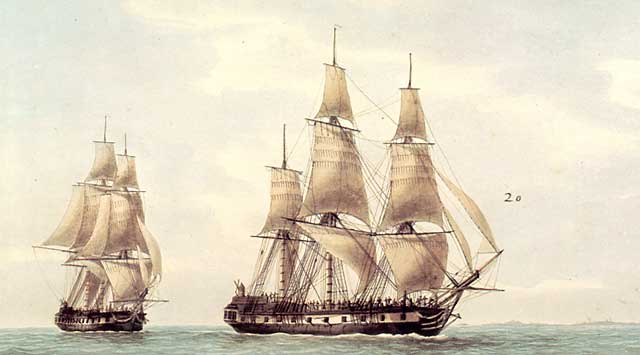
French ships Recherche, and Esperance, from the d'Entrecasteaux expedition, reaching Tasmania, c. 1792-1793
French ships Recherche, and Esperance, from the d’Entrecasteaux expedition, reaching Tasmania, c. 1792-1793

In September, we share four installments of this short story Tasmania, a Lovesong, by Australian author John Bryson, which journeys us along the eastern waters of Tasmania.

BEAUTY AND ABUNDANCE and solitude are wonders, sure, but most of us live in the cities, either born there or we joined to drift to deny some definition we had then of poverty. My genes come from out of town although I’m a city boy, and judging by the sort of people we happen on in Tasmania, anyway in the eastern half and may be all over, a lot of genes come from outside city walls, and some redefinition of poverty is taking place.

I have in mind surprises like a wayside kiosk in the Derwent Valley, now the shopfront for a local potter, one-time Englishman who fled famed Wedgewood, although he was its chief artisan, and now turns far finer things at the opposite end of the world. This is no surprise to Tasmanians, who are well accustomed to peerless hand-worked furniture and, for another example, to every day recitals from woodwind musicians who have traded the forests of Sibelius and Greig for Ferntree and Lune River.

And I have in mind happenings like watching a long married couple fish shingle pools on the Huon with deep longtail flies, in lovers’ springtime, when garlands of upstream blossom float the eddies and new salmon run beneath. While the action was slow this husband spoke his Romeo lines, with cumulus breath for it was fiercely cold, and his wife answered as Juliet lighting the East, then scene on scene, and all without fault or stammer, because both are Elizabethan scholars, he a professor of English literature, once of Glasgow but now of hereabouts, and she his captivating actress.

Here is something signal about the way folk live in these parts. Around here the intellectual world and the physical are amiable kin, they voyage together, a phenomenon I’ve not seen so strongly anywhere.

About the Author:

In 1985, the book Evil Angels by Australian author John Bryson was released. Its revelatory investigation into the disappearance of Azaria Chamberlain shed new light on the controversial case and quickly became a career defining piece of work for Bryson. Other publications include the novel, To the Death, Amic (Viking/Penguin 1994) a collection of short fiction, Whoring Around (Penguin 1981) and a collection of reportage Backstage at the Revolution. Bryson lectures in law, literary journalism, and fiction, acts on advisory panels to government, NGOs, and universities, and on literary judging panels. At the end of the millennium, a Schools of Journalism panel included him in ‘The 100 Australian Journalists of the Century’. In 2014, he was awarded membership of the Order of Australia.
Tasmania, a Lovesong: Part I

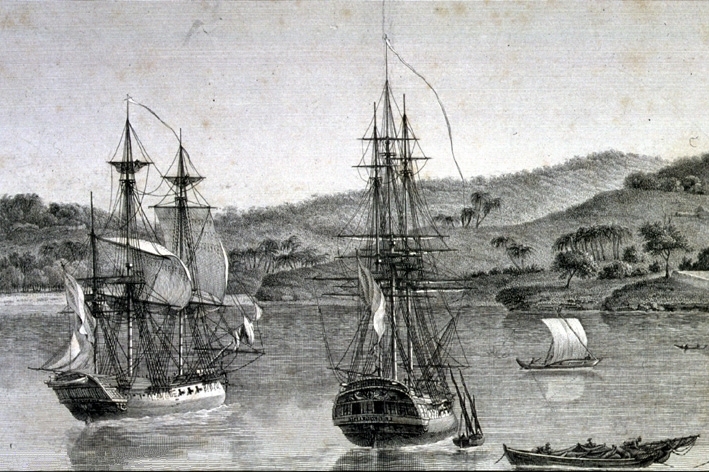
Ships Le Géographe and Le Naturaliste, from the Nicolas Baudin expedition to Australia, c. 1800-1803

In September, we share four installments of this short story Tasmania, a Lovesong, by Australian author John Bryson, which journeys us along the eastern waters of Tasmania.

SNOW ON THE MOUNTAIN above, and awash with the tides are Waterman’s steps, where a pretty Gaff Trader lies forever in state, on show to the modern world, built one hundred and ten years back, so plying these Hobart wharves in 1912, in commission loading lumber, when a Norwegian anchored alongside, this the Fram, an adventurer, leaky and gouged from the ices South, lying back on her chain while a longboat ferried quiet Amundsen for the Dockside, he loosing his greatcoat for the walk to the telegraph, composing the words to be sent to his King.

Those times, northbound out of Hobart town meant first laying south by Opossum Bay and out of the estuary, past the Iron Pot, where such is the concentration of reef-bed ore that compasses swoon and chronometers pause, beyond the Bruny Isle and the last docile lees in Storm Bay, making East under Port Arthur and the Isle of the Dead, to slip behind Tasman Island, for a few minutes out of the South East swell, which breaks shore here for the first time since it left the Antarctic.

Only gunboats, merchants and race-fleets go that way any more. The rest of us save 60 sea-miles by heading for the isthmus on which the Dutch of the Heemskirk first landed, now the channel town Dunally, where the narrows have been dredged through to the Tasman Sea, and the woody peninsular below seems to be hinged there by the Swing Bridge. Most boats anchor on the inland side overnight, and navigators will tell you this is for safer passage, although when dusk falls every one wades to the wrinkled shallows, with torches and fire sticks, so it will strike you that skillful pilotage around here has to do with grilled Southern flounder and fried anchovies.

At the earliest light the bridge draws, and the way ahead is as placid as a flooded meadow, but the tussocks float aside on the bow’s wave, for these are awakening swan and preening duck, and the depth underfoot is plenty. The bridge-keeper walking the bank in pyjamas and oilskins, collects his toll with a long handled dip net, and the tradition here is that the fee be already hitched to bottle of Pilsner so to provide ballast in transit. From here on, the perspective is of tall ash and stringybark, the forest closes astern and parts ahead, and I have watched this from landward too, the vessel seems to be sailing the woods. Here comes a time now at which the treeline thins enough to release the astonishing sun, the waters flow like the mouth of a stream into a sandy and generous bay, where an inexplicable shade at the edge of the shiny current is, most likely, a spray of minnows or basking ray, and see how all these sunbeam shallows and channel blues speak of the Western Pacific, whatever the charts might say.

About the Author:

In 1985, the book Evil Angels by Australian author John Bryson was released. Its revelatory investigation into the disappearance of Azaria Chamberlain shed new light on the controversial case and quickly became a career defining piece of work for Bryson. Other publications include the novel, To the Death, Amic (Viking/Penguin 1994) a collection of short fiction, Whoring Around (Penguin 1981) and a collection of reportage Backstage at the Revolution. Bryson lectures in law, literary journalism, and fiction, acts on advisory panels to government, NGOs, and universities, and on literary judging panels. At the end of the millennium, a Schools of Journalism panel included him in ‘The 100 Australian Journalists of the Century’. In 2014, he was awarded membership of the Order of Australia.

Just Across the Road

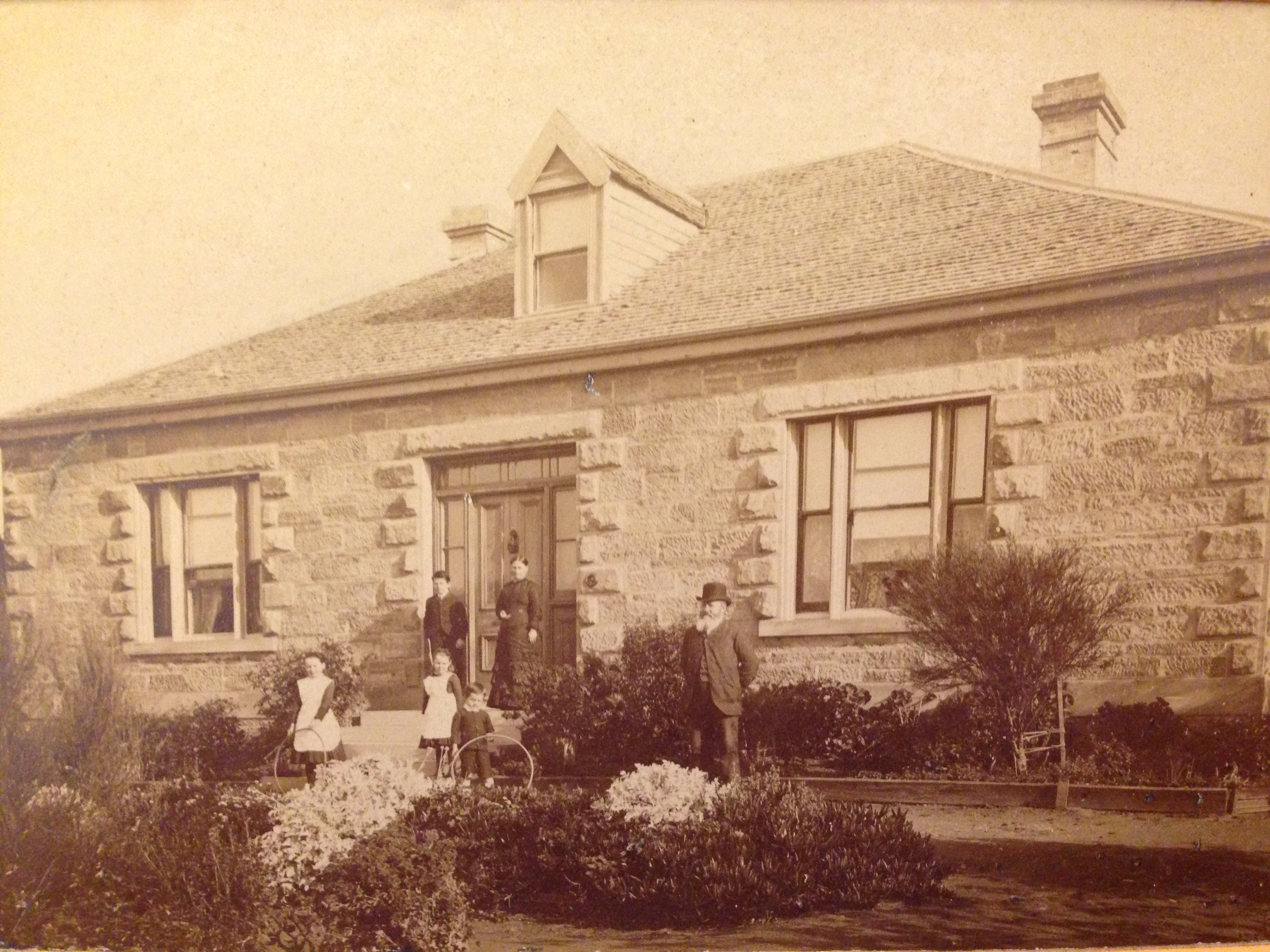
Chapman family at Maritimo

What is the story behind the house that looks over to ours, shares our street name, and watches us as we come and go? Our Girl Friday, Kristen Erskine digs a little deeper to find out.

A young Nutmegger put up his age and set sail from New Bedford, Connecticut, aboard a whaler in the early 1800s. He eventually served on the Menkar (named for one of the stars in the constellation Cetus also known as The Whale). The ship was crippled on a reef in Poverty Bay, New Zealand and limped to Hobart Town in 1858 where it was condemned and wrecked. Undaunted, Charles Augustus Chapman then joined one of the ‘luckiest and most profitable ships’ of the time, the Runnymede barque.

Three years later he married Jane Gaylor, sister of Charles (the founder of Customs House Hotel) on December 7th 1861 and continued his life at sea until he sought his real fortune by heading to the west coast and purchasing mining concessions with Dr Crowther around 1882. With the fortune he made from selling the shares in the Anchor Tin Mine he retired to Hobart Town and purchased 3 acres of land in Sandy Bay between the dairy farms of what would be Dynnyrne and the huge orchards that stretched to Nutgrove Beach.

By 1885 Maritimo (from the Portuguese for “view to the sea”) stood proudly facing the ocean where he’d spent most of his life. Already a father of four, he and Jane produced three more children with the youngest being premature and dying at birth.

I’d first laid eyes on the house whilst taking my eldest child to a nearby park. At that time it was one of those fantastic “haunted” houses, set well back from the road and virtually invisible because of the trees surrounding it. I just noted it as I walked to and from the park and as the years passed and more children joined us and more trips to the park ensued, a fair number of stories revolving around this mysterious house appeared in my writing.

Last year this all changed. We had a chance to move house and lo and behold it was directly across the road from that house which had fueled myriad plots conceived during those occasional idle moments whilst caring for my children.

When it occurred to me to look up, from beneath the boxes and chaos I realised a magical change had been wrought on the house. The hidden had become visible, the house standing proud on its gentle hill. The gigantic shrubbery tamed and snipped and trimmed. The white paint covering the bottom storey scrubbed away allowing the original sandstone to glow. And oh, what a glow in the morning, the house facing east and the stone changing hues with the dawn. There are children again, skipping and running and throwing balls. Some days I’m tempted to take them a hoop and stick across and see if they can recreate some late Victorian childhood games.

My dreams of living across the road from a haunted house have been tamed by the shouts of laughter, birthday parties, fertile pear trees and sharing a cider on the verandah. I am quite content. Some homes are grand and forbidding, Maritimo, now I’ve had the chance to get to know it, was simply lonely, needing a family and warmth within again. Not haunted at all, just waiting, for the walls to echo once more with children’s delight and for the spaces to be cherished again, the gardens cared for and reimagined.

The only photograph I’ve seen of Charles and Jane Chapman is in front of the home with some of their children, who were obviously trying very hard to be “good” but there is mischief in their grins and even Mrs Chapman is smiling slightly. I suspect she and her husband would be well pleased to see their home now. Once again a warm and congenial family home, still a “view to the sea”, and settling into a new generation growing within its sturdy walls. Meanwhile, I’m marking out other houses to feature in my haunted writing, Maritimo is far too sunny natured now.