The City Once An Island That Went To The Dogs – Part II


Part II_isle of dogs_Sean Preston Open Pen TransportationLondon editor, Sean Preston looks at the island that isn’t an island, at odds with itself and the relentless change of the city it sits within.

You can go to The Isle of Dogs now, and you’ll still find ‘indigenous’ Islanders there. They’re fewer and farther between, but they’re there. But it doesn’t overturn the change of pace and face to the Island. House prices are of course indicative of its popularity. I see the same in Limehouse. The Occupyists and ‘Shire artistes squat in derelict shops and the onset is forged: The rivers will run red with their watercolours. In time, my road will fall much in the way of the rest of East London. Those that have moved here, often seeking to oppose the banking establishment, are those that trendify an area. And they have a right to, I believe. There’s no point in begrudging London’s nature, for London has always been tidal. Is this tide synthetic? Probably. I’ll not be quashed by many for suggesting that, generally, in this city, like all others, wealth will have its way.

President Ted Johns of the Republic of the Isle of Dogs didn’t stand for it for long and I believe his method of ridicule and farce as a political tool made much sense. I have argued, perhaps to my detriment in some corners, that trolling is the great art of our time. I really do believe that to be the case (and look at it this way, if it proves not to be, I can always pretend I was just trolling). From his presidential home, which was in fact a small council flat on the Island, Johns and family presided over the new republic and, significantly, invited the world’s media into their home, their lives, their nation. The passports, barricades, immigration documentation, to me, are important artifacts of post-war London. And the newspaper cuttings even more so. It is known to us by now that to live by the media is to die by the media, and so it was with the independent state. The fortnight of coverage brought with it exposure of the squalor that even The Times called “Victorian”, but caused enough of a stir upstairs that the full tabloided onslaught was visited upon it.

Humour, bizarrely, has to be at the centre of our endeavours against those that seek to garrote social equality. Irony as a defense mechanism is nothing new; it’s unreservedly London, English. Literature has a part to play in this, and has been the primary canvas of insurrection and mockery for as long as we’ve scribbled. It’s hard to know how relevant, or how conspicuous this form of literary fiction can be in the century already well underway. I suppose the one thing about the oppression of opinion labelled extreme by those that gain from doing so, is that it requires the artist – the writer – to augment their creativity, just as Ted Johns did, abruptly, sensationally, for a fortnight in 1970.

The City Once An Island That Went To The Dogs – Part I

Part I_Isle of dogs-iod

London editor, Sean Preston looks at the island that isn’t an island, at odds with itself and the relentless change of the city it sits within.

Londoners will know to which area the riddled title of this piece refers, the rest of the world, perhaps not. The Isle of Dogs isn’t an island, not really. It’s a peninsula in London and an area unlike no other, enriched with the fog of a confused identity. Once the home of mass and abject poverty, often degradation, community, Dockers, now the home of mild gentrification, marginalized poverty, and of course, what we call “The City” which is in fact London’s vainglorious project of the last part of the 20th Century in the form of skyscrapers that line the north of the Island, blocking out the sun. It’s East London, but sort of sits in the South and feels like it too, drooping, weighing down our Thames and bending it all out of shape. The Isle of Dogs has been threatening to burst for centuries. I wonder if all of London would seep down through it, down the plug, into the Garden of England via Bromley.

Abruptly, sensationally, for a fortnight in 1970, it became an independent state. In a move unavoidably likened to the Ealing comedy Passport To Pimlico, Labour’s Ted Johns, originally from Limehouse where I live, and a man of some lineage (his forebearers were involved in the Dockers’ Strike of 1889 and fought against Franco’s brand of Fascism in the Spanish Civil War), issued a Unilateral Declaration of Independence as a reaction to, primarily, poor facilities for its some 10,000 residents of the topographic wonderland. The Island had been pushed as far as it could withstand. Paucity was a way of life, and with it anger. Routinely, the Islanders were overlooked, ignored, condescended. Inhabitants were treated obnoxiously by the Port authority, and Poplar’s Labour, a political party they backed unreservedly, seemingly ignored them. So too did Tower Hamlets which later encompassed the Island. It was time for regime change. It was time for President Johns. Of course, the move was always going to be more a statement (a crucially well-covered light trolling of the authorities) than it was a military coup with geographical longevity.

Within this anomaly in time, we see a microcosm of what was to come in East London. Gentrification, state-led or otherwise, is paramount for all of us to see. It’s the theme storified in pubs over pints. A friend of mine, rather crudely, told a two-part tale: In 2001 he was offered full board by a lady of Dalston’s night for a nominal figure. Just ten years later, he couldn’t get a pint for the same price in the same area. I laughed recently when another friend told me that the name Poppy, a name presumably favoured for baby daughters by the money-classed new parents of the eighties, was short for Pop-Up Shop. We joke, but Working Class Inner London is on its way out. Perhaps it’s this nagging truth that draws me to East London’s local history. There’s something rather horrendous to watch, most would agree, in the act of uprooting a tree. It seems cruel and tasteless, and I say that as someone not known for his environmentalist sympathies. The Islanders knew that troubles lay ahead in this respect. Microlocalism is important to those with little else. They were going to be dug up and chucked out. Not immediately, not barbarically, and not unlike the undesirables of London are being tossed asunder now. Quietly, permanently, eradicated.

Read more on the Isle of Dogs next week.

Tasmania, a Lovesong: Part IV

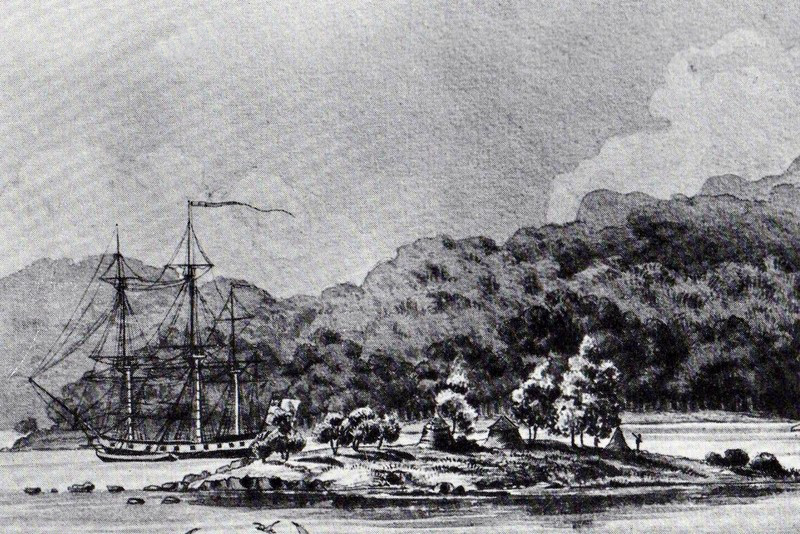
Week 4 – 24 sep – last instalment of john Bryson The ship Ocean, off Hunter Island c. 1804
The ship Ocean, off Hunter Island c. 1804

In September, we share four installments of the short story Tasmania, a Lovesong, by Australian author John Bryson, which journeys us along the eastern waters of Tasmania. Here is the final part.

SUCH IS THE TIMING of these passages that I’ve never seen this part of the coast other than etched on the radar screen, at night. Bisheno town makes a bright circle, and you’d think so snug a harbour safe in any weather, but a bar-room wall somewhere in every fishing village carries a framed photograph of the tempest of the 1960s, this causeway astream with foam, trawlers at terrified mid-leap, overwrought anchor cables whining and defeated, hulls on the Esplanade already stripped to the ribs, where huddle the watchful townsfolk, awed, ruined.

A southbound freighter, chatty, nearly home, found the right frequency to tell us we would have a tough night once we made it around the corner. He meant Cape Naturaliste, and we knew already. The sea was still slick, but the deck was atilt from other pressures high in the rigging. Mathers, who delights in the advent of small miracles, found he could read a magazine at the stern rail, so bright was the luminous wake. This was partly the gift of the vanishing moon, now heading to the clouds.

The Eddystone Beacon, blinding as it caught the deck, swept then the path maybe a mile ahead, rain squalls and scuttling cloud at whitecap height. By Mussel Roe Bay, at the northern tip, we were into the gale. The tide was headstrong, so we stood toward Clarke Island, to quarter the seas, but maybe also because of the association with good fortune, for when the Sydney Cove went down around here in 1797 the nine survivors were taken by Captain Flinders only as far as the mainland edge, told to walk to Botany Bay, and Clarke, with one other, made it.

Mathers was showing considerable grit himself, and I revere the picture of him still. This was his first passage and he might have hoped for better. Making soup, he jammed himself by the stove to hold the kettle over the flame. He judged the troughs, rather than the crests, would give him the correct momentum to run a steaming mug up the stairway, from the galley through to wheelhouse. It was Mather’s idea to extinguish all deck lights, since what they lit best were the frightening seas, and no freighter could see us anyway. Meantimes, he lay on the saloon floor, not to be thrown again from the bunks, and it was his questing fingers which found water there, so we had damage the pumps were not holding.

At sour first light we swung for Franklin Sound, between Flinders Island and Cape Barren. The approach is long and lumpy in these conditions, but around midmorning we had company, a fishing boat waiting in the channel to stand alongside us the rest of the way in. I knew her well, had fished on her two years or more, and might have expected nothing less than her appearance here, at this moment, should have expected her clowning skipper to toss a can of beer off board so we could toast landfall in tandem, should have expected his waving wife, who is also the Harbour Master here, to shout of a readied birth at the wharf.

Astounding it was how these folk warmed the morning. Is this all it takes, these acts of kindness, to sweeten the world? To remember that these are seas of beauty and abundance, where you may happen on one hundred and fifty acres of resting shearwaters, watch ridiculous dolphin roll and dandy for hours under the bow, sometime follow wave upon wave of glittery tuna surfing the shoals?

To still the wind, to blue the deep, to summer the firmaments? Is this all it takes?

About the Author:

In 1985, the book Evil Angels by Australian author John Bryson was released. Its revelatory investigation into the disappearance of Azaria Chamberlain shed new light on the controversial case and quickly became a career defining piece of work for Bryson. Other publications include the novel, To the Death, Amic (Viking/Penguin 1994) a collection of short fiction, Whoring Around (Penguin 1981) and a collection of reportage, Backstage at the Revolution. Bryson lectures in law, literary journalism, and fiction, acts on advisory panels to government, NGOs, and universities, and on literary judging panels. At the end of the millennium, a Schools of Journalism panel included him in ‘The 100 Australian Journalists of the Century’. In 2014, he was awarded membership of the Order of Australia.

Tasmania, a Lovesong: Part III

The Lady Nelson in the Thames, whose explorations included the Bass Strait c. 1802

In September, we share four installments of this short story Tasmania, a Lovesong, by Australian author John Bryson, which journeys us along the eastern waters of Tasmania.

THE SEA PASSAGE I’m speaking of now also carried Peter Mathers who was, around that time, moving from the writing of novels to the writing of plays, despite his brace of Miles Franklin awards, or maybe because of them. From the Dunnally channel we set North, to take the landward side of Maria, the mountain Island named for the wife Van Diemen, and the convict settlement until Port Arthur was thought of. Mathers likes stories to do with delusional grandure, and he had a fine time with this place. Maria, in the late 1800s, was leased for its limestone, kilns built, a hostelry sprang to its feet at North Point, the township fattened, and the company’s paper given a flutter on the London stock exchange. All this enterprise was the vision of Diego Bernacci who then renamed the town San Diego. The timing was just right, as events turned out, for the crash of the 1890s, but thirty years later Bernacci did it again, this time for the crash of 1929. Tasmanians have changed the name of the town back to Darlington.

Not far off course, and worth every mile, is Isle des Phoques. Left over from some previous arrangement of nature, these grand pillars have no inland to support any more. The pose is of enough scale, and of might, to stand as a nostalgia for the size of the world once was: here is Atlas relieved of duty. The trick now is to glide as closely as nerve allows. These heavy portals have been teetering here a long time so far anyway, and watch the birds nesting the ledges. The instant they scream: the terns, gulls, cormorants, all into the heart-beating whirling air, so will it seem that you have chosen the exact moment for the collapse of the counterpoise, of the entire crumbling vault, pealing from higher than the masthead, a landslide exploding into the waters all around, and I’ve watched seafarers go ashen right then, until the eyes catch up with the action enough to see that these are seals, hundreds maybe, the bulls and the cows roaring their dainty calves to the long plunge, to surface again in the tumultuous water, whiskery and inquisitive.

Dusk is not long away, but before it’s too dark I want to get us through the Schouten Passage, sea side of the Great Oyster Bay, and near enough to halfway now to Bass Strait. We could go around, and out into the Tasman, but the charm of the inshore route is the scenery, and the navigator’s excuse that, in here, we dodge the south set of the outer current. The island and the peninsular almost meet, and it’s difficult to see the convenient gap. But the run, when you find it, is very deep indeed, and so a favourite of locals. I know a Hobart seaman with a Masters ticket whose job is to pilot rusty ships from the far Orient to his home port for refit, and who, one summer evening, turned the 25,000 tonnes of Japanese freighter under his command through the skimpy passage here, grinding neither side on the rocks, to the tooting delight of the nearby lobster fleet, which understood just who must be up on the Bridge there, whose hand to the wheel.

About the Author:

In 1985, the book Evil Angels by Australian author John Bryson was released. Its revelatory investigation into the disappearance of Azaria Chamberlain shed new light on the controversial case and quickly became a career defining piece of work for Bryson. Other publications include the novel, To the Death, Amic (Viking/Penguin 1994) a collection of short fiction, Whoring Around (Penguin 1981) and a collection of reportage, Backstage at the Revolution. Bryson lectures in law, literary journalism, and fiction, acts on advisory panels to government, NGOs, and universities, and on literary judging panels. At the end of the millennium, a Schools of Journalism panel included him in ‘The 100 Australian Journalists of the Century’. In 2014, he was awarded membership of the Order of Australia.

Tasmania, a Lovesong: Part II

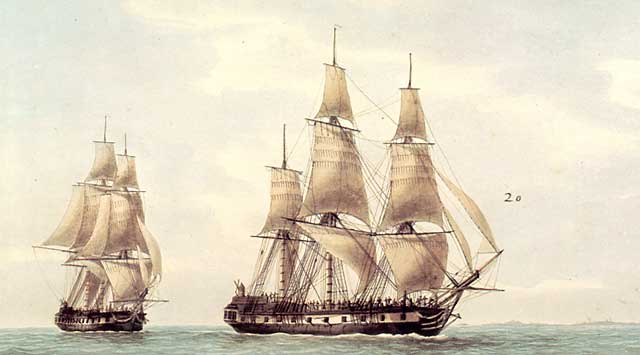
French ships Recherche, and Esperance, from the d'Entrecasteaux expedition, reaching Tasmania, c. 1792-1793
French ships Recherche, and Esperance, from the d’Entrecasteaux expedition, reaching Tasmania, c. 1792-1793

In September, we share four installments of this short story Tasmania, a Lovesong, by Australian author John Bryson, which journeys us along the eastern waters of Tasmania.

BEAUTY AND ABUNDANCE and solitude are wonders, sure, but most of us live in the cities, either born there or we joined to drift to deny some definition we had then of poverty. My genes come from out of town although I’m a city boy, and judging by the sort of people we happen on in Tasmania, anyway in the eastern half and may be all over, a lot of genes come from outside city walls, and some redefinition of poverty is taking place.

I have in mind surprises like a wayside kiosk in the Derwent Valley, now the shopfront for a local potter, one-time Englishman who fled famed Wedgewood, although he was its chief artisan, and now turns far finer things at the opposite end of the world. This is no surprise to Tasmanians, who are well accustomed to peerless hand-worked furniture and, for another example, to every day recitals from woodwind musicians who have traded the forests of Sibelius and Greig for Ferntree and Lune River.

And I have in mind happenings like watching a long married couple fish shingle pools on the Huon with deep longtail flies, in lovers’ springtime, when garlands of upstream blossom float the eddies and new salmon run beneath. While the action was slow this husband spoke his Romeo lines, with cumulus breath for it was fiercely cold, and his wife answered as Juliet lighting the East, then scene on scene, and all without fault or stammer, because both are Elizabethan scholars, he a professor of English literature, once of Glasgow but now of hereabouts, and she his captivating actress.

Here is something signal about the way folk live in these parts. Around here the intellectual world and the physical are amiable kin, they voyage together, a phenomenon I’ve not seen so strongly anywhere.

About the Author:

In 1985, the book Evil Angels by Australian author John Bryson was released. Its revelatory investigation into the disappearance of Azaria Chamberlain shed new light on the controversial case and quickly became a career defining piece of work for Bryson. Other publications include the novel, To the Death, Amic (Viking/Penguin 1994) a collection of short fiction, Whoring Around (Penguin 1981) and a collection of reportage Backstage at the Revolution. Bryson lectures in law, literary journalism, and fiction, acts on advisory panels to government, NGOs, and universities, and on literary judging panels. At the end of the millennium, a Schools of Journalism panel included him in ‘The 100 Australian Journalists of the Century’. In 2014, he was awarded membership of the Order of Australia.

Tasmania, a Lovesong: Part I

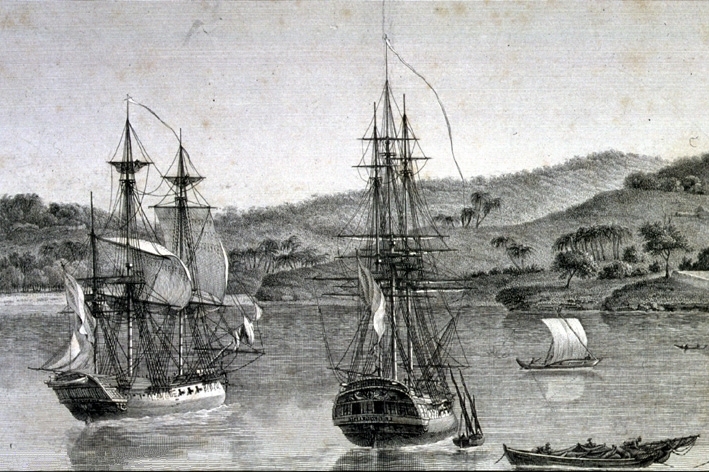
Ships Le Géographe and Le Naturaliste, from the Nicolas Baudin expedition to Australia, c. 1800-1803

In September, we share four installments of this short story Tasmania, a Lovesong, by Australian author John Bryson, which journeys us along the eastern waters of Tasmania.

SNOW ON THE MOUNTAIN above, and awash with the tides are Waterman’s steps, where a pretty Gaff Trader lies forever in state, on show to the modern world, built one hundred and ten years back, so plying these Hobart wharves in 1912, in commission loading lumber, when a Norwegian anchored alongside, this the Fram, an adventurer, leaky and gouged from the ices South, lying back on her chain while a longboat ferried quiet Amundsen for the Dockside, he loosing his greatcoat for the walk to the telegraph, composing the words to be sent to his King.

Those times, northbound out of Hobart town meant first laying south by Opossum Bay and out of the estuary, past the Iron Pot, where such is the concentration of reef-bed ore that compasses swoon and chronometers pause, beyond the Bruny Isle and the last docile lees in Storm Bay, making East under Port Arthur and the Isle of the Dead, to slip behind Tasman Island, for a few minutes out of the South East swell, which breaks shore here for the first time since it left the Antarctic.

Only gunboats, merchants and race-fleets go that way any more. The rest of us save 60 sea-miles by heading for the isthmus on which the Dutch of the Heemskirk first landed, now the channel town Dunally, where the narrows have been dredged through to the Tasman Sea, and the woody peninsular below seems to be hinged there by the Swing Bridge. Most boats anchor on the inland side overnight, and navigators will tell you this is for safer passage, although when dusk falls every one wades to the wrinkled shallows, with torches and fire sticks, so it will strike you that skillful pilotage around here has to do with grilled Southern flounder and fried anchovies.

At the earliest light the bridge draws, and the way ahead is as placid as a flooded meadow, but the tussocks float aside on the bow’s wave, for these are awakening swan and preening duck, and the depth underfoot is plenty. The bridge-keeper walking the bank in pyjamas and oilskins, collects his toll with a long handled dip net, and the tradition here is that the fee be already hitched to bottle of Pilsner so to provide ballast in transit. From here on, the perspective is of tall ash and stringybark, the forest closes astern and parts ahead, and I have watched this from landward too, the vessel seems to be sailing the woods. Here comes a time now at which the treeline thins enough to release the astonishing sun, the waters flow like the mouth of a stream into a sandy and generous bay, where an inexplicable shade at the edge of the shiny current is, most likely, a spray of minnows or basking ray, and see how all these sunbeam shallows and channel blues speak of the Western Pacific, whatever the charts might say.

About the Author:

In 1985, the book Evil Angels by Australian author John Bryson was released. Its revelatory investigation into the disappearance of Azaria Chamberlain shed new light on the controversial case and quickly became a career defining piece of work for Bryson. Other publications include the novel, To the Death, Amic (Viking/Penguin 1994) a collection of short fiction, Whoring Around (Penguin 1981) and a collection of reportage Backstage at the Revolution. Bryson lectures in law, literary journalism, and fiction, acts on advisory panels to government, NGOs, and universities, and on literary judging panels. At the end of the millennium, a Schools of Journalism panel included him in ‘The 100 Australian Journalists of the Century’. In 2014, he was awarded membership of the Order of Australia.

Just Across the Road

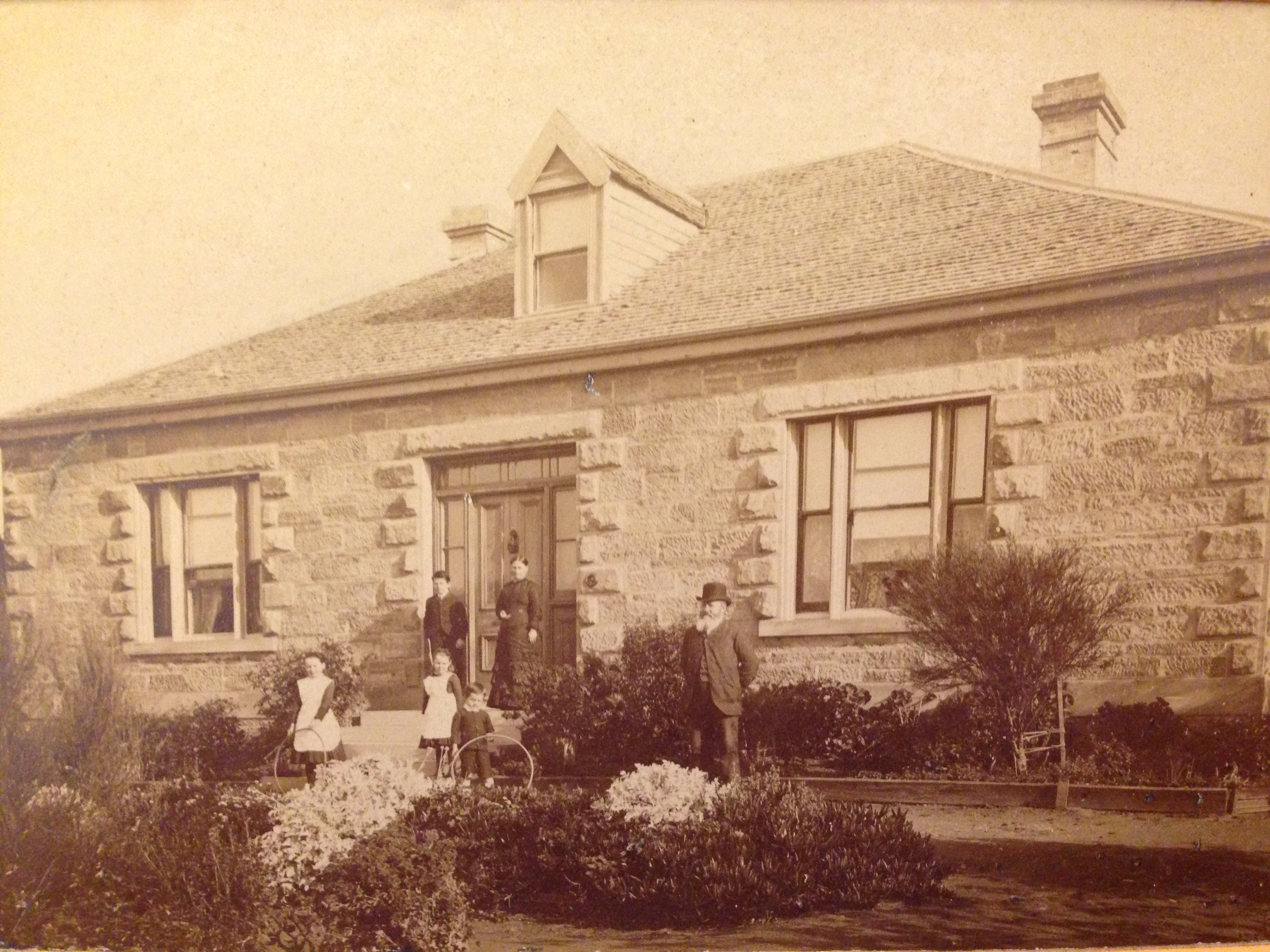
Chapman family at Maritimo

What is the story behind the house that looks over to ours, shares our street name, and watches us as we come and go? Our Girl Friday, Kristen Erskine digs a little deeper to find out.

A young Nutmegger put up his age and set sail from New Bedford, Connecticut, aboard a whaler in the early 1800s. He eventually served on the Menkar (named for one of the stars in the constellation Cetus also known as The Whale). The ship was crippled on a reef in Poverty Bay, New Zealand and limped to Hobart Town in 1858 where it was condemned and wrecked. Undaunted, Charles Augustus Chapman then joined one of the ‘luckiest and most profitable ships’ of the time, the Runnymede barque.

Three years later he married Jane Gaylor, sister of Charles (the founder of Customs House Hotel) on December 7th 1861 and continued his life at sea until he sought his real fortune by heading to the west coast and purchasing mining concessions with Dr Crowther around 1882. With the fortune he made from selling the shares in the Anchor Tin Mine he retired to Hobart Town and purchased 3 acres of land in Sandy Bay between the dairy farms of what would be Dynnyrne and the huge orchards that stretched to Nutgrove Beach.

By 1885 Maritimo (from the Portuguese for “view to the sea”) stood proudly facing the ocean where he’d spent most of his life. Already a father of four, he and Jane produced three more children with the youngest being premature and dying at birth.

I’d first laid eyes on the house whilst taking my eldest child to a nearby park. At that time it was one of those fantastic “haunted” houses, set well back from the road and virtually invisible because of the trees surrounding it. I just noted it as I walked to and from the park and as the years passed and more children joined us and more trips to the park ensued, a fair number of stories revolving around this mysterious house appeared in my writing.

Last year this all changed. We had a chance to move house and lo and behold it was directly across the road from that house which had fueled myriad plots conceived during those occasional idle moments whilst caring for my children.

When it occurred to me to look up, from beneath the boxes and chaos I realised a magical change had been wrought on the house. The hidden had become visible, the house standing proud on its gentle hill. The gigantic shrubbery tamed and snipped and trimmed. The white paint covering the bottom storey scrubbed away allowing the original sandstone to glow. And oh, what a glow in the morning, the house facing east and the stone changing hues with the dawn. There are children again, skipping and running and throwing balls. Some days I’m tempted to take them a hoop and stick across and see if they can recreate some late Victorian childhood games.

My dreams of living across the road from a haunted house have been tamed by the shouts of laughter, birthday parties, fertile pear trees and sharing a cider on the verandah. I am quite content. Some homes are grand and forbidding, Maritimo, now I’ve had the chance to get to know it, was simply lonely, needing a family and warmth within again. Not haunted at all, just waiting, for the walls to echo once more with children’s delight and for the spaces to be cherished again, the gardens cared for and reimagined.

The only photograph I’ve seen of Charles and Jane Chapman is in front of the home with some of their children, who were obviously trying very hard to be “good” but there is mischief in their grins and even Mrs Chapman is smiling slightly. I suspect she and her husband would be well pleased to see their home now. Once again a warm and congenial family home, still a “view to the sea”, and settling into a new generation growing within its sturdy walls. Meanwhile, I’m marking out other houses to feature in my haunted writing, Maritimo is far too sunny natured now.

Henry Savery: The Hermit of Van Diemen’s Land

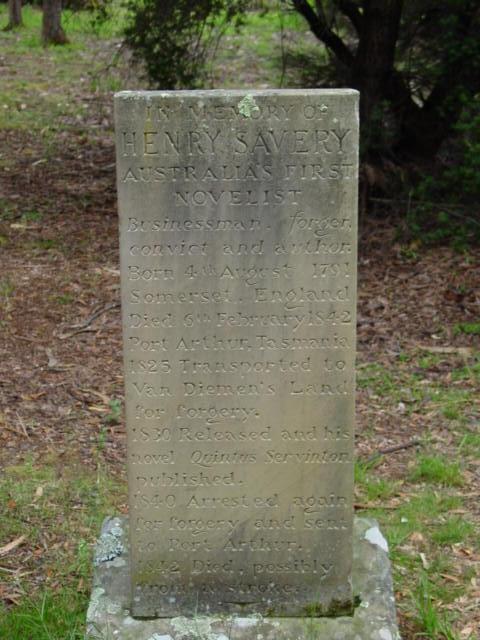
Henry Savery memorial stone, Isle of the Dead, Tasmania

Our Tasmanian editor, Rachel Edwards investigates the origin of the first published Australian novel, its distant legacy and the state of literacy today.

In 1825 a chap called Henry Savery, who had been sentenced for forgery was transported to Van Diemen’s land. He went on to become, via a stint writing a column using the pseudonym Hermit of Van Diemen’s Land and slandering various public figures, saved only by diaphanous nicknames – and via an unmatched moment in the history of the world where one small town had two newspapers with the same names and the same serial numbers, but I digress, Henry Savery went on to write what has become known as the first Australian novel. It is called Quintus Servinton and by all accounts it is an overwritten, dense, not very enjoyable read – and a thinly veiled autobiography and attempt to win back his wife, who had begun an affair with Sir Algernon Sidney Montagu, who was to join the Supreme Court in Hobart town, and who Montagu Bay was named after – and was brought up his by family friends, The Wordsworths.

Henry called himself ‘The Hermit of Van Diemen’s Land,’ an attempt at anonymity for writing a newspaper column (as indentured convict labour, it wasn’t all brickmaking and fending off bushrangers), in which he wrote assiduous and cutting summations of what was going on under Governor Arthur’s increasingly neurotic rule.

Quintus Servinton was published in 1830 and it varied most significantly from Savery’s life in its happy ending. It preceded Woman’s Love by another Van Diemonian, Mary Grimstone by 2 years and For the Term of His Natural Life, generally presumed to be the first Australian novel, by 44 years. For more academic detail about both Savery and Grimstone here is a PDF of E. Morris Miller’s 1958 paper ‘Australia’s First Two Novels, origins and background’

While it is a proud fact that these shores gave rise to the first Australian novel and it is often quoted that Tasmania has more readers per capita than other states – and more writers, we currently have only 50% functional literacy. 50% of people are ONLY functionally literate in Tasmania. It is a gobsmacking figure in Australia today and a heartbreaking one for Tasmania. In this, the International year of Communication, even more a call to action.

Readers and writers in Tasmania have a duty of care to others who struggle with these crucial life skills. While reading fiction makes the reader more empathetic and compassionate,  awards and recognition for writing are crucially important for Tasmania. To recognise and value the writing that is being done in Tasmania right now is to show that literacy is valued – and while spelling out a word in the supermarket may seem a long way from the books that have won the Tasmanian Literary Prizes, they are part of the same continuum. As a friend said “you can’t encourage kids to play footy and then take the AFL away.” The Tasmanian Literary Prize is a valuable institution that the State government must return to celebrate the strength and beauty of writing in this state and to show a society with decreasing literacy that reading and communication are valued, from the top down.

Here is an interview with Rod Howard, author of A Forger’s Tale, a biography of Henry, in 2011

Adapted from a filmed piece for the Tasmanian Leaders’ Program, July 2014.

Islands and Cities: Time and Space

post time and space

Emma L Waters reflects on time and space; its visibility, changeability and its constant influence.

The pace is different back here and I am impatient. People move with the drifting disorder of the clouds, which blow in from all directions. Tumbling down from the plentiful mountains on this island. Seeping along the rivers. This island at odds with the sea around it.

They like space here and plenty of it. When there are crowds they are not used to reigning in their movements and collide. In a drunken festival crowd, people knock into each other as they spin and turn against the city folk who’ve flown in. The contained city folk, whose bodies are bridled to small boxes.

In the city, people rat race from A to B and all the other letters too. Not stopping. Sharpening each other’s edges.

Here, people drift with time and space on their hands. They throw themselves out into the road, not expecting traffic. Thrusting themselves out like gusts of wind across the stream.

I returned here, for this dominance of nature. The sense of time and space that floats from the mountains, across farmland and down the quiet streets and out to sea. But I move in a different way. The way of the city. The way my body grew used to maneuvering through tight spaces and narrow streets. Crowds and queues. Space. Never enough.

They like time here and plenty of it. I queue behind a man for many minutes. I am leaving very definite imprints in the air, in the bitumen, in the sound waves, yet he still doesn’t know I’m here. Right behind him. I am a transient with no such permanency. A person. Not a statue. Not a shop. Not a boundary. I have just arrived and am still not grounded in this place. But – I am here – though he doesn’t seem to know it yet. He turns and I am forced to step out of his way to avoid being trampled. And still, he doesn’t see me as he leaves. Face intent on a thought that will take him to join this dot to the next dot in today’s puzzle.

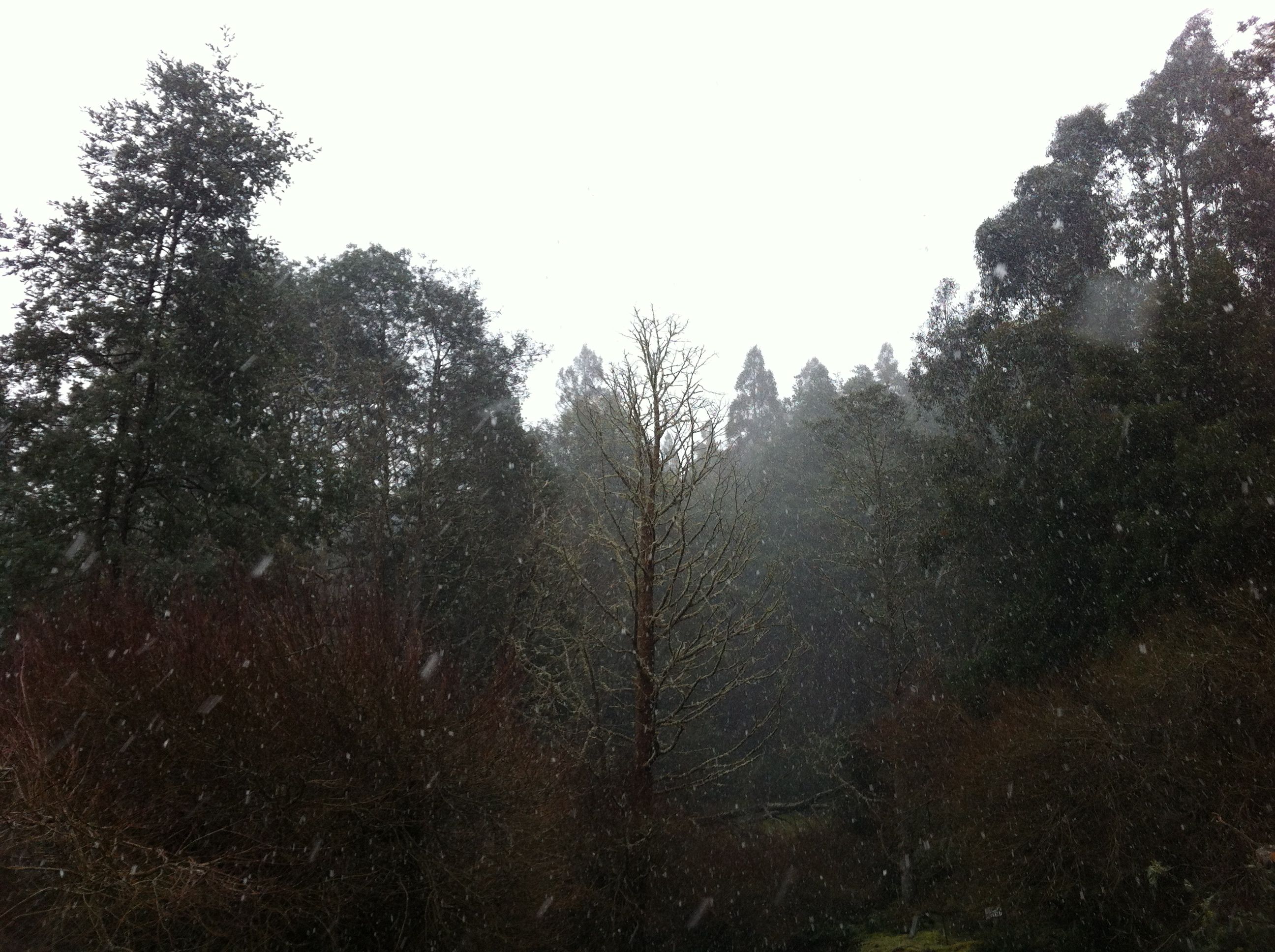
I walk in snow. It falls in large flat platelets that idle as they fall, though the wind in the treetops is certain of its strength and speed. In a forest of myrtle and tall gums. I can see distance in the air exactly. Every mobile fleck of it. All around as the slow snow falls. Far away. From high, high, high and further. Mid-air. Mid-distance. Close. On my nose, tongue and the prickle on naked eyes. It strobes the air in pointillation, like an icy pollen. It melts around my feet and then crystallizes again in a cold tightening that pulls at the skin. I watch it fall through all the open spaces between leaves and branches. Falling through to rest on the curling mud and gravel road ahead. And then there is sun, and soon all the leaves that were laden with the temporal tiny white, slip away to glossy dark green. The river tells itself to hush, but it cannot, and the more it tells itself to shh in its secret ravine, the louder it gets. Brimming and tumbling with a secret it cannot keep. And time flows at its regular pace again. The wind shakes the last of the slow snow away. I pull my feet from the ground and walk on.