The Hateful Sea

The Hateful seaby Tadhg Muller

LEAVING MY HOTEL room I tread into early morning, out onto a street of shadows and darkness. It is hell to distinguish one thing from another, there are tangible objects like dull weights that lend the earth some concrete meaning: bricks, walls, streetlights, gutters, bins overflowing with shit, and waste, and refuse. But something else captures my dull morning consciousness, the sponge like sensation of cardboard moving beneath my feet, moving like tectonic plates, moving on the stone shifting the reality I am in, and leaving in its wake minor eruptions and minor marks of ruin. There are countless boxes broken and laid out under arches, inside doorways, beneath the rotting awnings of this tired Mediterranean dump. Grim shelters that call to mind a thousand lamentations: failed pasts, lost dreams, broken promises, and mostly misery, mostly the misery and inequality of this age we are in. Mega wealth, competition and success; poverty, defeat and failure.I’m on route to a funeral – on an island that I must take a ferry too. I hate the sea. I hate the sea twice over. I’ll walk the 10 kilometres down to the port, the prospect of old companions and water lend themselves to a long fruitless walk, and the constant reminder of my hate for the sea. There are only two ferries this week (even though it is high season), and on this route I anticipate a ferry packed full of old acquaintances. The face of my past, faces that once belonged to friends. I’ll know once and for all how much I hated them, each and every last one, and I’ll see my own hate reflected back at me. And we will reflect on how we have grown old, and fat, and bald, and ugly… mostly ugly and mean with age.

I begin my walk amongst long forgotten and decrepit buildings, on a side street that will metamorphose into an urban highway, a highway that runs to the port and along which I will chart my journey. A tired road, cracked and damaged like a skeleton, its walls stencilled with empty slogans. There is a madness to this world.

The footpath becomes narrower its surface broken. There are groups of scroungers by the side of the road. I’ll make my way down an adjoining street: find some peace and quiet and compose myself. I turn on my I-Phone and go to Google Map. I have been walking for some time and the water I have is empty. There is a hint of salt on the breeze. I turn a corner and discover I am back on that main road. Aren’t we always pressured and pulled towards the centre. Isn’t that life all over. One moment we make the call and we head out in our own direction only to be pulled back, driven towards the centre. It is hard to pull away, it is hard to chart your own course.Now I am descending further and further into the freeway apocalypse, the pit and the concrete labyrinth that surrounds the modern city. Its poison, and gas, and rage, and fury – somewhere beyond this is the water. Rising on elevated concrete pillars the road narrows like a funnel, higher, faster, madder, more unforgiving. Along the edge, the footpath is vanishing into overgrown vine: I have entered the hinterland. All the while the traffic becomes madder and madder. Cars hurtle closer and closer. Drivers thump horns and gesture frantically towards me as if I have intruded on a very intimate moment – finally the footpath is gone altogether. And the cars come closer, and the drivers’ faces feel as if they are pressed against my own. Mostly they look dead, angry, sad and desperate. It is hard to understand what this is all for. I turn back and very carefully follow the map on my I-Phone, and I go a long way down until I can exit back onto the main road… this time intent on taking the right turn… No! I realise I have made the same mistake, and the whole world is hurtling towards me once more, and I am hot and tired and there is no respite.

I start to visualise the players and pieces that filled my past down at the port in a long sensible line. My brothers and sisters, a school teacher, a friend now a lawyer, a doctor, a member of parliament, a teacher, a kid from down the rd, a girl I convinced myself I loved, an old man from the bottom of my street. I have taken the wrong path once more, made the same mistake again and again, looked back and retraced the footsteps of this life and lost my way having always angled away from the centre. I turn back carefully and retrace my footsteps, mindful not to look at my reflection, mindful not to tread upon my shadow.

And I find it, I find the way.

And I am standing at the port with one thousand ferries, the crowds, the ticket officers, the docks, the point of arrival and departure, revellers… And the journey has taken half the day.

The faces that strike me, they belong to strangers. All those people were never too bad (that inhabited the past). Fool that I was to consider that their journeys were any straighter than my own, any more orderly, any more predictable. I’ll mark the death of this friend on his island alone. I make my way to the waters edge, the water is still and calm, the hateful sea it is empty.

You can read, The Reprieve, by Tadhg Muller in the upcoming publication from Transportation Press, Islands and Cities, for updates on the release subscribe to our newsletter.
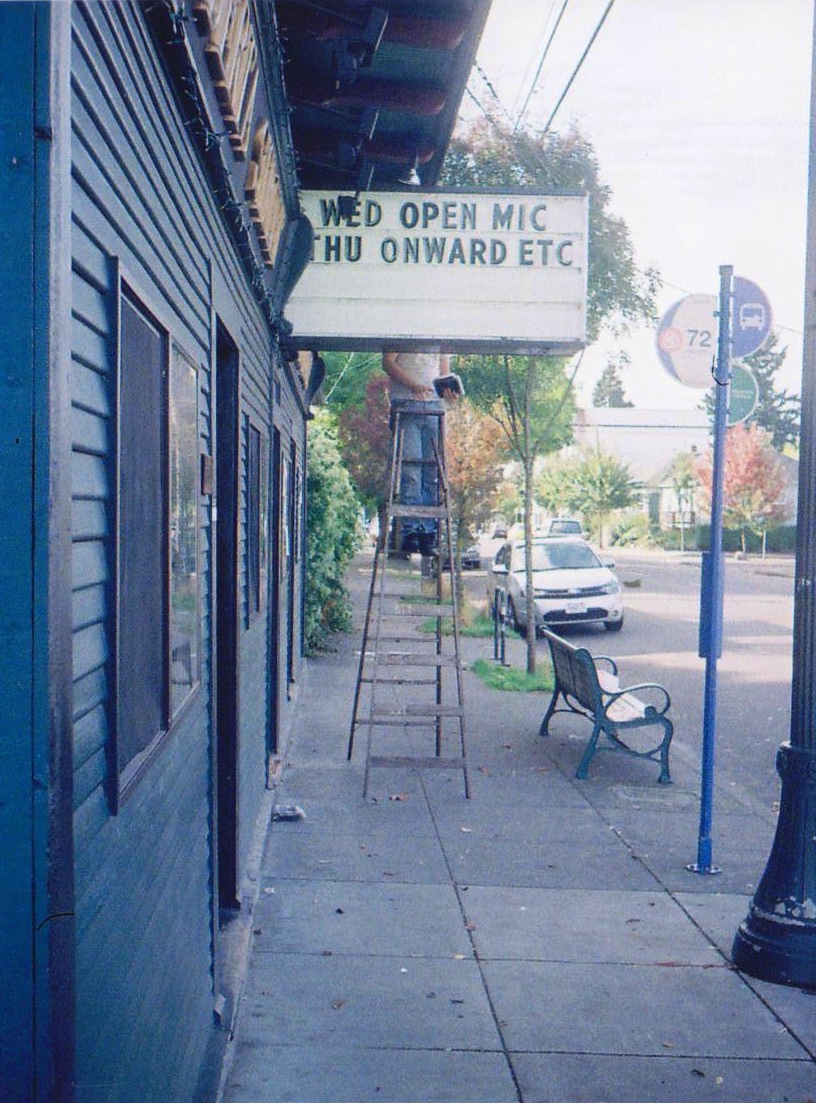
Not Writing a Novel

Photograph: Oliver Mestitz

by Oliver Mestitz

A couple of years ago I told everyone I was writing a novel. I’d finished a Bachelor of Arts, majoring in Creative Writing, which included a class called Novels. I’d written a first and last chapter and planned what would happen in between. I was unemployed and playing in a band and had a job lined up overseas that I had to wait a couple of months for. I spent most of the time browsing the University careers website, looking for participant surveys and PhD experiments that paid ten dollars for an hour’s work. I’d even thought of a title. My novel was called Whalefish.

The only person who knew I was lying was a girl I had a crush on, which in my mind made it seem like an illicit, personal truth that would inevitably bring us together (it didn’t). I met her parents – genuine, non-judgemental people – and when they asked me what I did I told them I was writing a novel. I looked at her after I said it, all knees under the table, as if to say: See?

Most people left me alone. Few seemed to care. Not one person I told about my novel got as far as asking me what the title was or what it was about, let alone how far through I was or if they could maybe read some of it. The exception was my grandfather, famous among his family and friends for his love of literature. He told me once that so many people recommend books for him to read that he’s had to develop the 50 page test – after that it’s pass or fail. Like Joaquin Phoenix in Gladiator, his thumb wavering. He has his own library, which has a ladder in it.

Every now and then my grandfather would send me letters on a slip of letter-writing pad: How’s the novel? Each letter was headed with a sticky label with his name and return address printed in a small but legible font. I would send him long, indefinite answers or else recommend more books for him to read as a distraction. Once I tried to change tack, to lower his expectations: It’s actually more of a short story cycle than a novel. But he didn’t take the hint or else chose to ignore it, asking after the novel whenever he saw me with a persistence that was tragic and flattering.

Eventually I went overseas and came back fourteen months later armed with a new, if temporary, answer to the inevitable question: So What Do You Do? The next time I saw my grandfather I promised to send him a copy of my first EP, which I’d recorded in my bedroom using someone else’s microphone and an 8-track cassette machine. I wrapped a CD in tissue paper and put it in the mail. My grandfather wrote back saying that he could get to like it if only he could hear the words.

You can read, How to Pick Up an Echidna, by Oliver Mestitz in the upcoming publication from Transportation Press, Islands and Cities, for updates on the release subscribe to our newsletter.
Shelter

Susie greenhill october 2014

by Susie Greenhill

They found places to keep things, islands, that’s how it started. Atolls for cartons of egg-shells, for foreign postcards stacked in boxes. Archipelagos cluttered with shipping-crates of photographs, moss-terrariums, insects adrift in methyl-alcohol, vials of nectar, jars of ochre-coloured soil. Islets devoted to feathers, to gem-stones they’d found while still clinging to the mainland coast, still sifting through the deserts. Uncut sapphires glinting in torch light, kicked over on the goldfields – carried now in buckets with amber, quartz, granite flecked with mica – coated with dust from dilapidated shacks, busted cities, from the gully where their tumbling down home had once stood, leaning into the westerlies, into winds that brought ice then razed forests, bared the green of the plain.

They had an atoll for seeds, un-germinated seeds which they’d stored for posterity, a vestige of hope. They ferried them to that island in flotillas of walnut shell boats, while the ocean was still as a stone. She remembers that day as the last when they knew they could still return to their home.

They built shelters: a tower of spiralling shell, bunkers lined with coral, they slept on pandanus. When night fell they paced out the shores of their islands, the silt coves, they followed the rhythms, the turnings of the phosphorescent tide, they spoke about the sky, about the lights they saw sometimes in the distance, the fishing hulks, the ferries carrying children, rising, falling on the horizon to the north.

‘What will we do if they come here?’

‘Why would anyone come?’

‘If they’re lost?’

‘These islands are too small, they’re too low. They will see that.’

‘But those boats, they’re not safe.’

‘If they come here we will go.’

And things did come: discarded things, a child in a basket of reeds, up-turned rafts, leather boots, things that sting. They fended them off, they waded into the shallows and veered them off-shore with poles whittled from palms, with nets woven of shoe-laces, frayed ends of string. They were grateful for the fins, for the singing.

The winds came. They swept over the islands like a flood. Pieces of damp paper, torn letters shivering in leaves, in the branches, filled the air above their islands like locusts, cicadas falling from the spinning of the sky – catching in her hair, covering the floor of his boat. In the tower she pieced them together, words about love, about things they had lost.

‘Will nothing grow now?’

‘I don’t know. Some things will.’

She placed her hand on the warmth of her belly, she remembered the swelling, the kicking of feet, tiny elbows sculpting tents out of skin. She thought of the child in the basket.

‘He could have stayed. There is room.’

‘It’s too late.’

You can read Unravelling, by Susie Greenhill, in the upcoming publication through Transportation Press, Islands and Cities. To stay updated on release date, subscribe to our newsletter. 

Tasmania, a Lovesong: Part IV

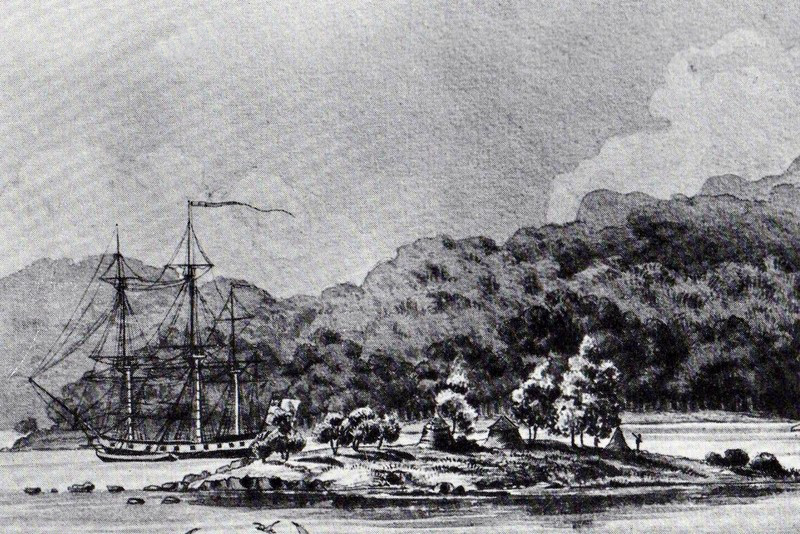
Week 4 – 24 sep – last instalment of john Bryson The ship Ocean, off Hunter Island c. 1804
The ship Ocean, off Hunter Island c. 1804

In September, we share four installments of the short story Tasmania, a Lovesong, by Australian author John Bryson, which journeys us along the eastern waters of Tasmania. Here is the final part.

SUCH IS THE TIMING of these passages that I’ve never seen this part of the coast other than etched on the radar screen, at night. Bisheno town makes a bright circle, and you’d think so snug a harbour safe in any weather, but a bar-room wall somewhere in every fishing village carries a framed photograph of the tempest of the 1960s, this causeway astream with foam, trawlers at terrified mid-leap, overwrought anchor cables whining and defeated, hulls on the Esplanade already stripped to the ribs, where huddle the watchful townsfolk, awed, ruined.

A southbound freighter, chatty, nearly home, found the right frequency to tell us we would have a tough night once we made it around the corner. He meant Cape Naturaliste, and we knew already. The sea was still slick, but the deck was atilt from other pressures high in the rigging. Mathers, who delights in the advent of small miracles, found he could read a magazine at the stern rail, so bright was the luminous wake. This was partly the gift of the vanishing moon, now heading to the clouds.

The Eddystone Beacon, blinding as it caught the deck, swept then the path maybe a mile ahead, rain squalls and scuttling cloud at whitecap height. By Mussel Roe Bay, at the northern tip, we were into the gale. The tide was headstrong, so we stood toward Clarke Island, to quarter the seas, but maybe also because of the association with good fortune, for when the Sydney Cove went down around here in 1797 the nine survivors were taken by Captain Flinders only as far as the mainland edge, told to walk to Botany Bay, and Clarke, with one other, made it.

Mathers was showing considerable grit himself, and I revere the picture of him still. This was his first passage and he might have hoped for better. Making soup, he jammed himself by the stove to hold the kettle over the flame. He judged the troughs, rather than the crests, would give him the correct momentum to run a steaming mug up the stairway, from the galley through to wheelhouse. It was Mather’s idea to extinguish all deck lights, since what they lit best were the frightening seas, and no freighter could see us anyway. Meantimes, he lay on the saloon floor, not to be thrown again from the bunks, and it was his questing fingers which found water there, so we had damage the pumps were not holding.

At sour first light we swung for Franklin Sound, between Flinders Island and Cape Barren. The approach is long and lumpy in these conditions, but around midmorning we had company, a fishing boat waiting in the channel to stand alongside us the rest of the way in. I knew her well, had fished on her two years or more, and might have expected nothing less than her appearance here, at this moment, should have expected her clowning skipper to toss a can of beer off board so we could toast landfall in tandem, should have expected his waving wife, who is also the Harbour Master here, to shout of a readied birth at the wharf.

Astounding it was how these folk warmed the morning. Is this all it takes, these acts of kindness, to sweeten the world? To remember that these are seas of beauty and abundance, where you may happen on one hundred and fifty acres of resting shearwaters, watch ridiculous dolphin roll and dandy for hours under the bow, sometime follow wave upon wave of glittery tuna surfing the shoals?

To still the wind, to blue the deep, to summer the firmaments? Is this all it takes?

About the Author:

In 1985, the book Evil Angels by Australian author John Bryson was released. Its revelatory investigation into the disappearance of Azaria Chamberlain shed new light on the controversial case and quickly became a career defining piece of work for Bryson. Other publications include the novel, To the Death, Amic (Viking/Penguin 1994) a collection of short fiction, Whoring Around (Penguin 1981) and a collection of reportage, Backstage at the Revolution. Bryson lectures in law, literary journalism, and fiction, acts on advisory panels to government, NGOs, and universities, and on literary judging panels. At the end of the millennium, a Schools of Journalism panel included him in ‘The 100 Australian Journalists of the Century’. In 2014, he was awarded membership of the Order of Australia.

Tasmania, a Lovesong: Part III

The Lady Nelson in the Thames, whose explorations included the Bass Strait c. 1802

In September, we share four installments of this short story Tasmania, a Lovesong, by Australian author John Bryson, which journeys us along the eastern waters of Tasmania.

THE SEA PASSAGE I’m speaking of now also carried Peter Mathers who was, around that time, moving from the writing of novels to the writing of plays, despite his brace of Miles Franklin awards, or maybe because of them. From the Dunnally channel we set North, to take the landward side of Maria, the mountain Island named for the wife Van Diemen, and the convict settlement until Port Arthur was thought of. Mathers likes stories to do with delusional grandure, and he had a fine time with this place. Maria, in the late 1800s, was leased for its limestone, kilns built, a hostelry sprang to its feet at North Point, the township fattened, and the company’s paper given a flutter on the London stock exchange. All this enterprise was the vision of Diego Bernacci who then renamed the town San Diego. The timing was just right, as events turned out, for the crash of the 1890s, but thirty years later Bernacci did it again, this time for the crash of 1929. Tasmanians have changed the name of the town back to Darlington.

Not far off course, and worth every mile, is Isle des Phoques. Left over from some previous arrangement of nature, these grand pillars have no inland to support any more. The pose is of enough scale, and of might, to stand as a nostalgia for the size of the world once was: here is Atlas relieved of duty. The trick now is to glide as closely as nerve allows. These heavy portals have been teetering here a long time so far anyway, and watch the birds nesting the ledges. The instant they scream: the terns, gulls, cormorants, all into the heart-beating whirling air, so will it seem that you have chosen the exact moment for the collapse of the counterpoise, of the entire crumbling vault, pealing from higher than the masthead, a landslide exploding into the waters all around, and I’ve watched seafarers go ashen right then, until the eyes catch up with the action enough to see that these are seals, hundreds maybe, the bulls and the cows roaring their dainty calves to the long plunge, to surface again in the tumultuous water, whiskery and inquisitive.

Dusk is not long away, but before it’s too dark I want to get us through the Schouten Passage, sea side of the Great Oyster Bay, and near enough to halfway now to Bass Strait. We could go around, and out into the Tasman, but the charm of the inshore route is the scenery, and the navigator’s excuse that, in here, we dodge the south set of the outer current. The island and the peninsular almost meet, and it’s difficult to see the convenient gap. But the run, when you find it, is very deep indeed, and so a favourite of locals. I know a Hobart seaman with a Masters ticket whose job is to pilot rusty ships from the far Orient to his home port for refit, and who, one summer evening, turned the 25,000 tonnes of Japanese freighter under his command through the skimpy passage here, grinding neither side on the rocks, to the tooting delight of the nearby lobster fleet, which understood just who must be up on the Bridge there, whose hand to the wheel.

About the Author:

In 1985, the book Evil Angels by Australian author John Bryson was released. Its revelatory investigation into the disappearance of Azaria Chamberlain shed new light on the controversial case and quickly became a career defining piece of work for Bryson. Other publications include the novel, To the Death, Amic (Viking/Penguin 1994) a collection of short fiction, Whoring Around (Penguin 1981) and a collection of reportage, Backstage at the Revolution. Bryson lectures in law, literary journalism, and fiction, acts on advisory panels to government, NGOs, and universities, and on literary judging panels. At the end of the millennium, a Schools of Journalism panel included him in ‘The 100 Australian Journalists of the Century’. In 2014, he was awarded membership of the Order of Australia.

Tasmania, a Lovesong: Part II

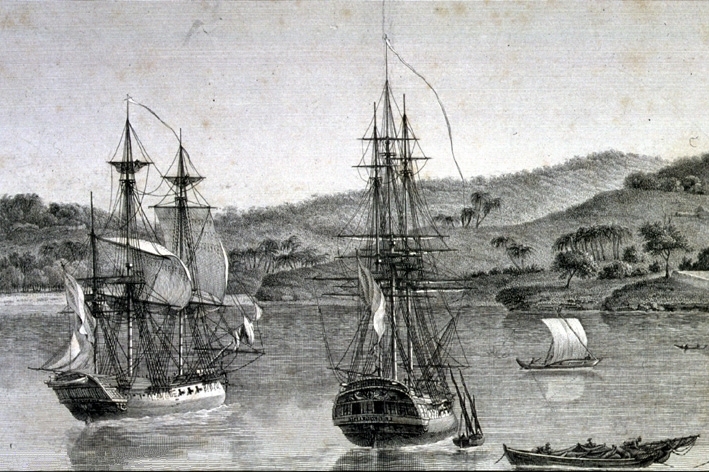
French ships Recherche, and Esperance, from the d'Entrecasteaux expedition, reaching Tasmania, c. 1792-1793
French ships Recherche, and Esperance, from the d’Entrecasteaux expedition, reaching Tasmania, c. 1792-1793

In September, we share four installments of this short story Tasmania, a Lovesong, by Australian author John Bryson, which journeys us along the eastern waters of Tasmania.

BEAUTY AND ABUNDANCE and solitude are wonders, sure, but most of us live in the cities, either born there or we joined to drift to deny some definition we had then of poverty. My genes come from out of town although I’m a city boy, and judging by the sort of people we happen on in Tasmania, anyway in the eastern half and may be all over, a lot of genes come from outside city walls, and some redefinition of poverty is taking place.

I have in mind surprises like a wayside kiosk in the Derwent Valley, now the shopfront for a local potter, one-time Englishman who fled famed Wedgewood, although he was its chief artisan, and now turns far finer things at the opposite end of the world. This is no surprise to Tasmanians, who are well accustomed to peerless hand-worked furniture and, for another example, to every day recitals from woodwind musicians who have traded the forests of Sibelius and Greig for Ferntree and Lune River.

And I have in mind happenings like watching a long married couple fish shingle pools on the Huon with deep longtail flies, in lovers’ springtime, when garlands of upstream blossom float the eddies and new salmon run beneath. While the action was slow this husband spoke his Romeo lines, with cumulus breath for it was fiercely cold, and his wife answered as Juliet lighting the East, then scene on scene, and all without fault or stammer, because both are Elizabethan scholars, he a professor of English literature, once of Glasgow but now of hereabouts, and she his captivating actress.

Here is something signal about the way folk live in these parts. Around here the intellectual world and the physical are amiable kin, they voyage together, a phenomenon I’ve not seen so strongly anywhere.

About the Author:

In 1985, the book Evil Angels by Australian author John Bryson was released. Its revelatory investigation into the disappearance of Azaria Chamberlain shed new light on the controversial case and quickly became a career defining piece of work for Bryson. Other publications include the novel, To the Death, Amic (Viking/Penguin 1994) a collection of short fiction, Whoring Around (Penguin 1981) and a collection of reportage Backstage at the Revolution. Bryson lectures in law, literary journalism, and fiction, acts on advisory panels to government, NGOs, and universities, and on literary judging panels. At the end of the millennium, a Schools of Journalism panel included him in ‘The 100 Australian Journalists of the Century’. In 2014, he was awarded membership of the Order of Australia.

Tasmania, a Lovesong: Part I

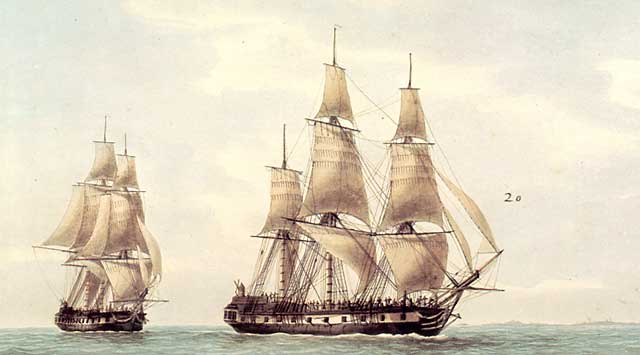
Ships Le Géographe and Le Naturaliste, from the Nicolas Baudin expedition to Australia, c. 1800-1803

In September, we share four installments of this short story Tasmania, a Lovesong, by Australian author John Bryson, which journeys us along the eastern waters of Tasmania.

SNOW ON THE MOUNTAIN above, and awash with the tides are Waterman’s steps, where a pretty Gaff Trader lies forever in state, on show to the modern world, built one hundred and ten years back, so plying these Hobart wharves in 1912, in commission loading lumber, when a Norwegian anchored alongside, this the Fram, an adventurer, leaky and gouged from the ices South, lying back on her chain while a longboat ferried quiet Amundsen for the Dockside, he loosing his greatcoat for the walk to the telegraph, composing the words to be sent to his King.

Those times, northbound out of Hobart town meant first laying south by Opossum Bay and out of the estuary, past the Iron Pot, where such is the concentration of reef-bed ore that compasses swoon and chronometers pause, beyond the Bruny Isle and the last docile lees in Storm Bay, making East under Port Arthur and the Isle of the Dead, to slip behind Tasman Island, for a few minutes out of the South East swell, which breaks shore here for the first time since it left the Antarctic.

Only gunboats, merchants and race-fleets go that way any more. The rest of us save 60 sea-miles by heading for the isthmus on which the Dutch of the Heemskirk first landed, now the channel town Dunally, where the narrows have been dredged through to the Tasman Sea, and the woody peninsular below seems to be hinged there by the Swing Bridge. Most boats anchor on the inland side overnight, and navigators will tell you this is for safer passage, although when dusk falls every one wades to the wrinkled shallows, with torches and fire sticks, so it will strike you that skillful pilotage around here has to do with grilled Southern flounder and fried anchovies.

At the earliest light the bridge draws, and the way ahead is as placid as a flooded meadow, but the tussocks float aside on the bow’s wave, for these are awakening swan and preening duck, and the depth underfoot is plenty. The bridge-keeper walking the bank in pyjamas and oilskins, collects his toll with a long handled dip net, and the tradition here is that the fee be already hitched to bottle of Pilsner so to provide ballast in transit. From here on, the perspective is of tall ash and stringybark, the forest closes astern and parts ahead, and I have watched this from landward too, the vessel seems to be sailing the woods. Here comes a time now at which the treeline thins enough to release the astonishing sun, the waters flow like the mouth of a stream into a sandy and generous bay, where an inexplicable shade at the edge of the shiny current is, most likely, a spray of minnows or basking ray, and see how all these sunbeam shallows and channel blues speak of the Western Pacific, whatever the charts might say.

About the Author:

In 1985, the book Evil Angels by Australian author John Bryson was released. Its revelatory investigation into the disappearance of Azaria Chamberlain shed new light on the controversial case and quickly became a career defining piece of work for Bryson. Other publications include the novel, To the Death, Amic (Viking/Penguin 1994) a collection of short fiction, Whoring Around (Penguin 1981) and a collection of reportage Backstage at the Revolution. Bryson lectures in law, literary journalism, and fiction, acts on advisory panels to government, NGOs, and universities, and on literary judging panels. At the end of the millennium, a Schools of Journalism panel included him in ‘The 100 Australian Journalists of the Century’. In 2014, he was awarded membership of the Order of Australia.